The Prague Post - Please don't croak: Setting the mood to save Venezuelan frog

EUR -
AED 4.401854
AFN 77.897256
ALL 96.833701
AMD 453.488183
ANG 2.145273
AOA 1098.954337
ARS 1729.081733
AUD 1.717911
AWG 2.15866
AZN 2.040433
BAM 1.967924
BBD 2.410672
BDT 146.262316
BGN 2.012596
BHD 0.451741
BIF 3559.317113
BMD 1.198423
BND 1.51589
BOB 8.270852
BRL 6.245461
BSD 1.196884
BTN 109.783816
BWP 15.753184
BYN 3.410526
BYR 23489.096101
BZD 2.407251
CAD 1.629915
CDF 2684.467728
CHF 0.918076
CLF 0.026087
CLP 1030.047915
CNY 8.334614
CNH 8.319005
COP 4402.875269
CRC 594.668609
CUC 1.198423
CUP 31.758217
CVE 110.793941
CZK 24.250068
DJF 212.983927
DKK 7.467255
DOP 75.441109
DZD 154.838707
EGP 56.32577
ERN 17.976349
ETB 185.75505
FJD 2.638029
FKP 0.875018
GBP 0.869277
GEL 3.229785
GGP 0.875018
GHS 13.10474
GIP 0.875018
GMD 87.484534
GNF 10486.203264
GTQ 9.183655
GYD 250.410645
HKD 9.3486
HNL 31.710475
HRK 7.538203
HTG 156.968364
HUF 380.014633
IDR 20012.470194
ILS 3.722842
IMP 0.875018
INR 109.714872
IQD 1569.934484
IRR 50483.580457
ISK 145.296991
JEP 0.875018
JMD 188.048533
JOD 0.849674
JPY 182.912353
KES 154.872094
KGS 104.8009
KHR 4830.844578
KMF 493.750766
KPW 1078.604207
KRW 1722.583589
KWD 0.36696
KYD 0.997445
KZT 602.997475
LAK 25817.036779
LBP 102525.11035
LKR 370.616394
LRD 222.24754
LSL 19.126971
LTL 3.538632
LVL 0.724915
LYD 7.579969
MAD 10.851761
MDL 20.180327
MGA 5362.944187
MKD 61.664206
MMK 2516.748037
MNT 4272.540069
MOP 9.617632
MRU 47.793202
MUR 54.551915
MVR 18.515755
MWK 2080.462606
MXN 20.660008
MYR 4.735568
MZN 76.411323
NAD 19.12714
NGN 1687.955172
NIO 43.98542
NOK 11.521264
NPR 175.654642
NZD 1.992241
OMR 0.460804
PAB 1.196864
PEN 4.010525
PGK 5.10172
PHP 70.626078
PKR 335.259502
PLN 4.197765
PYG 8022.492074
QAR 4.363467
RON 5.096534
RSD 117.411955
RUB 91.863782
RWF 1740.110589
SAR 4.4941
SBD 9.680475
SCR 16.921881
SDG 720.847311
SEK 10.55304
SGD 1.512938
SHP 0.899128
SLE 29.124591
SLL 25130.335892
SOS 684.955658
SRD 45.895983
STD 24804.942092
STN 24.687519
SVC 10.472563
SYP 13254.051915
SZL 19.126646
THB 37.171467
TJS 11.179126
TMT 4.194481
TND 3.392135
TOP 2.885515
TRY 52.012492
TTD 8.139212
TWD 37.57956
TZS 3061.041504
UAH 51.378175
UGX 4273.36308
USD 1.198423
UYU 44.84629
UZS 14530.882075
VES 429.60616
VND 31319.59375
VUV 143.507965
WST 3.270848
XAF 660.03991
XAG 0.011307
XAU 0.000236
XCD 3.238799
XCG 2.157108
XDR 0.823023
XOF 662.125411
XPF 119.331742
YER 285.707797
ZAR 19.153443
ZMK 10787.225649
ZMW 23.632299
ZWL 385.891804
  • SCS

    0.0200

    16.14

    +0.12%

  • RBGPF

    -0.8300

    82.4

    -1.01%

  • CMSC

    -0.0196

    23.76

    -0.08%

  • AZN

    1.1800

    95.41

    +1.24%

  • NGG

    1.5870

    84.167

    +1.89%

  • RIO

    2.0840

    92.554

    +2.25%

  • CMSD

    -0.0640

    24.096

    -0.27%

  • GSK

    0.5050

    50.825

    +0.99%

  • RELX

    -1.2400

    38.27

    -3.24%

  • BTI

    1.0800

    60.07

    +1.8%

  • BCE

    0.2800

    25.43

    +1.1%

  • BP

    0.7050

    37.465

    +1.88%

  • RYCEF

    0.1500

    17.15

    +0.87%

  • BCC

    -1.8700

    81.53

    -2.29%

  • JRI

    -0.0300

    13.7

    -0.22%

  • VOD

    0.2550

    14.485

    +1.76%

Please don't croak: Setting the mood to save Venezuelan frog
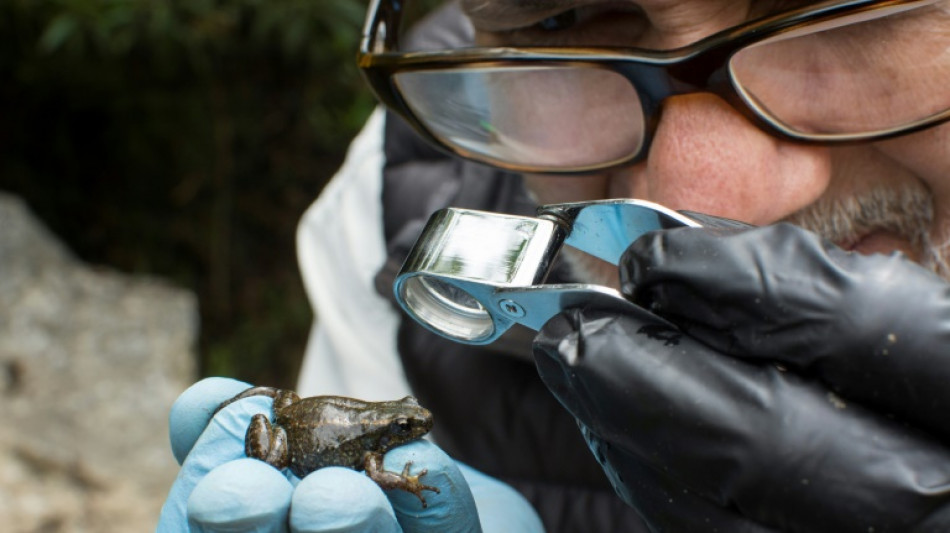
Please don't croak: Setting the mood to save Venezuelan frog / Photo: Miguel ZAMBRANO - AFP

Please don't croak: Setting the mood to save Venezuelan frog

Enormous expectations rest on the tiny endangered amphibian perched on a rock in a plastic box: the Mucuchies' Frog needs to produce offspring if its species is to survive.

Text size:

The dark, spotted creature is categorized as "critically endangered" on the Red List of threatened species of the International Union for Conservation of Nature (IUCN) -- the last step before an animal is declared "extinct in the wild."

But there is cause for hope.

Driven by a "passion" to save the unassuming two-centimeter (0.8-inch) critter, biologist Enrique La Marca and a team launched a breeding project at the REVA amphibian conservation center in Merida in Venezuela's northwest.

To date, some two dozen captured adults have created about 100 tiny jumpers released into nature, said La Marca -- more or less doubling the previously known number of Mucuchies' Frogs in the wild.

That should help the species, which according to the Red List, has seen 98 percent of its habitat in the forests of the Venezuelan Andes lost to deforestation.

Today, its entire population is limited to an area smaller than 10 square kilometers (3.9 square miles.)

- Streams dried up -

"Most of the population disappeared... between 15 and 25 years ago" from areas around the region of Mucuchies where it was once abundant, said La Marca.

The main reasons, according to the IUCN: crops and aquaculture encroaching on nature and polluting water sources, as well as the abstraction of surface water for irrigation.

"There are streams that have dried up and springs that have decreased significantly... All this has a negative impact on organisms that are directly associated with water," La Marca told AFP.

The Mucuchies' Frog is a species that breeds during the wet season, laying eggs onto leaf litter.

The male protects the eggs until they hatch, then carries the tadpoles on his back and releases them into small pools where they complete their development.

- Frog song, 'greatest joy' -

But before the REVA project started in 2018, "we didn’t know what it (the frog) fed on, what reproduction was like, we were improvising and learning on the fly," said La Marca.

They have since ascertained that for an amorous mood, the frog requires a sprinkling of plants such as bromelias, rocks and leaves for frolicking, the sexy sounds of a simulated stream, and a steady diet of insects and larvae.

The resultant offspring are reared in the lab for about a year after making the transition from tadpole to four-legged frog before they are released.

Then comes the "maximum challenge," according to La Marca: "to survive in the new natural conditions they will face."

On frequent field visits, the team searches for the slippery frogs between stones or on river banks, but it is hard to keep track of all of the bashful brood.

"The greatest joy comes when... we notice that there are more songs in the place, an indication that they are procreating," said La Marca.

X.Vanek--TPP