The Prague Post - Powerful Typhoon Shanshan slams into southern Japan

EUR -
AED 4.184053
AFN 74.618673
ALL 88.85418
AMD 417.545026
AOA 1045.742925
ARS 1708.2429
AUD 1.632259
AWG 2.050476
AZN 1.93108
BAM 1.960892
BBD 2.294148
BDT 140.615164
BHD 0.429586
BIF 3394.676737
BMD 1.139153
BND 1.47352
BOB 12.979707
BRL 5.85092
BSD 1.139053
BTN 109.103853
BWP 15.690678
BYN 3.267471
BYR 22327.404041
BZD 2.290849
CAD 1.606662
CDF 2591.573817
CHF 0.932853
CLF 0.027035
CLP 1064.004037
CNY 7.713492
CNH 7.710598
COP 3663.004289
CRC 518.243552
CUC 1.139153
CUP 30.187562
CVE 110.896247
CZK 24.182117
DJF 202.450838
DKK 7.475805
DOP 66.413869
DZD 151.914077
EGP 57.515116
ERN 17.087299
ETB 182.494234
FJD 2.541166
FKP 0.856274
GBP 0.857042
GEL 2.984233
GGP 0.856274
GHS 13.271048
GIP 0.856274
GMD 84.297612
GNF 9978.982699
GTQ 8.689528
GYD 238.258734
HKD 8.932499
HNL 30.619893
HRK 7.537552
HTG 148.865937
HUF 361.079739
IDR 20602.725994
ILS 3.485359
IMP 0.856274
INR 108.901059
IQD 1492.29078
IRR 1566478.136432
ISK 142.211756
JEP 0.856274
JMD 180.378425
JOD 0.807619
JPY 186.582107
KES 147.523123
KGS 99.618899
KHR 4603.954214
KMF 493.253228
KRW 1655.429135
KWD 0.353821
KYD 0.949161
KZT 544.762302
LAK 25807.517283
LBP 102011.174897
LKR 382.764
LRD 206.417527
LSL 19.126114
LTL 3.363624
LVL 0.689063
LYD 7.296236
MAD 10.671553
MDL 20.161268
MGA 4909.750792
MKD 61.679906
MMK 2392.421433
MNT 4096.203526
MOP 9.199991
MRU 45.62885
MUR 54.098476
MVR 17.611437
MWK 1977.570402
MXN 19.86421
MYR 4.660505
MZN 72.803345
NAD 19.126911
NGN 1556.971808
NIO 41.858752
NOK 11.038286
NPR 174.566566
NZD 1.96893
OMR 0.438004
PAB 1.139058
PEN 3.877715
PGK 5.006575
PHP 69.989341
PKR 316.524664
PLN 4.325992
PYG 6851.793424
QAR 4.151647
RON 5.231443
RSD 117.405694
RUB 89.70867
RWF 1668.859537
SAR 4.28195
SBD 9.186869
SCR 15.385122
SDG 684.065219
SEK 11.036155
SGD 1.47133
SLE 27.623884
SOS 651.022496
SRD 43.118662
STD 23578.172693
STN 24.947457
SVC 9.966883
SZL 19.120692
THB 38.207252
TJS 10.496157
TMT 3.998428
TND 3.377579
TRY 53.965193
TTD 7.747084
TWD 36.88077
TZS 3014.7698
UAH 51.223322
UGX 4300.148181
USD 1.139153
UYU 45.758831
UZS 13678.952897
VES 845.117297
VND 29999.601296
VUV 135.749045
WST 3.13382
XAF 657.661996
XAG 0.019937
XAU 0.000283
XCD 3.078618
XCG 2.052822
XDR 0.817036
XOF 653.301676
XPF 119.331742
YER 271.289043
ZAR 18.997777
ZMK 10253.744608
ZMW 21.300315
ZWL 366.806887
  • CMSC

    0.0600

    21.81

    +0.28%

  • CMSD

    0.0700

    22.12

    +0.32%

  • JRI

    0.0000

    12.91

    0%

  • RBGPF

    0.0000

    66

    0%

  • BCC

    2.1600

    80.38

    +2.69%

  • BCE

    0.5700

    21.81

    +2.61%

  • RIO

    -0.3100

    91.64

    -0.34%

  • BTI

    1.4800

    62.3

    +2.38%

  • RYCEF

    -0.1700

    18.7

    -0.91%

  • AZN

    2.8400

    172.48

    +1.65%

  • GSK

    1.7300

    53.71

    +3.22%

  • NGG

    -0.3500

    80.86

    -0.43%

  • RELX

    2.1100

    37.76

    +5.59%

  • VOD

    0.5900

    16.39

    +3.6%

  • BP

    -0.6400

    41.67

    -1.54%

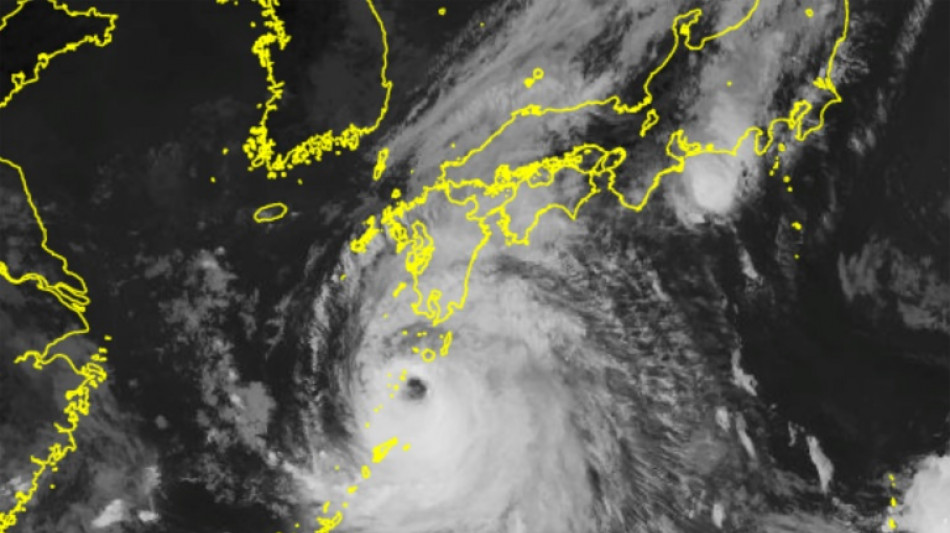
Powerful Typhoon Shanshan slams into southern Japan
Powerful Typhoon Shanshan slams into southern Japan / Photo: Handout - Japan Meteorological Agency/AFP

Powerful Typhoon Shanshan slams into southern Japan

Typhoon Shanshan slammed into Japan's main southern island of Kyushu early Thursday, with authorities advising thousands of people to evacuate and issuing the highest warning level for wind and storm surges.

Text size:

The weather office said that Japan's most powerful typhoon this year made landfall at around 8:00 am (2300 GMT Wednesday) packing gusts of up to 252 kilometres (157 miles) per hour.

Kyushu's utility operator said that 254,610 houses were already without power.

"Special warnings of violent storms, high waves and high tides are being issued to the Kagoshima region (of Kyuhsu)," the Japan Meteorological Office said.

"Please exercise maximum vigilance against violent storms, high waves and high tides in Kagoshima, as well as landslides, flooding in low-lying areas and overflowing rivers in southern Kyushu," it said.

"Please also be advised that the risk of a disaster due to heavy rain can rapidly escalate in western Japan as Friday approaches."

Heavy rain brought by Shanshan has been lashing large parts of Japan since Tuesday.

Three members of a family died after a landslide buried a house in Gamagori, a city in central Aichi prefecture, Japan's Kyodo news agency reported early Thursday, citing local government officials.

The deceased included a couple in their 70s as well as a son in his 30s, while two adult daughters in their 40s survived with injuries, Kyodo reported.

For southern Kyushu, the JMA predicted an enormous 1,100 millimetres (43 inches) of precipitation in the 48 hours to Friday morning.

Video on public broadcaster NHK TV showed roof tiles being blown off houses, broken windows and felled trees.

"Our carport roof was blown away in its entirety. I wasn't at home when it happened, but my kids say they felt the shaking so strong they thought an earthquake happened," a local resident in Miyazaki told NHK.

"I was surprised. It was completely beyond our imagination," she said.

Auto giant Toyota has suspended production at all 14 of its factories in Japan.

Japan Airlines cancelled 172 domestic flights and six international flights scheduled for Wednesday and Thursday, while ANA nixed 219 domestic flights and four international ones on Wednesday, Thursday and Friday.

The cancellations affected around 25,000 people.

Kyushu Railway said it would suspend some Shinkansen bullet train services between Kumamoto and Kagoshima Chuo from Wednesday night and warned of further possible disruption.

Trains between Tokyo and Fukuoka, the most populous city on Kyushu, may also be cancelled depending on weather conditions this week, other operators said.

Shanshan comes in the wake of Typhoon Ampil, which disrupted hundreds of flights and trains this month.

Despite dumping heavy rain, it caused only minor injuries and damage.

Ampil came days after Tropical Storm Maria brought record rains to northern areas.

Typhoons in the region have been forming closer to coastlines, intensifying more rapidly and lasting longer over land due to climate change, according to a study released last month.

C.Sramek--TPP