The Prague Post - Panama's water wheel trash collector keeps plastic at bay

EUR -
AED 4.182614
AFN 75.167292
ALL 93.902616
AMD 417.452931
AOA 1045.510427
ARS 1708.080292
AUD 1.632807
AWG 2.052867
AZN 1.934662
BAM 1.960456
BBD 2.293638
BDT 140.5839
BHD 0.429418
BIF 3406.074805
BMD 1.1389
BND 1.473193
BOB 12.976821
BRL 5.847793
BSD 1.1388
BTN 109.079596
BWP 15.68719
BYN 3.266744
BYR 22322.439964
BZD 2.29034
CAD 1.606618
CDF 2573.91431
CHF 0.932083
CLF 0.027043
CLP 1064.32451
CNY 7.70591
CNH 7.71078
COP 3650.071993
CRC 518.12833
CUC 1.1389
CUP 30.18085
CVE 110.527514
CZK 24.169792
DJF 202.405585
DKK 7.474959
DOP 66.347582
DZD 151.856354
EGP 57.513425
ERN 17.0835
ETB 183.805055
FJD 2.539462
FKP 0.856083
GBP 0.856971
GEL 2.984175
GGP 0.856083
GHS 13.266509
GIP 0.856083
GMD 84.278841
GNF 9995.740856
GTQ 8.687596
GYD 238.205762
HKD 8.930599
HNL 30.507458
HRK 7.533595
HTG 148.832839
HUF 359.702775
IDR 20606.117666
ILS 3.484584
IMP 0.856083
INR 108.869102
IQD 1491.843273
IRR 1566129.859978
ISK 142.202809
JEP 0.856083
JMD 180.338321
JOD 0.807457
JPY 186.558657
KES 147.544381
KGS 99.597067
KHR 4603.914532
KMF 493.143631
KRW 1654.707165
KWD 0.353708
KYD 0.94895
KZT 544.641185
LAK 25810.301975
LBP 101977.706962
LKR 382.6789
LRD 206.118647
LSL 19.136667
LTL 3.362876
LVL 0.688909
LYD 7.306353
MAD 10.683174
MDL 20.156786
MGA 4880.59188
MKD 61.666192
MMK 2391.889523
MNT 4095.292812
MOP 9.197946
MRU 45.553193
MUR 54.086562
MVR 17.607592
MWK 1974.690081
MXN 19.858589
MYR 4.660351
MZN 72.787059
NAD 19.136752
NGN 1555.043387
NIO 41.909355
NOK 11.051509
NPR 174.527754
NZD 1.967706
OMR 0.437901
PAB 1.138805
PEN 3.87639
PGK 5.021928
PHP 70.016128
PKR 316.324501
PLN 4.32446
PYG 6850.270057
QAR 4.15146
RON 5.229715
RSD 117.390986
RUB 89.6864
RWF 1669.457795
SAR 4.269837
SBD 9.184827
SCR 15.384259
SDG 683.910885
SEK 11.04188
SGD 1.471681
SLE 27.618086
SOS 650.842958
SRD 43.109076
STD 23572.930532
STN 24.55822
SVC 9.964667
SZL 19.139374
THB 38.164723
TJS 10.493824
TMT 3.997539
TND 3.381216
TRY 53.953907
TTD 7.745362
TWD 36.878266
TZS 3014.102283
UAH 51.211933
UGX 4299.192125
USD 1.1389
UYU 45.748658
UZS 13722.59249
VES 844.929468
VND 29992.931451
VUV 135.718863
WST 3.133123
XAF 657.515777
XAG 0.019936
XAU 0.000283
XCD 3.077934
XCG 2.052366
XDR 0.816854
XOF 657.518671
XPF 119.331742
YER 271.228836
ZAR 19.006954
ZMK 10251.494404
ZMW 21.295579
ZWL 366.725335
  • GSK

    1.7100

    53.69

    +3.18%

  • BTI

    1.4900

    62.31

    +2.39%

  • NGG

    0.0600

    81.27

    +0.07%

  • RYCEF

    -0.0700

    18.8

    -0.37%

  • VOD

    0.5750

    16.375

    +3.51%

  • RIO

    -0.1300

    91.82

    -0.14%

  • BP

    -0.4650

    41.845

    -1.11%

  • AZN

    2.4000

    172.04

    +1.4%

  • RELX

    1.9900

    37.64

    +5.29%

  • RBGPF

    0.0000

    66

    0%

  • CMSC

    0.1596

    21.88

    +0.73%

  • JRI

    -0.0600

    12.85

    -0.47%

  • BCC

    2.0880

    80.308

    +2.6%

  • BCE

    0.4950

    21.735

    +2.28%

  • CMSD

    0.0550

    22.105

    +0.25%

Panama's water wheel trash collector keeps plastic at bay
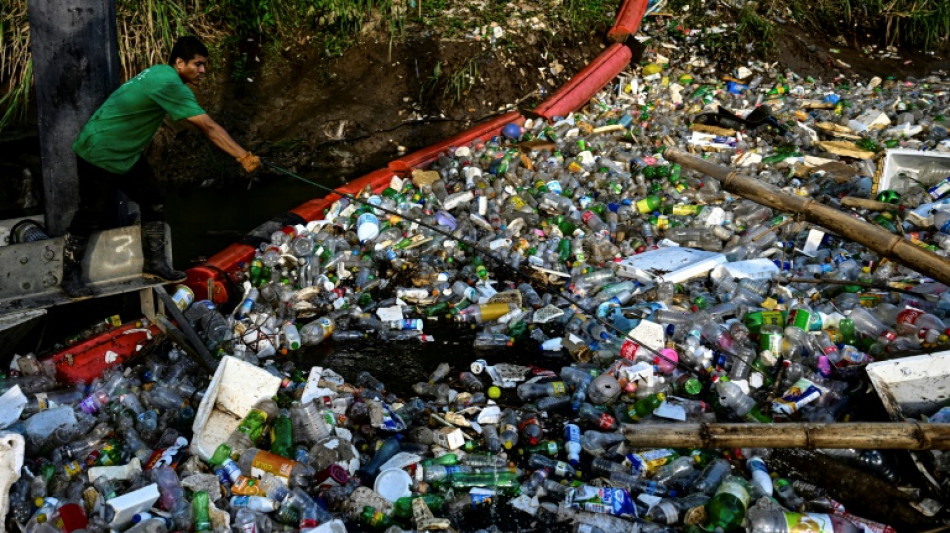
Panama's water wheel trash collector keeps plastic at bay / Photo: Martin BERNETTI - AFP

Panama's water wheel trash collector keeps plastic at bay

A trash-collecting machine powered by a water wheel and solar panels has prevented hundreds of tons of plastic and other garbage from Panama from littering mangroves and the ocean.

Text size:

All kinds of trash flow down rivers running through Panama City and end up on the coastline of the Central American nation.

To combat the pollution, the nonprofit Marea Verde Foundation installed a machine called Wanda two years ago to collect and separate trash for recycling.

"We've captured 256,000 kilos of waste that would be in the mangroves and sea if it had not been for Wanda," said Laura Gonzalez, the foundation's executive director.

The garbage is stopped by a barrier across the Juan Diaz River that runs through Panama City before several workers separate the waste, which is sent by a long conveyor belt to a huge container to be recycled.

Wanda also has solar panels in case the hydropower system that harnesses the energy of the river current fails.

No other river in Panama has a similar system, so tons of garbage continue to reach the sea.

The country's coastal mangroves are a vital resting place for hundreds of thousands of migratory birds, but pollution and urban growth pose a serious threat.

Experts estimate that 30 percent of Panama City's garbage goes uncollected, and that around 100,000 tons of the country's waste end up in the sea every year.

When it rains, rising waters carry away garbage that is often dumped on riverbanks in slums of the city of 1.4 million people.

"We're working hard every day to ensure that this waste does not reach the shore," Ezequiel Vargas, leader of the crew that operates Wanda, told AFP.

"Sadly, the garbage arrives constantly every day," he said.

- 'Environmental disaster' -

Uncollected garbage litters the streets and residential areas of Panama City and its surrounding areas, while on the coast, there are piles of all kinds of waste.

Environment Minister Juan Carlos Navarro called the state of the rivers an "environmental disaster" in July when he took office.

"We cannot continue polluting our rivers and seas," he said.

According to a report by the United Nations Environment Programme, Panama City generates around 2,300 tons of garbage every day, of which 30 percent -- mostly plastics -- ends up in rivers, on the coast and in the sea.

Some 61,500 tons of solid waste from Panamanian cities reach the sea every year through sewers and drains, it said.

The trash captured by Wanda includes plastic bottles, shampoo containers and footballs.

"It's crazy. We received a plastic unicorn a few days ago," Gonzalez said.

According to Marea Verde, there are eight other similar facilities around the world, including one in the US city of Baltimore, but Wanda is the only one of its kind in Latin America.

It began operating in September 2022 and captured 130 tons of waste in its first year.

But the amount of rubbish dumped in the river continues to increase.

"This year we will probably exceed what we collected in the first year," Gonzalez said.

E.Cerny--TPP