Germany to bury nuclear waste but toxic dispute unresolved / Photo: Ronny Hartmann - AFP
An elevator rattles down about a kilometre (3,000 feet) below ground in five minutes to reach Germany's nuclear necropolis, a future repository set to to entomb much of its radioactive waste.
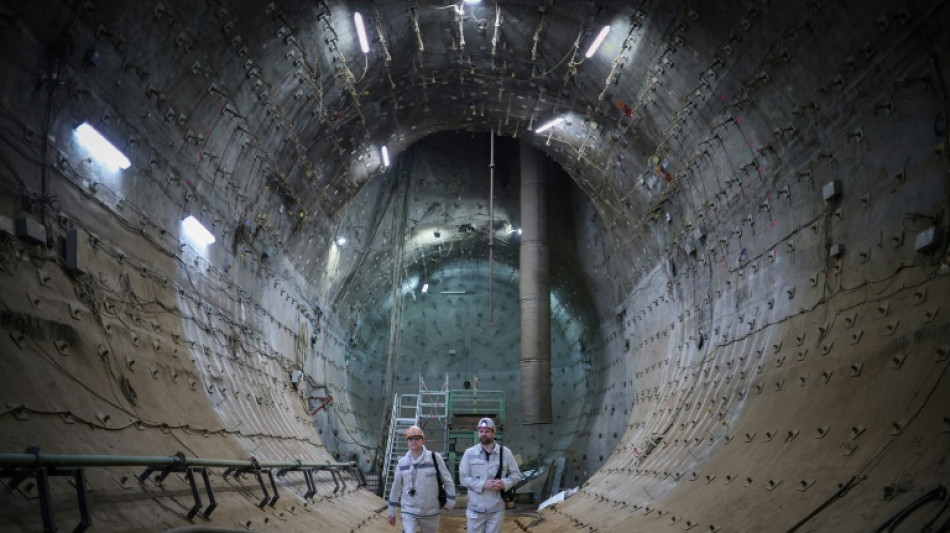
At the bottom, a jeep ride takes helmet-clad engineers and visitors through an underground tunnel complex into a cold, cavernous hall with concrete-lined walls that rise up some 15 metres.
In the future, atomic waste will be encased in concrete for eternity at the subterranean Konrad repository, said project manager Ben Samwer, "to prevent the radioactive substances from being released into the air."
"The safety levels we want to achieve require a high degree of care," he told AFP during a visit to the multi-billion-euro project deep below the western city of Salzgitter.
The former iron ore mine will become the final resting place for dangerous waste from the atomic power plants that Europe's top economy has shuttered over recent years.
Protests raged for decades in Germany around where to put its nuclear waste, leaving the Konrad site as the only approved location so far.
Konrad is meant to start operating in the early 2030s with space for more than 300,000 cubic metres of material with low and intermediate levels of contamination.
But over a year since Germany's last reactor was taken off the grid, under a nuclear phase-out decided following Japan's 2011 Fukushima disaster, the toxic political issue is far from buried.
Besides the technical challenge, developers have battled protests and legal resistance which saw activists, unions and local representatives lodge a new challenge in October.
The environmental pressure group Nabu, charged that the Konrad project was a "relic" that "does not meet the requirements for safe storage" and needs to be abandoned.
- 'Extremely complicated' -
Below ground, the engineers are pushing on, confident they can clear the technical and political hurdles.
Germany has a "problem" with the leftovers from nuclear power projects, construction manager Christian Gosberg told AFP. "We cannot leave it for decades or centuries above ground where it is now."
But he said building a storage facility has proved "significantly more complex" than he expected when he joined the project six years ago.
The expansion of the old mine comes with "special challenges", Gosberg said, adding that much of the machinery used to excavate the tunnels has to be taken apart and reassembled underground.
In some cases, every piece of rebar has to be placed by workers and "individually screwed together", Gosberg said. "The whole process is extremely complicated and of course takes a lot of time."
Building delays have pushed the opening back and driven up the cost to around 5.5 billion euros ($5.9 billion).
- 'We'll keep fighting' -
Meanwhile, the search for more sites goes on -- Germany will need to find another two underground locations to accommodate yet more nuclear waste.
For highly radioactive material, the difficult search for a safe place may last another half a century, the government estimates.
Mass protests around other earmarked locations through the 1980s and 90s led to the abandonment of other sites, including at the nearby Asse mine and a facility by the town of Gorleben.
For Germany's deep-rooted anti-nuclear movement, the closure of the last atomic reactor was a "huge success", said activist Ursula Schoenberger, for whom the campaign has lasted some 40 years.
"At the same time, the problem of nuclear waste is still there and we have to deal with it," she said.
The issue is personal for Schoenberger and Ludwig Wasmus, who live in a 19th-century farmhouse within sight of the Konrad mine's winding tower.
Wasmus described the years-long process that led to Konrad's approval in 2002 as "very controversial" and said he fears the repository will pose a "radioactive hazard".
The pair support the legal challenge that seeks to overturn the planning consent for Konrad.
The anti-nuclear movement had lost some steam and was now being "carried by local people", Schoenberger said, but she showed herself undeterred.
"As long as we live, we will be here and we will keep fighting."
D.Kovar--TPP