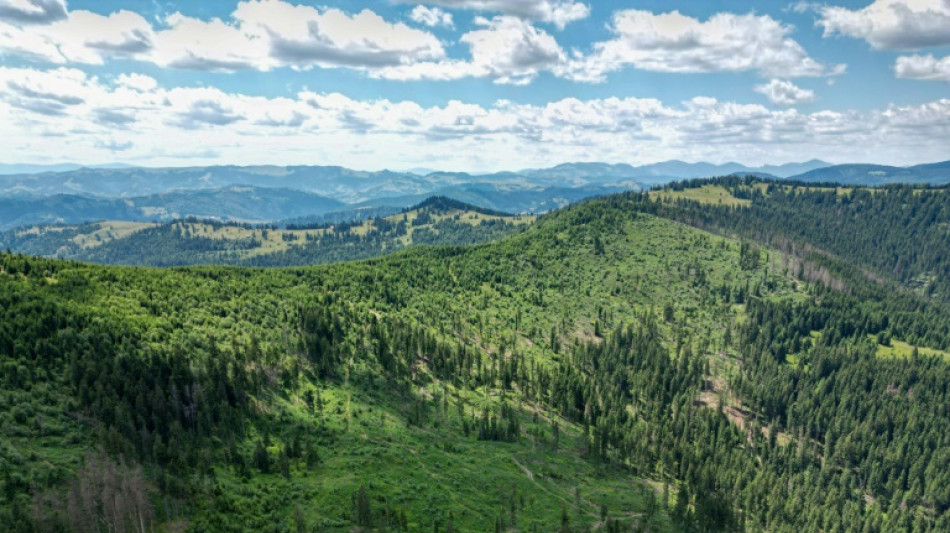
EU urged to act on forests' faltering absorption of carbon / Photo: Ionut IORDACHESCU - AFP/File
The amount of carbon dioxide absorbed by European forests has reduced dramatically in recent years putting the EU's climate targets at risk, researchers said Wednesday, calling for urgent action to halt the decline.
Forests, which cover 40 percent of the European Union's territory, are expected to play a crucial role in efforts to meet targets for overall reductions of the bloc's emissions of planet-warming gases.
But human and climate pressures, from logging to extreme weather and insect attacks, means their ability to absorb CO2 is "rapidly declining", according to an article, led by the European Commission's Joint Research Centre.
"Reversing the decline in European forests' ability to store carbon is essential -- and still possible -- with bold, science-based action today," said co-author Giacomo Grassi, who is a member of the UN's IPCC expert task force on greenhouse gas inventories.
Solutions include rapid reductions in carbon emissions, combined with efforts to improve management to make forests more resilient to climate impacts, and comprehensive monitoring.
Many European countries still rely on periodic inventories, which cannot keep up with rapid changes to forest health.
The authors emphasize the need to better understand forest dynamics.
They call in particular for better measuring of carbon flows between the soil, vegetation, and atmosphere, as well as improving predictions of how extreme weather will affect carbon sinks in the future.
- 'Steeper decline' -
The research looked at official 2024 data showing that the amount carbon absorbed by Europe's forests, ecosystems and changes to land use plummeted by around a third in the 2020 to 2022 period, compared to 2010 to 2014.
The authors said 2025 figures "suggest an even steeper decline".
"This trend, combined with the declining climate resilience of European forests, indicates that the EU's climate targets, which rely on an increasing carbon sink, might be at risk," the authors said.
Earlier this week another study in the Nature journal Communications Earth & Environment found that land accounts for a quarter of global emissions reductions in countries' climate plans and warned that a lack of funding and conservation focus was putting these in jeopardy.
Piers Forster, Director of the Priestley Centre for Climate Futures at Leeds University, who was not involved in Wednesday's study said it underscores the urgent need to slash emissions across the board.
"We can't bet our future on carbon removal -- either from planting more trees, from protecting forests, or from emerging technologies such as direct air capture and storage -- without understanding what is already happening to the land and natural systems," he said.
Scientists have warned that it is still unclear how carbon sinks might behave as the planet warms in future, and exactly how much heat-trapping carbon dioxide they might soak up from the atmosphere.
In April, research by Climate Analytics, a policy institute that independently assesses countries' climate plans, warned that major economies are overstating how much carbon their forests can absorb in a climate accounting fudge that could allow them to use even more fossil fuels.
D.Dvorak--TPP