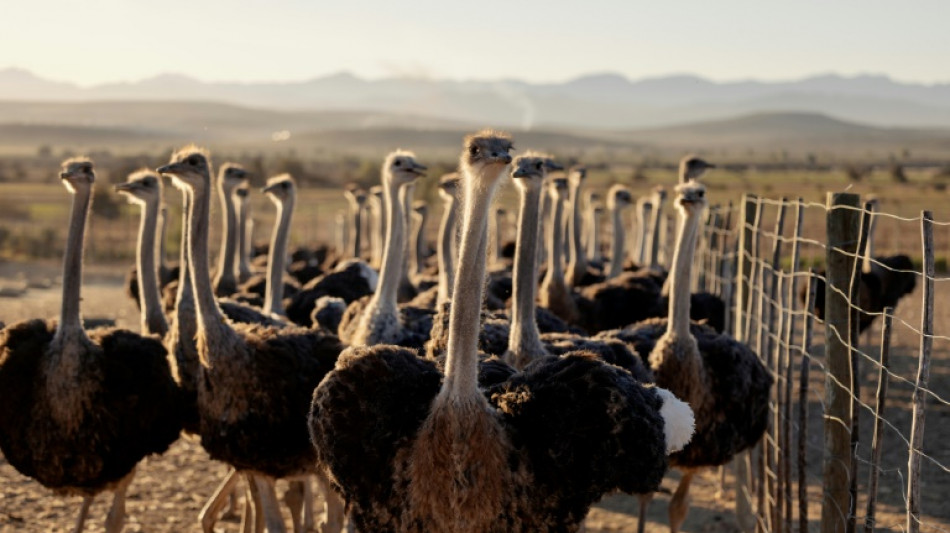
Ostrich and emu ancestor could fly, scientists discover / Photo: GIANLUIGI GUERCIA - AFP/File
How did the ostrich cross the ocean?
It may sound like a joke, but scientists have long been puzzled by how the family of birds that includes African ostriches, Australian emus and cassowaries, New Zealand kiwis and South American rheas spread across the world -- given that none of them can fly.
However, a study published Wednesday may have found the answer to this mystery: the family's oldest-known ancestors were able to take wing.
The only currently living member of this bird family -- which is called palaeognaths -- capable of flight is the tinamous in Central and South America. But even then, the shy birds can only fly over short distances when they need to escape danger or clear obstacles.
Given this ineptitude in the air, scientists have struggled to explain how palaeognaths became so far-flung.
Some assumed that the birds' ancestors were split up when the supercontinent Gondwana started breaking up 160 million years ago, creating South America, Africa, Australia, India, New Zealand and Antarctica.
However, genetic research has shown that "the evolutionary splits between palaeognath species happened long after the continents had already separated," lead study author Klara Widrig of the Smithsonian National Museum of Natural History told AFP.
- Wing and a prayer -
Widrig and colleagues analysed the specimen of a lithornithid, the oldest palaeognath group for which fossils have been discovered. They lived during the Paleogene period 66-23 million years ago.
The fossil of the bird Lithornis promiscuus was first found in the US state of Wyoming, but had been sitting in the Smithsonian museum's collection.
"Because bird bones tend to be delicate, they are often crushed during the process of fossilisation, but this one was not," she said.
"Crucially for this study, it retained its original shape," Widrig added. This allowed the researchers to scan the animal's breastbone, which is where the muscles that enable flight would have been attached.
They determined that Lithornis promiscuus was able to fly -- either by continuously beating its wings or alternating between flapping and gliding.
But this discovery prompts another question: why did these birds give up the power of flight?
- Taking to the ground -
"Birds tend to evolve flightlessness when two important conditions are met: they have to be able to obtain all their food on the ground, and there cannot be any predators to threaten them," Widrig explained.
Other research has also recently revealed that lithornithids may have had a bony organ on the tip of their beaks which made them excel at foraging for insects.
But what about the second condition -- a lack of predators?
Widrig suspects that palaeognath ancestors likely started evolving towards flightlessness after dinosaurs went extinct around 65 million years ago.
"With all the major predators gone, ground-feeding birds would have been free to become flightless, which would have saved them a lot of energy," she said.
The small mammals that survived the event that wiped out the dinosaurs -- thought to have been a huge asteroid -- would have taken some time to evolve into predators.
This would have given flightless birds "time to adapt by becoming swift runners" like the emu, ostrich and rhea -- or even "becoming themselves dangerous and intimidating, like the cassowary," she said.
The study was published in the Royal Society's Biology Letters journal.
K.Dudek--TPP