The Prague Post - Chimps ingest alcohol daily: study

EUR -
AED 4.118085
AFN 72.327475
ALL 90.580734
AMD 404.578149
ANG 2.00694
AOA 1028.259752
ARS 1712.747989
AUD 1.598703
AWG 2.021198
AZN 1.903137
BAM 1.954737
BBD 2.257372
BDT 138.614608
BGN 1.959896
BHD 0.422928
BIF 3361.771555
BMD 1.12133
BND 1.431721
BOB 13.174834
BRL 5.665411
BSD 1.12079
BTN 106.199765
BWP 15.396626
BYN 3.314197
BYR 21978.070272
BZD 2.254074
CAD 1.570614
CDF 2597.000736
CHF 0.920786
CLF 0.028087
CLP 1105.418227
CNY 7.488298
CNH 7.481834
COP 3575.349861
CRC 511.47164
CUC 1.12133
CUP 26.89837
CVE 110.197694
CZK 24.281841
DJF 199.581449
DKK 7.474596
DOP 68.775847
DZD 151.142973
EGP 62.00673
ERN 16.819952
ETB 183.578653
FJD 2.508639
FKP 0.838026
GBP 0.837129
GEL 2.903798
GGP 0.838026
GHS 12.989935
GIP 0.838026
GMD 82.978397
GNF 9919.604792
GTQ 8.565303
GYD 234.442488
HKD 8.793319
HNL 30.086636
HRK 7.534896
HTG 146.849475
HUF 366.175937
IDR 20248.250369
ILS 3.491152
IMP 0.838026
INR 106.312468
IQD 1699.075884
IRR 2054697.270937
ISK 136.19673
JEP 0.838026
JMD 177.933223
JOD 0.79498
JPY 175.966951
KES 145.61615
KGS 98.059312
KHR 4559.377873
KMF 492.842984
KPW 1009.197061
KRW 1485.594095
KWD 0.348038
KYD 0.933992
KZT 502.066929
LAK 25227.279049
LBP 100365.711751
LKR 372.037651
LRD 191.095212
LSL 18.485046
LTL 3.310997
LVL 0.678282
LYD 7.180095
MAD 11.000817
MDL 20.129052
MGA 5082.235805
MKD 61.586768
MMK 2355.184548
MNT 4036.851961
MOP 9.051777
MRU 44.786641
MUR 52.713464
MVR 17.335666
MWK 1943.442974
MXN 20.998112
MYR 4.579406
MZN 71.602163
NAD 18.485046
NGN 1492.434425
NIO 41.247566
NOK 10.457865
NPR 169.903923
NZD 1.969269
OMR 0.431087
PAB 1.12079
PEN 3.850406
PGK 5.01927
PHP 71.105777
PKR 310.203282
PLN 4.377565
PYG 6426.504666
QAR 4.096754
RON 5.3474
RSD 117.507568
RUB 91.832024
RWF 1656.499041
SAR 4.209702
SBD 9.054269
SCR 15.747974
SDG 674.478168
SEK 11.115
SGD 1.432353
SHP 0.83797
SLE 25.734597
SLL 23513.736798
SOS 640.551608
SRD 42.217519
STD 23209.269443
STN 24.486682
SVC 9.806666
SYP 14579.533814
SZL 18.482947
THB 37.822525
TJS 10.305503
TMT 3.935869
TND 3.340268
TOP 2.699893
TRY 55.772268
TTD 7.605863
TWD 36.560186
TZS 2965.91809
UAH 50.505031
UGX 4802.388013
USD 1.12133
UYU 44.935159
UZS 13345.741339
VES 986.533792
VND 28976.852191
VUV 133.357612
WST 3.100149
XAF 655.957
XAG 0.020789
XAU 0.000279317907
XCD 3.03045
XCG 2.019901
XDR 0.792839
XOF 655.957
XPF 119.331742
YER 264.744902
ZAR 18.51282
ZMK 10093.325175
ZMW 22.499763
ZWL 361.06784
SSP 6442.957706
MXV 2.370051
  • BTI

    -1.1200

    59.35

    -1.89%

  • BCC

    -0.9400

    77.245

    -1.22%

  • CMSD

    -0.0250

    19.6

    -0.13%

  • RIO

    -0.6800

    83.43

    -0.82%

  • NGG

    -1.3100

    81.32

    -1.61%

  • GSK

    -0.4800

    50.73

    -0.95%

  • BP

    0.8700

    50.91

    +1.71%

  • BCE

    -0.2500

    20.55

    -1.22%

  • RYCEF

    -0.3500

    17

    -2.06%

  • JRI

    0.0522

    10.7438

    +0.49%

  • AZN

    -1.6200

    170.98

    -0.95%

  • VOD

    -0.4650

    15.655

    -2.97%

  • RELX

    -0.0150

    40.6

    -0.04%

  • RBGPF

    -0.7200

    70.53

    -1.02%

  • CMSC

    -0.0700

    19.6

    -0.36%

Chimps ingest alcohol daily: study
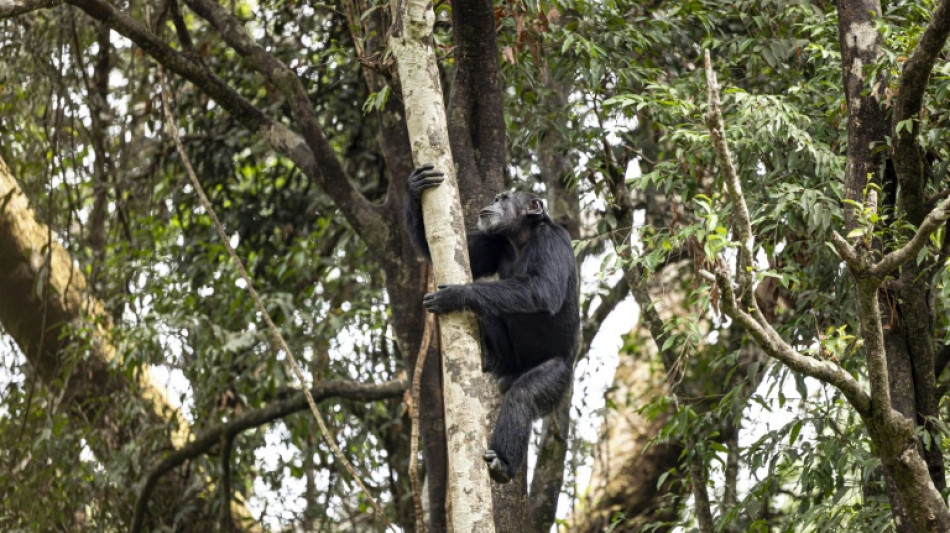
Chimps ingest alcohol daily: study / Photo: PATRICK MEINHARDT - AFP

Chimps ingest alcohol daily: study

Chimpanzees consume the equivalent of at least one alcoholic drink per day as they eat ripe, fermenting fruit, says a study out Wednesday that addresses one possible reason why humans are drawn to booze.

Text size:

The study, carried out in the wilds of Africa where the animals live, supports the theory that people may have inherited from primates a taste for alcohol and ability to metabolize it even though it is toxic for us.

The researchers collected fruits that chimps eat and measured their ethanol content, which is produced as sugar ferments. They concluded that these evolutionary cousins of ours consume alcohol on a daily basis.

And not just a little. Through the large amount of fruit that chimps eat, the researchers reckon the animals take in about 14 grams (half an ounce) of alcohol per day.

Correcting for body size, it is like the chimps are drinking a pint of beer per day, Aleksey Maro, lead author of the study published in the journal Science Advances, told AFP.

"It's not an insubstantial amount of alcohol, but very diluted and more associated with food," said the PhD candidate at the University of California, Berkeley.

- The 'drunken monkey' theory -

"We've seen for the first time that, indeed, our closest living relatives are consuming physiologically relevant doses of alcohol routinely daily," Maro said.

This is in line with the "drunken monkey theory" espoused more than a decade ago by US biologist Robert Dudley, who co-authored the new study.

As the theory goes, humans liking alcohol and being able to metabolize it stems from our primate ancestors ingesting it daily through the fruit they eat.

"The drunken monkey hypothesis is becoming more and more a reality," said Maro. "Its name is unfortunate. A better name would be the evolutionary hangover."

The theory was initially met with skepticism among experts. But it has gained traction in recent years as studies showed that some primates eat fermented fruit and, given a choice of nectars with varying amounts of alcohol, they prefer the booziest one.

Nathaniel Dominy, a professor of anthropology and evolutionary biology at Dartmouth College who did not take part in this study, welcomed it enthusiastically.

"The paper is a tour de force," he told AFP.

Dominy also said it "puts to rest the debate over the prevalence of ethanol in tropical fruits."

But he added that the study raises new questions on the biological and behavioral consequences of chronic low-level ethanol exposure for nonhuman primates.

Another unanswered question is whether chimps actively search out boozy fruit or just eat it when they find it. The researchers in this study said they did not know.

The issue of chimps ingesting alcohol will remain under study to learn more about the origins of human alcohol consumption and assess its risks and possible benefits, according to Maro.

"We can learn about ourselves through the chimpanzees," he said.

B.Hornik--TPP