The Prague Post - Round-the-clock care for Peru's oil-stained sea birds

EUR -
AED 4.187514
AFN 75.816272
ALL 93.795134
AMD 415.989364
AOA 1045.595917
ARS 1706.355504
AUD 1.628071
AWG 2.052425
AZN 1.936044
BAM 1.95575
BBD 2.292611
BDT 140.40641
BHD 0.429278
BIF 3400.493769
BMD 1.140236
BND 1.469298
BOB 12.640677
BRL 5.797414
BSD 1.138241
BTN 109.859228
BWP 15.723184
BYN 3.264917
BYR 22348.622614
BZD 2.289311
CAD 1.607675
CDF 2576.933303
CHF 0.928949
CLF 0.027483
CLP 1081.650372
CNY 7.721793
CNH 7.715508
COP 3670.179744
CRC 517.973129
CUC 1.140236
CUP 30.21625
CVE 110.261214
CZK 24.151679
DJF 202.692151
DKK 7.475346
DOP 66.286561
DZD 151.985767
EGP 57.786931
ERN 17.103538
ETB 183.718069
FJD 2.53845
FKP 0.855861
GBP 0.854749
GEL 2.993142
GGP 0.855861
GHS 13.237545
GIP 0.855861
GMD 84.377557
GNF 9986.262988
GTQ 8.683778
GYD 238.141823
HKD 8.941735
HNL 30.487418
HRK 7.535592
HTG 148.819669
HUF 359.462201
IDR 20536.787852
ILS 3.452062
IMP 0.855861
INR 109.304206
IQD 1491.161876
IRR 1567824.290378
ISK 143.008771
JEP 0.855861
JMD 180.540634
JOD 0.808396
JPY 186.452502
KES 147.672114
KGS 99.713366
KHR 4602.680493
KMF 494.861875
KRW 1675.280062
KWD 0.353724
KYD 0.948576
KZT 541.216163
LAK 25774.341029
LBP 101932.193906
LKR 382.52022
LRD 206.022926
LSL 19.225808
LTL 3.36682
LVL 0.689717
LYD 7.283718
MAD 10.659634
MDL 20.118486
MGA 5043.738345
MKD 61.504009
MMK 2394.494449
MNT 4098.003519
MOP 9.194465
MRU 45.429643
MUR 53.979005
MVR 17.617246
MWK 1973.69761
MXN 19.875797
MYR 4.659687
MZN 72.864585
NAD 19.225808
NGN 1555.989179
NIO 41.886909
NOK 10.991828
NPR 175.771881
NZD 1.966183
OMR 0.438418
PAB 1.138271
PEN 3.873701
PGK 5.091624
PHP 70.369087
PKR 316.174898
PLN 4.314276
PYG 6881.733525
QAR 4.138094
RON 5.232564
RSD 117.422626
RUB 88.995376
RWF 1677.212991
SAR 4.273135
SBD 9.214366
SCR 15.352867
SDG 684.712465
SEK 11.0375
SGD 1.470779
SLE 27.622241
SOS 650.466256
SRD 43.092362
STD 23600.57992
STN 24.498192
SVC 9.959745
SZL 19.223003
THB 38.252063
TJS 10.500439
TMT 3.990825
TND 3.373914
TRY 53.986856
TTD 7.733802
TWD 36.853902
TZS 3010.220312
UAH 51.010754
UGX 4290.852665
USD 1.140236
UYU 45.708431
UZS 13775.647799
VES 845.258437
VND 30005.306331
VUV 135.315331
WST 3.142855
XAF 655.922972
XAG 0.019189
XAU 0.000278
XCD 3.081545
XCG 2.051448
XDR 0.815758
XOF 655.931601
XPF 119.331742
YER 272.003513
ZAR 19.045963
ZMK 10263.492626
ZMW 21.086183
ZWL 367.155478
  • CMSD

    -0.0200

    21.98

    -0.09%

  • BCC

    1.3800

    77.84

    +1.77%

  • RBGPF

    -0.7300

    66

    -1.11%

  • NGG

    -0.0700

    82.3

    -0.09%

  • CMSC

    -0.0650

    21.725

    -0.3%

  • JRI

    0.1600

    13.06

    +1.23%

  • RIO

    -0.2900

    91.22

    -0.32%

  • BCE

    0.0900

    21.3

    +0.42%

  • RYCEF

    -0.1900

    18.17

    -1.05%

  • RELX

    1.5500

    34.41

    +4.5%

  • GSK

    0.6100

    51.35

    +1.19%

  • BTI

    1.1200

    60.96

    +1.84%

  • VOD

    -0.1000

    15.15

    -0.66%

  • BP

    -0.1100

    43.82

    -0.25%

  • AZN

    0.9900

    169.26

    +0.58%

Round-the-clock care for Peru's oil-stained sea birds

Round-the-clock care for Peru's oil-stained sea birds

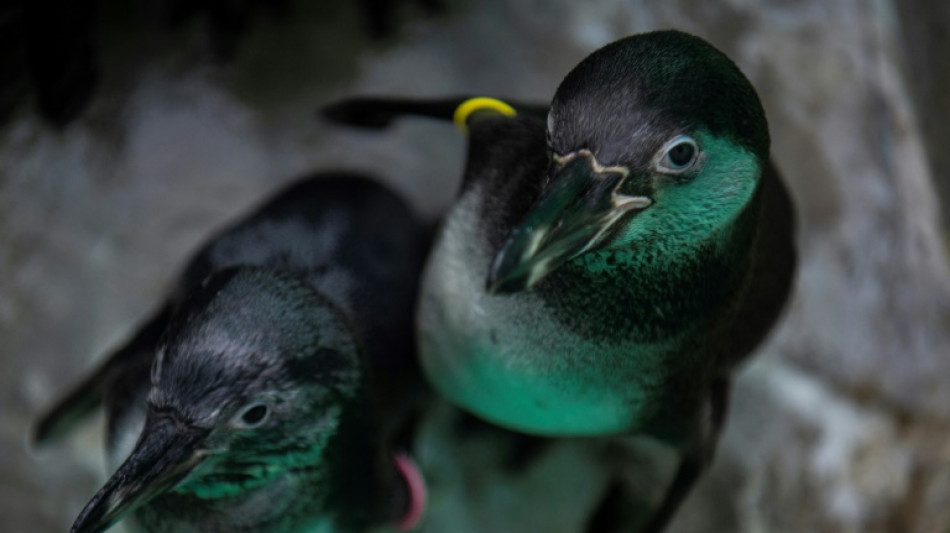
Hand fed fish and given gentle yet rigorous baths, penguins and other sea birds are slowly regaining their strength at a Peruvian zoo after a major oil spill that claimed many of their friends.

Text size:

Of about 150 oil-stained birds rescued alive after the January 15 spill of some 12,000 barrels of oil, half later died.

The survivors -- penguins, cormorants and pelicans -- are being nursed back to health and independence at the Parque de Las Leyendas zoo in Lima.

With oil on their wings, birds cannot fly or feed, and they lose the insulation they need to keep warm.

Even birds not directly contaminated with crude fell ill or died after eating fish that were.

- 'Very stressed' -

At the zoo, the rescued birds are fed fish -- for the penguins it is their preferred prey of silverside and anchovies.

They are given a special rehydration mixture through a tube, bathed, and dried with a towel.

"Many of them arrived in very bad condition, which makes it difficult for us to handle them," said Giovanna Yepez, one of the rescuers at the zoo.

"The animals were very contaminated... were very stressed," she added. "It is a very hard job."

But after two weeks of intensive care, the penguins at least "have tripled their food consumption," said Yepez.

"I believe the penguins are on the right track, they are clean and waiting for the impermeability of their feathers to return so they can be released."

Even when the feathers appear clean, the slightest vestige of crude inside the beak "can affect (the bird) through the digestive system, the liver," added veterinarian Giancarlo Inga Diaz, hence the need for patience and thoroughness.

- 'Disaster' -

The spill, described as an "ecological disaster" by the Peruvian government, happened when an Italian-flagged tanker was unloading oil at a refinery off Peru's coast.

Spanish oil company Repsol said the tanker was hit by freak waves triggered by a tsunami after a massive volcanic eruption near Tonga, thousands of kilometers away.

The oil slick was dragged by ocean currents about 140 kilometers (87 miles) north of the refinery, prosecutors said, killing countless fish and birds, polluting tourist beaches and robbing fishermen of their livelihood.

The Humbold penguin -- a species classified as "vulnerable" by the International Union for Conservation of Nature -- lives in colonies on the Peruvian and Chilean coasts, feeding in the cold, nutrient-rich waters of the Humboldt Current which flows north from Antarctica.

Some 9,000 of the black-and-white flightless birds are known to exist in Peru.

They stand about 50 centimeters tall.

Peru has demanded compensation from Repsol for the spill at its refinery.

M.Jelinek--TPP