The Prague Post - 'Bigger, hotter, faster': extreme blazes drive rise in CO2 fire emissions

EUR -
AED 4.284288
AFN 76.486388
ALL 96.679532
AMD 441.221231
ANG 2.088283
AOA 1068.593189
ARS 1675.261173
AUD 1.731585
AWG 2.099855
AZN 1.979668
BAM 1.959439
BBD 2.346357
BDT 142.49461
BGN 1.95913
BHD 0.439797
BIF 3448.81918
BMD 1.166586
BND 1.497387
BOB 8.079003
BRL 6.265748
BSD 1.164963
BTN 105.812946
BWP 15.609987
BYN 3.353327
BYR 22865.092088
BZD 2.342951
CAD 1.61581
CDF 2537.325606
CHF 0.928795
CLF 0.026229
CLP 1035.683392
CNY 8.129765
CNH 8.112325
COP 4289.829586
CRC 567.75431
CUC 1.166586
CUP 30.914538
CVE 110.470616
CZK 24.308918
DJF 207.445222
DKK 7.47187
DOP 74.137672
DZD 151.704284
EGP 55.328746
ERN 17.498795
ETB 181.799098
FJD 2.651422
FKP 0.868773
GBP 0.867811
GEL 3.138502
GGP 0.868773
GHS 12.587375
GIP 0.868773
GMD 86.32775
GNF 10198.983051
GTQ 8.932626
GYD 243.722589
HKD 9.096661
HNL 30.723052
HRK 7.535335
HTG 152.553944
HUF 385.568232
IDR 19794.228559
ILS 3.686739
IMP 0.868773
INR 106.184318
IQD 1526.134005
IRR 49142.449378
ISK 146.219884
JEP 0.868773
JMD 183.84218
JOD 0.827142
JPY 184.481653
KES 150.279956
KGS 102.018096
KHR 4691.732577
KMF 495.799485
KPW 1049.915137
KRW 1723.502991
KWD 0.359274
KYD 0.970803
KZT 592.580412
LAK 25191.780709
LBP 104321.322926
LKR 360.840074
LRD 210.852453
LSL 19.196047
LTL 3.444626
LVL 0.705656
LYD 6.330756
MAD 10.738541
MDL 19.896948
MGA 5281.808228
MKD 61.544279
MMK 2449.873335
MNT 4157.19281
MOP 9.356575
MRU 46.504358
MUR 53.884206
MVR 18.034809
MWK 2020.051201
MXN 20.514187
MYR 4.727592
MZN 74.543013
NAD 19.196047
NGN 1653.670973
NIO 42.869792
NOK 11.717419
NPR 169.300388
NZD 2.000031
OMR 0.448549
PAB 1.164963
PEN 3.912966
PGK 4.977264
PHP 69.394968
PKR 325.982344
PLN 4.2245
PYG 7766.422114
QAR 4.258927
RON 5.093665
RSD 117.381628
RUB 90.413154
RWF 1699.062412
SAR 4.374674
SBD 9.476893
SCR 15.559621
SDG 701.699179
SEK 10.727205
SGD 1.498981
SHP 0.875242
SLE 28.173012
SLL 24462.731213
SOS 664.637068
SRD 44.670337
STD 24145.981723
STN 24.545686
SVC 10.192928
SYP 12901.948899
SZL 19.189635
THB 36.293088
TJS 10.857409
TMT 4.094718
TND 3.412552
TOP 2.80886
TRY 50.488305
TTD 7.906683
TWD 36.898891
TZS 2944.530417
UAH 50.412515
UGX 4059.538494
USD 1.166586
UYU 44.983727
UZS 13935.938531
VES 398.173765
VND 30640.389984
VUV 141.337036
WST 3.258608
XAF 657.180189
XAG 0.012357
XAU 0.000247
XCD 3.152758
XCG 2.099499
XDR 0.817318
XOF 657.177367
XPF 119.331742
YER 278.201713
ZAR 19.09906
ZMK 10500.676851
ZMW 23.32832
ZWL 375.640323
  • NGG

    1.5300

    80.89

    +1.89%

  • VOD

    0.0200

    13.47

    +0.15%

  • RELX

    -0.2200

    41.63

    -0.53%

  • RBGPF

    0.0000

    84.04

    0%

  • CMSC

    -0.0700

    23.48

    -0.3%

  • RYCEF

    0.0500

    17.08

    +0.29%

  • GSK

    -0.9000

    48.22

    -1.87%

  • SCS

    0.0200

    16.14

    +0.12%

  • BP

    0.2300

    35.38

    +0.65%

  • RIO

    -1.2200

    85.13

    -1.43%

  • BTI

    0.1400

    58.22

    +0.24%

  • CMSD

    -0.0600

    23.92

    -0.25%

  • AZN

    0.4740

    94.427

    +0.5%

  • BCE

    -0.1000

    24.14

    -0.41%

  • BCC

    -0.7600

    85.51

    -0.89%

  • JRI

    0.1600

    13.7

    +1.17%

'Bigger, hotter, faster': extreme blazes drive rise in CO2 fire emissions
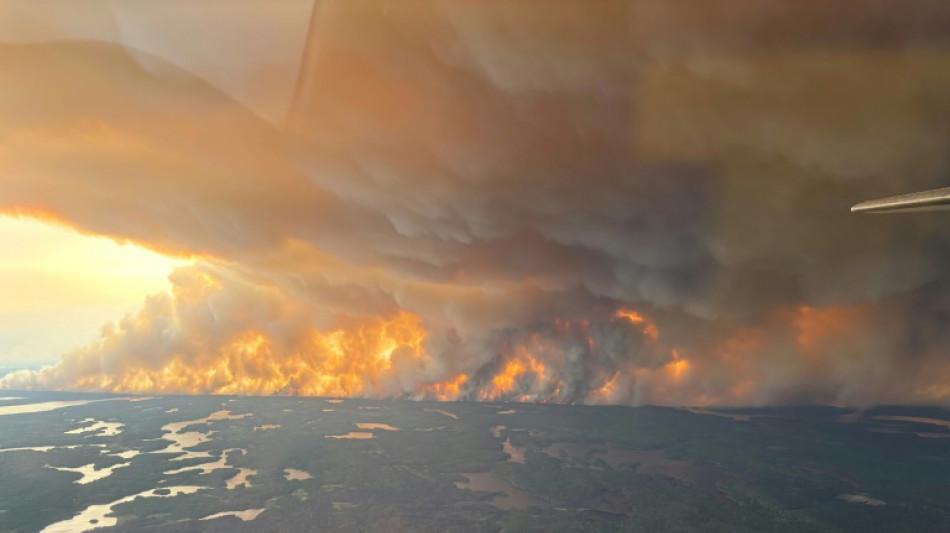
'Bigger, hotter, faster': extreme blazes drive rise in CO2 fire emissions / Photo: HANDOUT - Manitoba Government/AFP

'Bigger, hotter, faster': extreme blazes drive rise in CO2 fire emissions

Rampant wildfires in the Americas drove a jump in global greenhouse gas emissions from fires in the year to February, new research found Thursday, warning that climate change was fanning the flames.

Text size:

Infernos that ravaged huge areas of Canada's boreal forest and swept through the dry forests and vulnerable wetlands in South America drove global fire CO2 emissions 10 percent above the 20 year average, the State of Wildfires report found.

That is despite a below-average total of areas burned across the world, the international team of researchers said.

The report found that heat, drought and human activities helped intensify blazes in particularly carbon-rich forests and ecosystems.

"It's the scale and frequency of these extreme events that I find most staggering," said co-author Matthew Jones, of the University of East Anglia in eastern England.

He said satellite monitoring has shown that fires are becoming more intense across the world, expanding in key ecosystems and burning more material than in the past.

"During these extreme wildfire years, we see more fires, bigger fires, hotter fires and faster fires and these properties all aggregate up to extreme extent and destructive impacts on people and nature," Jones told AFP.

Climate change is one key factor, helping to create the optimal hot, dry conditions for fire to spread and burn.

The report, which looked at extreme wildfires from March 2024 to February 2025, found that devastating infernos in Los Angeles and parts of South America were two to three times more likely due to climate change.

Warming also made the area burned during those events 25 to 35 times larger, the authors said.

Global temperatures in 2024 were the hottest on record, going above 1.5C relative to the pre-industrial period for the first time.

Flames engulfed millions of hectares of forests and farmland last year in Canada, western parts of the United States and the Amazon, as well as in the Pantanal, the world's largest tropical wetland, which is shared by Brazil, Bolivia and Paraguay.

Across the world, the authors said wildfires killed 100 people in Nepal, 34 in South Africa and 31 in Los Angeles during the report period, with smoke drifting across continents and causing dangerous levels of air pollution far from the heat of the flames.

Globally, the report said fires emitted over eight billion tonnes of CO2 in the 2024-2025 period -- about 10 percent above average since 2003.

It comes after the World Meteorological Organization on Wednesday warned that the increase in the amount of carbon dioxide in the atmosphere last year was the biggest ever recorded.

The WMO voiced "significant concern" that the land and oceans were becoming unable to soak up CO2, leaving the greenhouse gas in the atmosphere.

It warned that the planet could be witnessing a so-called "vicious cycle" of climate feedback -- whereby increasing greenhouse gas emissions fuel rising temperatures that help stoke wildfires that release more CO2, while warmer oceans cannot absorb as much CO2 from the air.

C.Sramek--TPP