The Prague Post - Iraqis cover soil with clay to curb sandstorms

EUR -
AED 4.257284
AFN 73.61114
ALL 95.76109
AMD 436.872538
ANG 2.074715
AOA 1063.015882
ARS 1622.367014
AUD 1.620624
AWG 2.086619
AZN 1.962852
BAM 1.949858
BBD 2.337039
BDT 142.126913
BGN 1.910005
BHD 0.437631
BIF 3444.009456
BMD 1.159233
BND 1.475648
BOB 8.017672
BRL 6.016299
BSD 1.160399
BTN 106.535287
BWP 15.506151
BYN 3.407974
BYR 22720.959083
BZD 2.333649
CAD 1.572737
CDF 2521.331008
CHF 0.902897
CLF 0.026105
CLP 1030.777978
CNY 7.972068
CNH 7.970976
COP 4301.807871
CRC 547.944493
CUC 1.159233
CUP 30.719664
CVE 109.930969
CZK 24.404149
DJF 206.625721
DKK 7.471996
DOP 69.659537
DZD 152.572269
EGP 60.038143
ERN 17.388489
ETB 179.987902
FJD 2.547819
FKP 0.861385
GBP 0.864701
GEL 3.152854
GGP 0.861385
GHS 12.520011
GIP 0.861385
GMD 84.623795
GNF 10172.310237
GTQ 8.896966
GYD 242.763397
HKD 9.072531
HNL 30.712209
HRK 7.523073
HTG 152.150962
HUF 387.337892
IDR 19577.120255
ILS 3.596299
IMP 0.861385
INR 106.639024
IQD 1520.081148
IRR 1532157.735304
ISK 145.704135
JEP 0.861385
JMD 182.069912
JOD 0.82192
JPY 183.719836
KES 149.876227
KGS 101.375087
KHR 4656.950026
KMF 490.355379
KPW 1043.349102
KRW 1711.079452
KWD 0.355617
KYD 0.966962
KZT 565.431903
LAK 24856.579093
LBP 103909.306613
LKR 360.685592
LRD 212.336635
LSL 18.886494
LTL 3.422912
LVL 0.701209
LYD 7.407651
MAD 10.820368
MDL 19.969751
MGA 4813.457085
MKD 61.567423
MMK 2433.734987
MNT 4151.10701
MOP 9.350248
MRU 46.058842
MUR 53.220595
MVR 17.921451
MWK 2012.021073
MXN 20.460745
MYR 4.536655
MZN 74.074403
NAD 18.886413
NGN 1619.251053
NIO 42.701171
NOK 11.153615
NPR 170.458992
NZD 1.958014
OMR 0.445726
PAB 1.160379
PEN 4.047965
PGK 5.001888
PHP 68.618425
PKR 324.201587
PLN 4.271546
PYG 7555.173527
QAR 4.231343
RON 5.092273
RSD 117.398366
RUB 91.775048
RWF 1696.374737
SAR 4.350456
SBD 9.333747
SCR 15.951114
SDG 696.698563
SEK 10.656188
SGD 1.476503
SHP 0.869725
SLE 28.515268
SLL 24308.527385
SOS 661.999897
SRD 43.516413
STD 23993.774469
STN 24.426306
SVC 10.153149
SYP 128.96611
SZL 18.891922
THB 36.78419
TJS 11.104355
TMT 4.068906
TND 3.393489
TOP 2.791154
TRY 51.103825
TTD 7.873111
TWD 36.867657
TZS 2990.820457
UAH 50.913276
UGX 4298.955922
USD 1.159233
UYU 46.798205
UZS 14104.083114
VES 505.073699
VND 30432.753997
VUV 138.436711
WST 3.16557
XAF 653.981124
XAG 0.013324
XAU 0.000224
XCD 3.132884
XCG 2.091146
XDR 0.813343
XOF 653.983937
XPF 119.331742
YER 276.595351
ZAR 18.981853
ZMK 10434.483834
ZMW 22.510987
ZWL 373.272426
  • RBGPF

    0.1000

    82.5

    +0.12%

  • AZN

    0.0400

    194.99

    +0.02%

  • RYCEF

    0.7800

    17.68

    +4.41%

  • CMSC

    0.0300

    23.25

    +0.13%

  • NGG

    -0.5600

    89.85

    -0.62%

  • RIO

    1.3300

    91.68

    +1.45%

  • BTI

    1.0800

    59.41

    +1.82%

  • VOD

    -0.0200

    14.46

    -0.14%

  • GSK

    -0.1900

    55.32

    -0.34%

  • RELX

    -0.4900

    35.19

    -1.39%

  • BCE

    0.5100

    26.39

    +1.93%

  • CMSD

    -0.0800

    23.08

    -0.35%

  • JRI

    0.0600

    12.64

    +0.47%

  • BCC

    -1.9500

    72.54

    -2.69%

  • BP

    -0.7100

    39.94

    -1.78%

Iraqis cover soil with clay to curb sandstorms
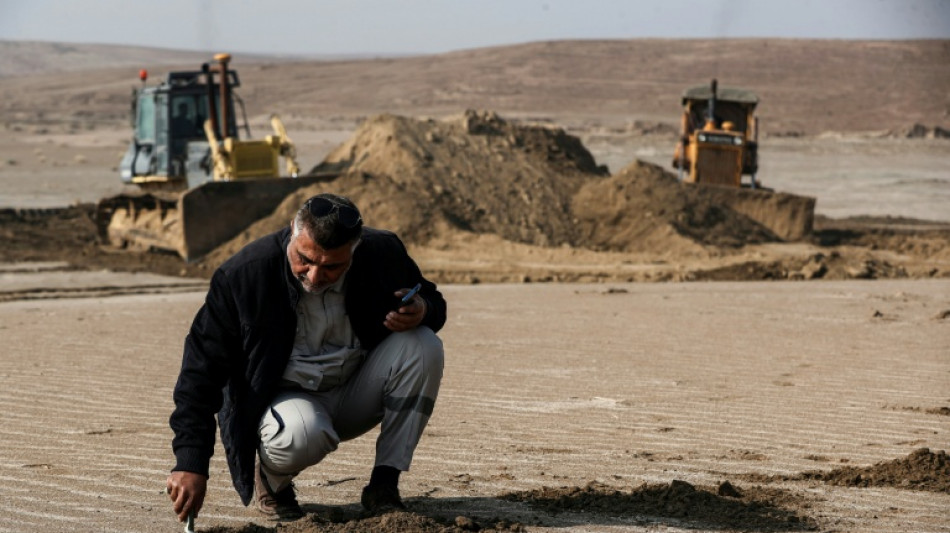
Iraqis cover soil with clay to curb sandstorms / Photo: AHMAD AL-RUBAYE - AFP

Iraqis cover soil with clay to curb sandstorms

Deep in Iraq's southern desert, bulldozers and earthmovers spread layers of moist clay over sand dunes as part of a broader effort to fight increasingly frequent sandstorms.

Text size:

Iraq has long suffered from sand and dust storms, but in recent years they have become more frequent and intense as the country falls prey to the effects of climate change.

Sand and dust storms -- driven by severe drought, rising temperatures and deforestation -- have cloaked cities and villages in an endless ochre haze, grounded flights and filled hospitals with patients suffering from breathing difficulties.

Iraqi authorities have warned that these suffocating storms will intensify further, adding urgency to address the root of the problem.

In a relatively small area between the cities of Nasiriyah and Samawah, not far from ancient Sumerian ruins, labourers are working hard to stabilise the soil by applying a layer of moist clay 20–25 centimetres thick.

The project also includes planting heat-tolerant seedlings like Prosopis and Conocarpus to further stabilise the soil.

"The main goal is to reduce the impact of transboundary dust storms, which may reach Kuwait, Saudi Arabia and Qatar," said Udai Taha Lafta from UN-Habitat, which is leading the project to combat sandstorms with Iraqi expertise.

"It is a vital area despite its small size, and will hopefully help reduce dust storms next summer," Lafta said.

A short-term objective is to shield a southern highway where many traffic accidents have occurred due to poor visibility during dust storms.

- 'Slow but steady' -

The Ministry of Environment estimates that Iraq now faces about 243 storms per year, and the frequency is expected to increase to 300 "dust days" by 2050 unless drastic mitigation measures are adopted.

In 2023, Iraqi authorities teamed up with the UN-Habitat and the Kuwait Fund for Arab Economic Development in areas that have been identified as major sources of sandstorms.

The project has been implementing several methods in three southern areas, including digging water canals and supplying electricity to pump water from the Euphrates river, preparing barren lands for vegetation.

One of the project's ultimate goals is to increase green spaces and for farmers to eventually sustain the lands after droughts and chronic water shortages have drastically reduced agricultural areas.

Qahtan al-Mhana, from the agriculture ministry, said that stabilising the soil gives agricultural efforts in sandy areas a chance to endure.

He added that Iraq has extensive "successful" experience in combating desertification and dust storms by stabilising sand dunes.

Since the 1970s, the country has implemented such projects, but after decades of turmoil, environmental challenges have largely fallen by the wayside.

With the severe recent impact of climate change, "work has resumed," said Najm Abed Taresh from Dhi Qar University.

"We are making slow but steady progress," Taresh said.

J.Marek--TPP