The Prague Post - Arctic sea ice at lowest level ever this winter

EUR -
AED 4.237535
AFN 72.121065
ALL 94.93196
AMD 424.957221
ANG 2.065932
AOA 1059.239324
ARS 1653.769787
AUD 1.649154
AWG 2.079824
AZN 1.967886
BAM 1.956038
BBD 2.322783
BDT 141.855413
BGN 1.926846
BHD 0.435253
BIF 3437.603294
BMD 1.153855
BND 1.485987
BOB 7.968969
BRL 5.95597
BSD 1.15324
BTN 110.378428
BWP 15.651972
BYN 3.183129
BYR 22615.565224
BZD 2.319482
CAD 1.613032
CDF 2626.174736
CHF 0.921982
CLF 0.0268
CLP 1054.785392
CNY 7.814774
CNH 7.821634
COP 4116.782877
CRC 526.464045
CUC 1.153855
CUP 30.577167
CVE 110.276982
CZK 24.190405
DJF 205.364983
DKK 7.474265
DOP 67.578221
DZD 154.048379
EGP 60.028863
ERN 17.307831
ETB 181.722007
FJD 2.567039
FKP 0.861813
GBP 0.86339
GEL 3.057941
GGP 0.861813
GHS 12.858564
GIP 0.861813
GMD 84.231139
GNF 10102.097612
GTQ 8.791031
GYD 241.209344
HKD 9.042228
HNL 30.831617
HRK 7.535365
HTG 150.738338
HUF 355.128409
IDR 20737.088684
ILS 3.415354
IMP 0.861813
INR 110.456499
IQD 1510.78379
IRR 1586753.056622
ISK 143.793666
JEP 0.861813
JMD 182.462197
JOD 0.818118
JPY 185.233052
KES 149.493432
KGS 100.904502
KHR 4644.585148
KMF 492.695985
KPW 1038.30281
KRW 1764.939194
KWD 0.356033
KYD 0.961121
KZT 563.24852
LAK 25388.088506
LBP 103276.063716
LKR 384.323423
LRD 209.898263
LSL 19.049752
LTL 3.407035
LVL 0.697956
LYD 7.3668
MAD 10.697562
MDL 20.07853
MGA 4840.588866
MKD 61.647424
MMK 2422.683862
MNT 4129.440791
MOP 9.309292
MRU 45.715967
MUR 55.234965
MVR 17.838259
MWK 1999.843284
MXN 20.07091
MYR 4.692729
MZN 73.729836
NAD 19.049835
NGN 1571.169826
NIO 42.444612
NOK 10.987068
NPR 176.607781
NZD 1.994237
OMR 0.443595
PAB 1.15324
PEN 3.923426
PGK 5.048549
PHP 70.750904
PKR 320.92556
PLN 4.25213
PYG 7084.800477
QAR 4.204511
RON 5.239542
RSD 117.340207
RUB 83.075427
RWF 1693.61337
SAR 4.332361
SBD 9.283428
SCR 15.783731
SDG 692.891994
SEK 10.992838
SGD 1.485854
SHP 0.86147
SLE 28.442579
SLL 24195.77258
SOS 659.083035
SRD 43.109212
STD 23882.476504
STN 24.502981
SVC 10.091096
SYP 127.538054
SZL 19.045234
THB 38.01896
TJS 10.754448
TMT 4.050032
TND 3.386112
TOP 2.778207
TRY 53.254943
TTD 7.836953
TWD 36.487217
TZS 3023.098745
UAH 51.823231
UGX 4347.491202
USD 1.153855
UYU 46.585062
UZS 13850.504883
VES 654.205065
VND 30376.97336
VUV 138.014559
WST 3.168353
XAF 656.039651
XAG 0.018115
XAU 0.000283
XCD 3.118352
XCG 2.078453
XDR 0.815574
XOF 656.028279
XPF 119.331742
YER 275.368006
ZAR 19.044094
ZMK 10386.082502
ZMW 19.922424
ZWL 371.540958
  • RBGPF

    2.0500

    60.72

    +3.38%

  • NGG

    -0.7000

    80.38

    -0.87%

  • RYCEF

    -0.2300

    16.49

    -1.39%

  • VOD

    0.3800

    15.05

    +2.52%

  • CMSD

    0.0100

    22.29

    +0.04%

  • CMSC

    -0.0100

    22.3

    -0.04%

  • RIO

    -2.3600

    99.06

    -2.38%

  • BCE

    0.1300

    24.71

    +0.53%

  • AZN

    -4.4700

    178.96

    -2.5%

  • RELX

    -0.9600

    33.98

    -2.83%

  • GSK

    -0.0800

    51.17

    -0.16%

  • BCC

    -1.7000

    68.31

    -2.49%

  • BTI

    1.1700

    61.12

    +1.91%

  • JRI

    0.1400

    12.86

    +1.09%

  • BP

    0.2800

    42.95

    +0.65%

Arctic sea ice at lowest level ever this winter
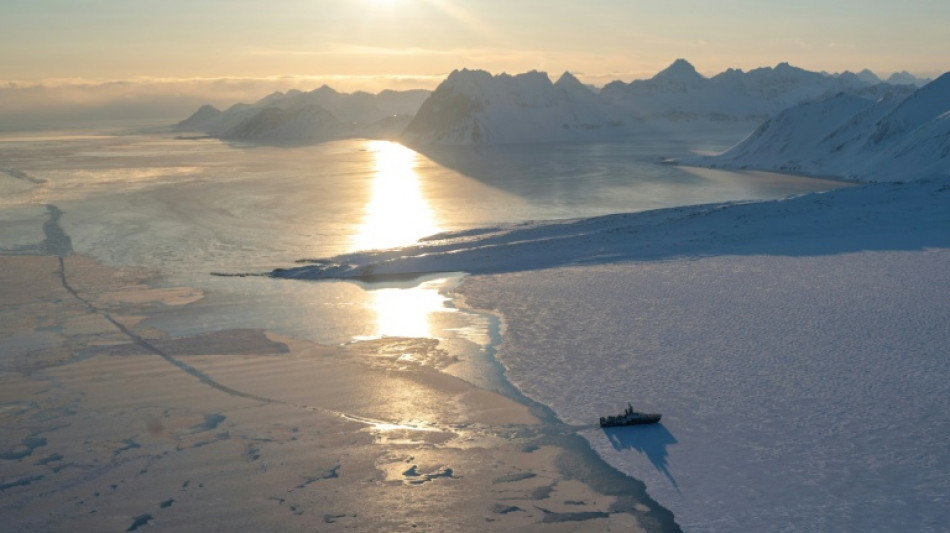
Arctic sea ice at lowest level ever this winter / Photo: Olivier MORIN - AFP

Arctic sea ice at lowest level ever this winter

Arctic sea ice reached its lowest level ever recorded, statistically tying last year's record, a leading US climate observatory for this geopolitically significant region said on Thursday.

Text size:

The ice is formed by seawater that freezes through the winter. It partially melts through the summer. However, the amount of reformation each winter is in decline, as rising temperatures due to climate change disproportionately affect the Arctic.

- Earlier and lower levels -

This year's maximum ice level was reached on March 15 -- a week earlier than last year.

The ice clocked in just below last year's level at 14.29 million square kilometers, a statistical tie with last year's all-time record low of 14.31 million square kilometers, according to the National Snow and Ice Data Center (NSIDC) in Boulder, Colorado.

It is the lowest level observed in 48 years of satellite monitoring. Previous records were set in 2016, 2017, and 2018.

This year's weak ice formation "gives a head start to the spring and summer melt season," said NSIDC Senior Researcher Walt Meier.

Samantha Burgess of the European Centre for Medium-Range Weather Forecasts (ECMWF) had a similar analysis in a recent conversation with AFP, saying it may trigger a "potentially faster and more extensive summer melt."

The weak ice growth was visible on satellite for weeks, as AFP reported earlier in March.

- Impacts on wildlife, geopolitics -

Unlike land-based ice -- such as glaciers or ice sheets -- melting sea ice does not directly raise sea levels. But it does cause wide-ranging climate impacts that threaten ecosystems.

Many species, including polar bears in the Arctic and emperor penguins in Antarctica, rely on sea ice to breed and feed.

Some effects can cascade.

"There are areas, for example, in the Beaufort Sea, near Canada or the Siberian seas of the ocean, that had never been exposed to the atmosphere," says Gilles Garric, a polar oceanographer at Mercator Ocean Toulouse. That exposure, in turn, could make these waters warmer in the summer.

The melt also has geopolitical consequences, as it opens new shipping routes and access to mineral resources. Since returning to the White House, Donald Trump has repeatedly said he wants to take over Greenland.

"From a geopolitical perspective, the climate change-induced melting of sea ice is turning the Arctic into the new Mediterranean: a common shared maritime resource surrounded by competing states," Elizabeth Chalecki, an expert on climate change and security, told AFP.

G.Kucera--TPP