The Prague Post - Hong Kong's 'hero trees' lose their glory as climate warms

EUR -
AED 4.237535
AFN 72.121065
ALL 94.93196
AMD 424.957221
ANG 2.065932
AOA 1059.239324
ARS 1653.769787
AUD 1.649154
AWG 2.079824
AZN 1.967886
BAM 1.956038
BBD 2.322783
BDT 141.855413
BGN 1.926846
BHD 0.435253
BIF 3437.603294
BMD 1.153855
BND 1.485987
BOB 7.968969
BRL 5.95597
BSD 1.15324
BTN 110.378428
BWP 15.651972
BYN 3.183129
BYR 22615.565224
BZD 2.319482
CAD 1.613032
CDF 2626.174736
CHF 0.921982
CLF 0.0268
CLP 1054.785392
CNY 7.814774
CNH 7.821634
COP 4116.782877
CRC 526.464045
CUC 1.153855
CUP 30.577167
CVE 110.276982
CZK 24.190405
DJF 205.364983
DKK 7.474265
DOP 67.578221
DZD 154.048379
EGP 60.028863
ERN 17.307831
ETB 181.722007
FJD 2.567039
FKP 0.861813
GBP 0.86339
GEL 3.057941
GGP 0.861813
GHS 12.858564
GIP 0.861813
GMD 84.231139
GNF 10102.097612
GTQ 8.791031
GYD 241.209344
HKD 9.042228
HNL 30.831617
HRK 7.535365
HTG 150.738338
HUF 355.128409
IDR 20737.088684
ILS 3.415354
IMP 0.861813
INR 110.456499
IQD 1510.78379
IRR 1586753.056622
ISK 143.793666
JEP 0.861813
JMD 182.462197
JOD 0.818118
JPY 185.233052
KES 149.493432
KGS 100.904502
KHR 4644.585148
KMF 492.695985
KPW 1038.30281
KRW 1764.939194
KWD 0.356033
KYD 0.961121
KZT 563.24852
LAK 25388.088506
LBP 103276.063716
LKR 384.323423
LRD 209.898263
LSL 19.049752
LTL 3.407035
LVL 0.697956
LYD 7.3668
MAD 10.697562
MDL 20.07853
MGA 4840.588866
MKD 61.647424
MMK 2422.683862
MNT 4129.440791
MOP 9.309292
MRU 45.715967
MUR 55.234965
MVR 17.838259
MWK 1999.843284
MXN 20.07091
MYR 4.692729
MZN 73.729836
NAD 19.049835
NGN 1571.169826
NIO 42.444612
NOK 10.987068
NPR 176.607781
NZD 1.994237
OMR 0.443595
PAB 1.15324
PEN 3.923426
PGK 5.048549
PHP 70.750904
PKR 320.92556
PLN 4.25213
PYG 7084.800477
QAR 4.204511
RON 5.239542
RSD 117.340207
RUB 83.075427
RWF 1693.61337
SAR 4.332361
SBD 9.283428
SCR 15.783731
SDG 692.891994
SEK 10.992838
SGD 1.485854
SHP 0.86147
SLE 28.442579
SLL 24195.77258
SOS 659.083035
SRD 43.109212
STD 23882.476504
STN 24.502981
SVC 10.091096
SYP 127.538054
SZL 19.045234
THB 38.01896
TJS 10.754448
TMT 4.050032
TND 3.386112
TOP 2.778207
TRY 53.254943
TTD 7.836953
TWD 36.487217
TZS 3023.098745
UAH 51.823231
UGX 4347.491202
USD 1.153855
UYU 46.585062
UZS 13850.504883
VES 654.205065
VND 30376.97336
VUV 138.014559
WST 3.168353
XAF 656.039651
XAG 0.018115
XAU 0.000283
XCD 3.118352
XCG 2.078453
XDR 0.815574
XOF 656.028279
XPF 119.331742
YER 275.368006
ZAR 19.044094
ZMK 10386.082502
ZMW 19.922424
ZWL 371.540958
  • RBGPF

    2.0500

    60.72

    +3.38%

  • RYCEF

    0.0400

    16.65

    +0.24%

  • RIO

    2.1800

    101.24

    +2.15%

  • BCC

    -0.0500

    68.26

    -0.07%

  • BTI

    0.4100

    61.53

    +0.67%

  • GSK

    1.2000

    52.37

    +2.29%

  • BCE

    -0.1950

    24.515

    -0.8%

  • NGG

    1.1400

    81.52

    +1.4%

  • CMSC

    0.0000

    22.3

    0%

  • BP

    0.8150

    43.765

    +1.86%

  • RELX

    -0.4700

    33.51

    -1.4%

  • AZN

    1.9200

    180.88

    +1.06%

  • VOD

    0.1200

    15.17

    +0.79%

  • CMSD

    0.0350

    22.325

    +0.16%

  • JRI

    -0.0100

    12.85

    -0.08%

Hong Kong's 'hero trees' lose their glory as climate warms
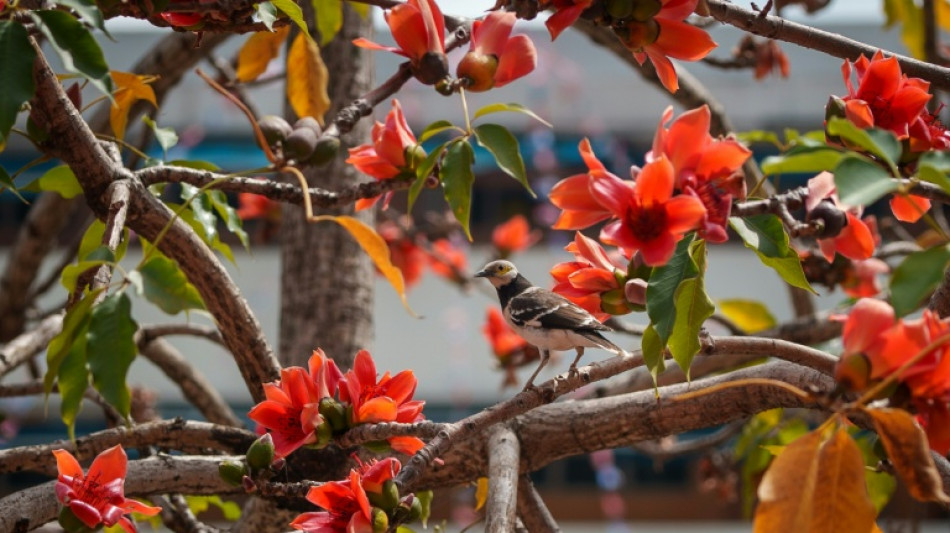
Hong Kong's 'hero trees' lose their glory as climate warms / Photo: Yan Zhao - AFP

Hong Kong's 'hero trees' lose their glory as climate warms

Hong Kong's beloved kapok trees are not blooming the way they used to, drawing concern from conservationists who see it as a sign that nature is falling out of sync as the climate warms.

Text size:

Locally known as "hero trees" for their majestic appearance, kapoks attract large numbers of photographers every spring when their bright red flowers bloom on otherwise bare branches.

But that contrast has been fading in recent years as leaves that should have been shed during winter stay put as the seasons change, worrying researchers.

"The kapok trees we see now very often have both flowers and leaves at the same time," said Lam Chiu-ying, former director of the Hong Kong Observatory.

"In some places, half the tree is covered in green leaves and the other half in red flowers."

The kapok, also known as the red silk-cotton tree, is native to tropical and subtropical Asia, including southern China.

The shift in their springtime appearance has "become increasingly common" over the past decade due to warming winters caused by climate change, Lam told AFP.

Hong Kong has just recorded its warmest winter on record, with the mean temperature from December to February hitting 19.3C, two degrees higher than normal, according to the observatory.

Angie Ng, an ecologist and conservation manager at local NGO The Conservancy Association, said the trees seemed to be blooming about two weeks earlier than usual this year, likely due to climate factors like temperature and moisture.

The trees have to divert resources to maintain both old leaves and new flowers, which may result in fewer blooms, she said.

The disruption could have knock-on effects on wildlife, as flowers provide nectar for birds and pollen for bees.

"Ecological processes function like an intricate web," Ng says.

"When the timing of animals and plants does not align properly, it can trigger ripple effects that impact not only animals dependent on those plants but also the broader ecological chains."

W.Cejka--TPP