The Prague Post - War imperils rare vultures' yearly odyssey to the Balkans

EUR -
AED 4.249992
AFN 72.906553
ALL 95.274038
AMD 426.307558
ANG 2.072004
AOA 1062.352843
ARS 1673.798689
AUD 1.638998
AWG 2.083045
AZN 1.97113
BAM 1.956277
BBD 2.329988
BDT 142.205879
BGN 1.93251
BHD 0.43631
BIF 3452.571088
BMD 1.157247
BND 1.487375
BOB 7.994017
BRL 5.976833
BSD 1.156792
BTN 110.310832
BWP 15.647948
BYN 3.195206
BYR 22682.04071
BZD 2.326687
CAD 1.610911
CDF 2644.88792
CHF 0.920515
CLF 0.027074
CLP 1065.55856
CNY 7.850418
CNH 7.837572
COP 4156.321946
CRC 533.834687
CUC 1.157247
CUP 30.667045
CVE 110.291874
CZK 24.167425
DJF 206.001975
DKK 7.474242
DOP 67.376999
DZD 154.544512
EGP 59.899083
ERN 17.358705
ETB 186.507156
FJD 2.562087
FKP 0.866996
GBP 0.86337
GEL 3.07859
GGP 0.866996
GHS 13.656446
GIP 0.866996
GMD 83.901276
GNF 10133.55671
GTQ 8.818225
GYD 242.031065
HKD 9.068824
HNL 30.929592
HRK 7.534605
HTG 151.258163
HUF 355.333865
IDR 20779.526683
ILS 3.409354
IMP 0.866996
INR 110.249357
IQD 1515.482358
IRR 1591272.452794
ISK 143.602865
JEP 0.866996
JMD 182.674511
JOD 0.820463
JPY 185.332523
KES 149.724342
KGS 101.200899
KHR 4647.172488
KMF 494.144477
KPW 1041.354765
KRW 1765.577183
KWD 0.357763
KYD 0.964043
KZT 564.902526
LAK 25473.426981
LBP 103595.237221
LKR 390.438508
LRD 211.123267
LSL 19.030501
LTL 3.417049
LVL 0.700007
LYD 7.372796
MAD 10.692405
MDL 20.117076
MGA 4853.224475
MKD 61.643362
MMK 2429.261797
MNT 4141.414254
MOP 9.337456
MRU 46.192654
MUR 55.409422
MVR 17.87952
MWK 2006.006118
MXN 20.115501
MYR 4.699119
MZN 73.959132
NAD 19.027294
NGN 1574.689292
NIO 42.570741
NOK 10.93662
NPR 176.497531
NZD 1.981112
OMR 0.444975
PAB 1.156892
PEN 4.016813
PGK 5.063234
PHP 71.153356
PKR 321.920221
PLN 4.237549
PYG 7124.597027
QAR 4.217428
RON 5.237932
RSD 117.374944
RUB 83.38654
RWF 1693.92738
SAR 4.344766
SBD 9.314198
SCR 15.730347
SDG 694.917525
SEK 10.884022
SGD 1.487317
SHP 0.864002
SLE 28.47206
SLL 24266.892878
SOS 661.166813
SRD 43.2226
STD 23952.67591
STN 24.506183
SVC 10.122554
SYP 127.912936
SZL 19.0258
THB 37.997623
TJS 10.793323
TMT 4.050364
TND 3.400329
TOP 2.786373
TRY 53.36943
TTD 7.84698
TWD 36.5646
TZS 3014.631898
UAH 51.968363
UGX 4364.101069
USD 1.157247
UYU 46.831816
UZS 13908.509136
VES 651.049888
VND 30470.312852
VUV 138.041786
WST 3.178208
XAF 656.122541
XAG 0.01687
XAU 0.000266
XCD 3.127517
XCG 2.084926
XDR 0.8198
XOF 656.11687
XPF 119.331742
YER 276.148106
ZAR 19.037234
ZMK 10416.610454
ZMW 20.546184
ZWL 372.633054
  • CMSC

    -0.0400

    22.32

    -0.18%

  • CMSD

    -0.0700

    22.34

    -0.31%

  • JRI

    0.0640

    12.524

    +0.51%

  • BCE

    0.3250

    24.505

    +1.33%

  • NGG

    0.6600

    80.83

    +0.82%

  • GSK

    0.4350

    51.075

    +0.85%

  • RIO

    -0.4600

    100.47

    -0.46%

  • AZN

    1.4530

    183.003

    +0.79%

  • BCC

    2.8800

    70.85

    +4.06%

  • RBGPF

    1.4900

    61.5

    +2.42%

  • BP

    -1.0800

    42.64

    -2.53%

  • VOD

    -0.0500

    14.76

    -0.34%

  • RELX

    0.5250

    35.045

    +1.5%

  • BTI

    0.3100

    60

    +0.52%

  • RYCEF

    0.3800

    16.9

    +2.25%

War imperils rare vultures' yearly odyssey to the Balkans
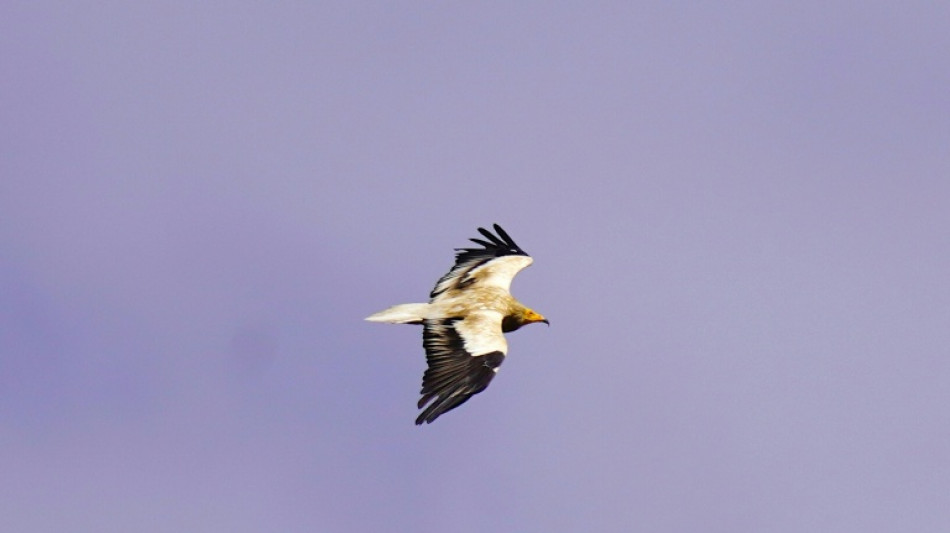
War imperils rare vultures' yearly odyssey to the Balkans / Photo: Raimond Kola - AFP

War imperils rare vultures' yearly odyssey to the Balkans

Endangered Egyptian vultures, with their vivid yellow face and white plumes, would usually be nesting across the Balkans in their dozens by April.

Text size:

But experts tracking the rare birds say local teams have struggled to find more than a handful in recent weeks, raising fears that the wars in the Middle East may have further disrupted their already perilous journey from Africa.

"The war is adding to the risks already present along this species' migration route," Nikolai Petkov, project manager at the Bulgarian Society for the Protection of Birds, told AFP.

From electrocution to poaching, the scavenger faces many hazards on its 5,000-kilometre (3,100-mile) annual migration to its Balkan breeding sites.

"The Middle East is a crucial migration corridor, and the war can have a considerable impact on this already sharply declining population," said Xhemal Xherri from the group Protection and Preservation of Natural Environment in Albania (PPNEA).

With thousands of people killed in bombing campaigns and the threat of further military action, any information on the impact on wildlife is hard to find, even for experts.

"Bombardments disturb not only Egyptian vultures, but also many other birds," he said, warning that the decline of the specific species could be a wider signal.

- A stark decline -

In the last 30 years, their numbers have fallen by 80 percent in the Balkans, according to Petkov, and the International Union for Conservation of Nature classifies the species as endangered worldwide.

Due to their key role in clearing carcasses -- which prevents the spread of disease -- conservationists and NGOs have long pushed efforts to protect the animal across their range.

Protecting resting places along with breeding programmes has helped their numbers improve slightly in Bulgaria, where the majority of the vultures now nest in the Balkans, Petkov said.

But they remain particularly vulnerable to accidental poisoning from bait use on farmland, which often means the birds eat tainted carrion.

- A hopeful wait -

In the rugged wilderness of southern Albania, the shepherds of Salaria are usually the first to notice the vultures return as a signal of the coming European spring.

As the season nears its end, they have recently spotted two soaring over their flocks.

Even for experts like Xherri, it took hours of scouring mountainous nesting sites to confirm the shepherds' report.

"Good news!" he exclaimed, as he squinted through binoculars at the white dot descending onto a ledge about 400 metres up a rockface.

He would have another long wait before confirming that a second of Europe's smallest vultures had also safely returned to its lofty perch.

The painstaking nature of the work makes it almost impossible to know how many animals actually reached nests in Albania, even before the war.

But Petkov remained optimistic, suggesting they may have delayed their journey due to colder weather earlier this year.

"So they might be a bit late, but hopefully, as we often say, you count the birds in autumn."

Q.Pilar--TPP