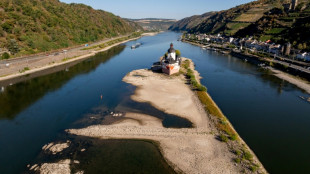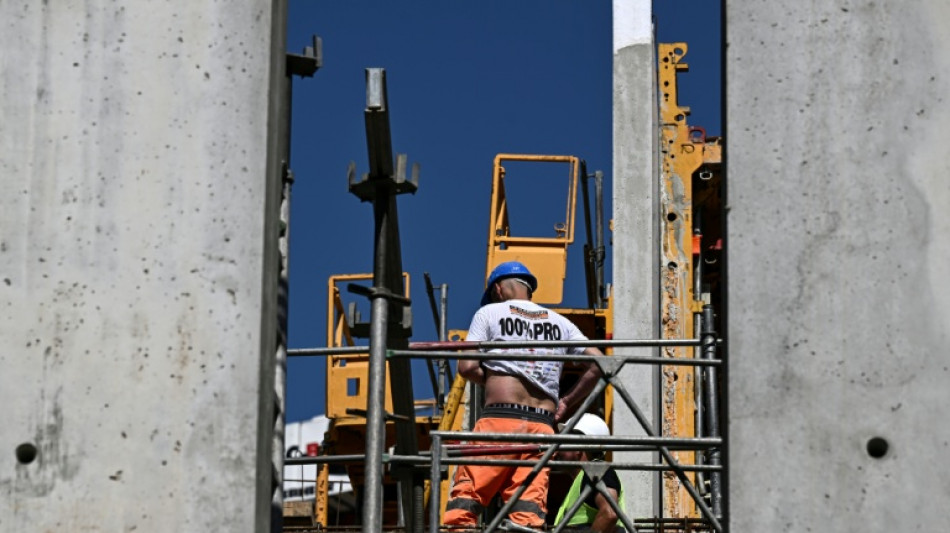
European economies suffer from heatwave / Photo: Christophe ARCHAMBAULT - AFP
When the mercury rises so do the costs for an economy as productivity melts and growth becomes lethargic, providing an additional challenge to Europe as it struggles with high energy prices.
"Extreme heat is emerging as a structural economic risk, with Europe highly exposed," wrote the trade credit arm of European insurer Allianz as the continent swelters under its second heatwave of the year.
Europe has a number of weaknesses: an ageing population, dense urban centres with many buildings not built for extreme heat, and just 19 percent of households with air conditioning compared to 90 percent in the United States, the analysts noted.
Heatwaves are becoming frequent as Europe warms faster than other regions of the world, and many scientists consider human activity will cause more extreme weather events.
"France is working in slow mode," recently observed Patrick Martin, head of Medef, France's main employers' organisation.
"Inevitably, it disrupts work and leads to less work being accomplished," he told BFM television.
Allianz Trade has identified "a critical threshold" of around 30C beyond which productivity losses intensify rapidly.
According to AFP's calculations more than 100 million people in Europe were set to experience temperatures in excess of 35C on Thursday, and nearly two-thirds of Europeans living where temperatures would surpass 30C.
- Medium-term impact -
In a blog post last year the European Central Bank said heatwaves in the spring, autumn and winter can boost economic activity, particularly construction, agriculture and outdoor dining.
"By contrast, heatwaves during the already warmer summers reduce economic activity, as physical exertion outdoors becomes increasingly impaired," it said.
Drops in productivity, the need to shift investment to climate adaptation, and energy price hikes that dampen purchasing power all contribute to a drop in economic activity.
ECB research found that summer heatwaves reduce regional activity of around one percent.
And in contrast to traditional views of a temporary disruption, the ECB found "the reduction in output is prolonged and even intensifies, reaching a trough of 1.5 percent lower after two years".
The Banque de France's new governor, Emmanuel Moulin, recently told France Inter radio that "there is clearly a negative effect on growth in the medium term".
- Food supplies a concern -
Extreme heat, which can provoke a hike in energy prices thanks to higher demand due to air conditioning, can also contribute to higher food prices and inflation over the medium term as it curtails yields and disrupts supply chains.
The ECB calculated that a 2022 drought caused European food prices to rise 0.7 percentage points. Olive crops were particularly affected, with the price of olive oil skyrocketing.
The central bank is concerned that climate change related increases in food prices could increase and create more difficulties for it to forecast inflation.
"Without a rapid shift that commits to climate adaptation and carbon neutrality, these phenomena risk becoming a long‑term structural drag on the economy," said Hazem Krichene, a climate and sustainability economist at Allianz.
He called for better coordination at the European level to act preventively.
Allianz Trade ran a stress scenario under which the five hottest years in each country between 2014 and 2024 were repeated between now and 2030.
It calculated that it could lead to cumulative losses in gross domestic product of between five and seven percent.
That would be a hit of $240 billion for France, $147 billion for Italy, $131 billion for Germany and $120 billion for Spain.
Tax revenue would also be hit, causing an estimated drop of 1.8 percent in France, just as expenses on infrastructure and health care need to be boosted.
That would worsen the already difficult situation many European countries find themselves in concerning budget deficits and debt, with their capacity to borrow constrained.
mpa/rl/js
D.Kovar--TPP