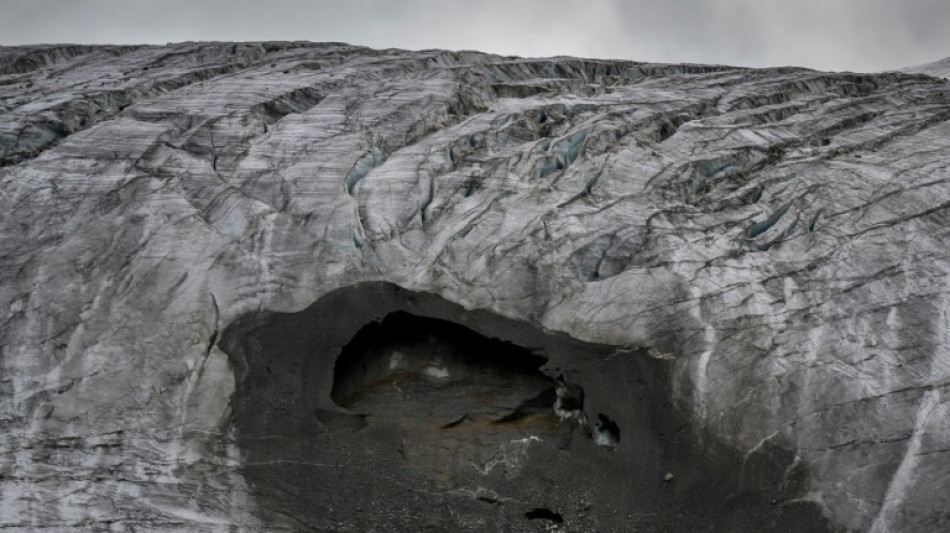
Swiss glaciers shrink in half since 1931: study / Photo: Fabrice COFFRINI - AFP
Swiss glaciers have shed half their volume since 1931, Swiss researchers said Monday, following the first reconstruction of the country's ice loss in the 20th century.
Rapid glacier melt in the Alps and elsewhere, which scientists say is driven by climate change, has been increasingly closely monitored since the early 2000s. However, until now there has been little insight into how glaciers changed prior to that during the 20th century, with only a handful of individual glaciers tracked over time, and with different models for estimating their volume.
But Swiss researchers from the ETH Zurich technical university and the Swiss Federal Institute for Forest, Snow and Landscape Research WSL say they had now reconstructed the topography of all Swiss glaciers in 1931, making it possible to show how they have evolved.
"Based on these reconstructions and comparisons with data from the 2000s, the researchers conclude that the glacier volume halved between 1931 and 2016," they said in a statement.
Their study, published in the scientific journal The Cryosphere, used material from the TerrA image archive, which covers about 86 percent of Switzerland's glacierised area, analysing around 21,700 photographs taken between 1916 and 1947.
- Dramatic change -
For their reconstruction, the glaciologists used so-called stereophotogrammetry -- a technique used to determine the nature, shape and position of any object on the basis of image pairs.
"If we know the surface topography of a glacier at two different points in time, we can calculate the difference in ice volume," lead study author Erik Schytt Mannerfelt said in the statement.
The researchers presented side-by-side picture pairs showing the same spot nearly a century apart, indicating the dramatic change that has taken place.
The Fiescher Glacier, for instance, resembled a massive sea of ice in 1928, but in 2021, a few tiny specs of white were all that remained on the lush green mountainside.
Since the images used for the reconstruction were taken in different years, the study used the mean year 1931 as a reference and reconstructed the surface topography of all glaciers for that year, the statement said.
In their statement, the researchers stressed that glaciers did not continuously recede over the past century, pointing out that there was even sporadic mass glacier growth in the 1920s and 1980s.
But while there may have been growth over short-term periods, Daniel Farinotti, a glaciology professor at ETH Zurich and WSL and co-author of the study, said it was "important to keep the big picture in mind."
"Our comparison between the years 1931 and 2016 clearly shows that there was significant glacial retreat during this period," he said in the statement.
And the total glacier volume is decreasing at an ever faster rate.
While Swiss glaciers lost half their volume in the 85 years leading up to 2016, the Swiss glacier monitoring network, GLAMOS indicates that they lost a further 12 percent in the following six years alone.
Farinotti said the evidence was clear: "Glacier retreat is accelerating."
O.Holub--TPP