The Prague Post - Restored Cheshire wetland becomes key UK breeding site for black-necked grebes

EUR -
AED 4.114333
AFN 72.820262
ALL 90.625134
AMD 404.80123
ANG 2.005114
AOA 1027.323983
ARS 1712.340161
AUD 1.596952
AWG 2.017958
AZN 1.910591
BAM 1.955616
BBD 2.258479
BDT 138.682553
BGN 1.958112
BHD 0.423177
BIF 3363.224275
BMD 1.12031
BND 1.432423
BOB 13.181292
BRL 5.64356
BSD 1.12134
BTN 106.252295
BWP 15.404173
BYN 3.315822
BYR 21958.072938
BZD 2.255179
CAD 1.57152
CDF 2594.637793
CHF 0.922177
CLF 0.027994
CLP 1101.679388
CNY 7.481485
CNH 7.477133
COP 3583.882393
CRC 511.77252
CUC 1.12031
CUP 26.910474
CVE 110.252683
CZK 24.273921
DJF 199.66413
DKK 7.47418
DOP 68.816305
DZD 150.858643
EGP 61.84379
ERN 16.804648
ETB 183.668638
FJD 2.520417
FKP 0.836867
GBP 0.83802
GEL 2.901936
GGP 0.836867
GHS 12.996302
GIP 0.836867
GMD 81.782865
GNF 9924.068492
GTQ 8.56954
GYD 234.557405
HKD 8.779297
HNL 30.099637
HRK 7.539122
HTG 146.922111
HUF 366.033178
IDR 20266.405074
ILS 3.487977
IMP 0.836867
INR 106.125999
IQD 1699.908722
IRR 2052827.75014
ISK 136.140046
JEP 0.836867
JMD 178.013291
JOD 0.794334
JPY 176.105971
KES 145.461773
KGS 97.97009
KHR 4561.755052
KMF 492.381482
KPW 1008.278816
KRW 1484.790775
KWD 0.347901
KYD 0.93445
KZT 502.313028
LAK 25239.644731
LBP 100414.908116
LKR 372.205064
LRD 191.17523
LSL 18.494107
LTL 3.307984
LVL 0.677664
LYD 7.183326
MAD 11.005767
MDL 20.138919
MGA 5084.72697
MKD 61.635526
MMK 2352.690103
MNT 4031.845367
MOP 9.054759
MRU 44.806794
MUR 52.789109
MVR 17.319826
MWK 1944.395594
MXN 20.948321
MYR 4.575394
MZN 71.58835
NAD 18.493034
NGN 1491.535624
NIO 41.267784
NOK 10.470517
NPR 170.003871
NZD 1.974272
OMR 0.430751
PAB 1.12134
PEN 3.852207
PGK 5.021529
PHP 71.10942
PKR 310.34287
PLN 4.375992
PYG 6429.396514
QAR 4.098506
RON 5.347577
RSD 117.512046
RUB 91.749702
RWF 1657.311009
SAR 4.193001
SBD 9.046031
SCR 15.487094
SDG 673.867346
SEK 11.113821
SGD 1.432002
SHP 0.837208
SLE 26.798095
SLL 23492.342196
SOS 640.865588
SRD 42.179106
STD 23188.15187
STN 24.498685
SVC 9.810904
SYP 14566.268236
SZL 18.490934
THB 37.779127
TJS 10.310646
TMT 3.932288
TND 3.341786
TOP 2.697437
TRY 55.597958
TTD 7.609591
TWD 36.471801
TZS 2963.211723
UAH 50.527757
UGX 4804.742004
USD 1.12031
UYU 44.95578
UZS 13351.746758
VES 985.636164
VND 28961.689926
VUV 132.954459
WST 3.102401
XAF 655.957
XAG 0.0203
XAU 0.000276061117
XCD 3.027694
XCG 2.020891
XDR 0.792117
XOF 655.957
XPF 119.331742
YER 264.486204
ZAR 18.494635
ZMK 10084.134734
ZMW 22.510791
ZWL 360.739313
SSP 6436.565401
MXV 2.364431
  • CMSC

    -0.0700

    19.6

    -0.36%

  • RBGPF

    -1.1000

    70.15

    -1.57%

  • BCC

    2.7000

    78.29

    +3.45%

  • CMSD

    -0.0250

    19.6

    -0.13%

  • JRI

    0.0600

    10.68

    +0.56%

  • NGG

    1.8600

    82.64

    +2.25%

  • BCE

    0.8300

    20.81

    +3.99%

  • RIO

    -2.7800

    84.14

    -3.3%

  • RYCEF

    -0.3500

    17

    -2.06%

  • RELX

    1.4900

    40.62

    +3.67%

  • GSK

    1.1900

    51.21

    +2.32%

  • VOD

    0.2700

    16.12

    +1.67%

  • BTI

    1.5700

    60.47

    +2.6%

  • BP

    0.2000

    50.05

    +0.4%

  • AZN

    4.1200

    172.57

    +2.39%

Restored Cheshire wetland becomes key UK breeding site for black-necked grebes

Restored Cheshire wetland becomes key UK breeding site for black-necked grebes

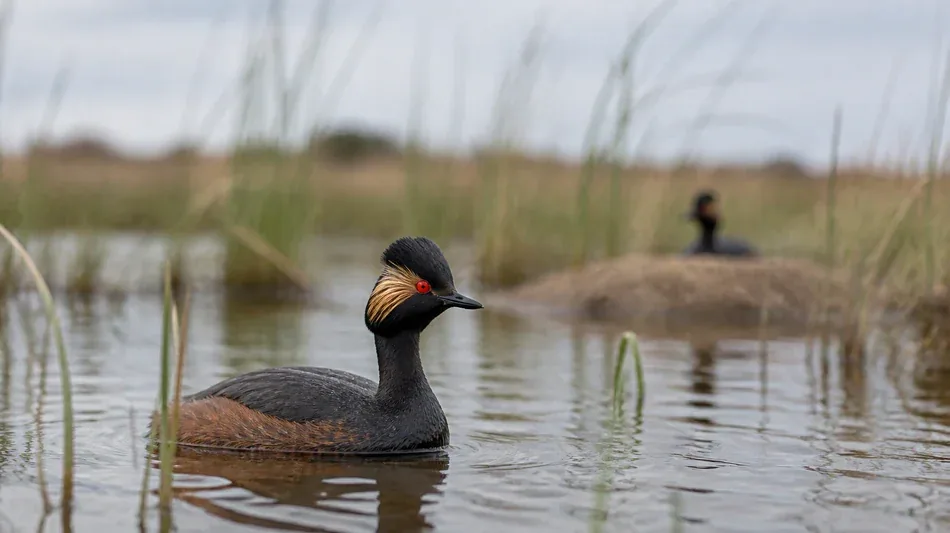
Habitat restoration at Woolston Eyes in Warrington has turned former canal-dredging lagoons into Britain's strongest breeding site for the rare black-necked grebe.

Text size:

Woolston Eyes in Warrington, Cheshire, has become Britain's most important breeding site for the rare black-necked grebe after a multi-year restoration of former settlement lagoons used for dredgings from the Manchester Ship Canal.Since 2021, the RSPB and the Woolston Eyes Conservation Group have restored and expanded the site into a mixture of freshwater pools, reedbeds, willow scrub and rough grassland. Managers revived dried and overgrown wetland areas and created nesting islands intended to attract black-headed gulls, which can provide protection for nesting grebes from predators.The results have been rapid. In 2023, four pairs of black-necked grebes bred in the restored area and raised 15 young. By 2025, 35 breeding pairs had been recorded at Woolston Eyes, including 29 pairs nesting on the newly restored habitat. That total represented 64% of the average number of black-necked grebe breeding pairs recorded annually across the UK.The site, designated as a Site of Special Scientific Interest, also supports other scarce species including willow tit, pochard and grasshopper warbler. Woolston Eyes depends on rainfall to remain wet, but managers can move water between sections so that individual pools can be dried, refreshed and flooded again. That rotation is important because black-necked grebes tend to leave wetlands that become too mature and densely vegetated.RSPB ecologist Gavin Thomas said the increase showed that targeted habitat management can support species recovery and argued that similar wetland restoration should be expanded elsewhere in the UK.

F.Prochazka--TPP