The Prague Post - Nepal glacier saw exceptional heat before collapse caused deadly floods: researcher

EUR -
AED 4.272977
AFN 76.210838
ALL 92.166336
AMD 423.399278
ANG 2.082426
AOA 1068.100094
ARS 1758.939905
AUD 1.611249
AWG 2.094313
AZN 1.967204
BAM 1.957209
BBD 2.342986
BDT 142.884067
BGN 1.973734
BHD 0.438616
BIF 3480.460153
BMD 1.163507
BND 1.472841
BOB 14.512445
BRL 5.965649
BSD 1.163337
BTN 109.852593
BWP 15.57521
BYN 3.577775
BYR 22804.745464
BZD 2.339584
CAD 1.603022
CDF 2652.797182
CHF 0.939939
CLF 0.027533
CLP 1087.169901
CNY 7.808646
CNH 7.806751
COP 3639.521025
CRC 527.980008
CUC 1.163507
CUP 30.832947
CVE 110.344419
CZK 24.210381
DJF 207.149093
DKK 7.474843
DOP 68.859561
DZD 154.938495
EGP 59.244054
ERN 17.452611
ETB 188.63787
FJD 2.552799
FKP 0.860687
GBP 0.858558
GEL 3.030922
GGP 0.860687
GHS 13.232524
GIP 0.860687
GMD 86.099971
GNF 10225.315616
GTQ 8.880353
GYD 243.375167
HKD 9.122812
HNL 31.211464
HRK 7.537549
HTG 152.130802
HUF 364.258685
IDR 20501.000769
ILS 3.504339
IMP 0.860687
INR 110.184327
IQD 1523.909915
IRR 1599357.302253
ISK 140.400815
JEP 0.860687
JMD 184.742967
JOD 0.82487
JPY 178.394745
KES 150.580737
KGS 101.748332
KHR 4710.430765
KMF 493.327202
KPW 1047.157021
KRW 1561.863298
KWD 0.359478
KYD 0.969406
KZT 528.404855
LAK 26068.986921
LBP 104173.272902
LKR 381.647967
LRD 203.575646
LSL 18.598646
LTL 3.435535
LVL 0.703794
LYD 7.394322
MAD 10.917658
MDL 20.095636
MGA 4981.585441
MKD 61.569314
MMK 2443.063116
MNT 4185.172677
MOP 9.394442
MRU 46.731635
MUR 54.522106
MVR 17.987501
MWK 2017.151823
MXN 19.741411
MYR 4.717787
MZN 74.351798
NAD 18.598646
NGN 1537.830908
NIO 42.810813
NOK 10.769
NPR 175.764505
NZD 1.983693
OMR 0.447367
PAB 1.163237
PEN 3.902843
PGK 5.16872
PHP 72.788815
PKR 323.073929
PLN 4.311231
PYG 6929.987782
QAR 4.228543
RON 5.251728
RSD 117.332759
RUB 100.358622
RWF 1715.834953
SAR 4.370073
SBD 9.308655
SCR 16.085507
SDG 699.860735
SEK 11.155814
SGD 1.470908
SHP 0.862003
SLE 28.680496
SLL 24398.167978
SOS 664.778467
SRD 43.916005
STD 24082.254515
STN 24.517541
SVC 10.178413
SYP 15127.923387
SZL 18.595384
THB 38.232683
TJS 10.742886
TMT 4.072276
TND 3.3952
TOP 2.801447
TRY 56.381821
TTD 7.896751
TWD 36.664461
TZS 3079.257348
UAH 51.705414
UGX 4397.164811
USD 1.163507
UYU 46.823499
UZS 13714.989088
VES 938.225737
VND 30206.97968
VUV 137.255673
WST 3.162548
XAF 656.429458
XAG 0.017567
XAU 0.000264
XCD 3.144437
XCG 2.096527
XDR 0.82266
XOF 656.429458
XPF 119.331742
YER 275.75067
ZAR 18.631273
ZMK 10472.961921
ZMW 22.306055
ZWL 374.648915
  • RIO

    0.4300

    103.27

    +0.42%

  • CMSC

    -0.1100

    20.81

    -0.53%

  • BCE

    -0.1400

    23.67

    -0.59%

  • RBGPF

    0.0000

    70

    0%

  • NGG

    -0.0500

    78.12

    -0.06%

  • BTI

    -0.6200

    55.35

    -1.12%

  • RYCEF

    0.1400

    19.92

    +0.7%

  • RELX

    -1.1400

    35.51

    -3.21%

  • GSK

    -0.9800

    49.89

    -1.96%

  • CMSD

    -0.0700

    20.69

    -0.34%

  • BP

    0.2300

    43.81

    +0.52%

  • VOD

    0.3200

    16.9

    +1.89%

  • AZN

    -2.0700

    162.7

    -1.27%

  • BCC

    2.0900

    79.21

    +2.64%

  • JRI

    -0.0700

    12.14

    -0.58%

Nepal glacier saw exceptional heat before collapse caused deadly floods: researcher
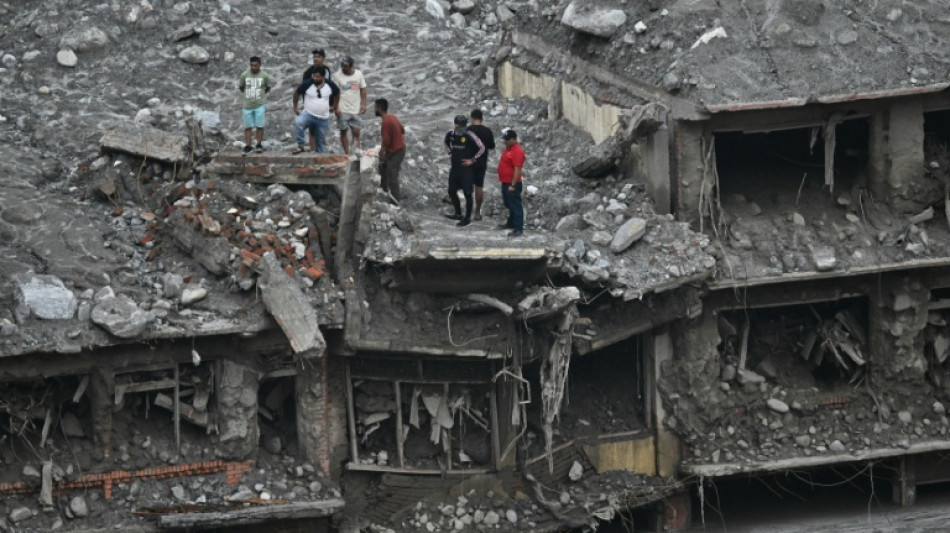
Nepal glacier saw exceptional heat before collapse caused deadly floods: researcher / Photo: Pedro PARDO - AFP

Nepal glacier saw exceptional heat before collapse caused deadly floods: researcher

The mountain section whose collapse triggered fatal floods in Nepal and China on August 26 had experienced unprecedented heat for the time of year, meteorological data analysed by a researcher shows.

Text size:

Average temperatures on the mountain glacier at an altitude of 5,200 metres (17,060 feet) were estimated at around five degrees Celsius between August 21 and 26.

This is exceptionally high.

They had not exceeded 4.0C over the same period in more than 55 years of data recording, although no direct link to the collapse has so far been established.

This series of highly localised temperatures was reconstructed by Robert Rohde, chief scientist at the independent Berkeley Earth organisation in California.

At the site of the collapse, the average temperature recorded over that six-day period has risen by about 1.8C since the mid-20th century.

Without the additional heat brought by climate change, a comparable temperature pattern "would probably occur only once in a few thousand years", Rohde calculated for AFP.

The collapse came during the Langtang region's fourth-hottest summer on record, according to AFP's analysis of data from Europe's Copernicus observatory dating back to 1970.

- Tipping point -

"These hot conditions can also explain permafrost thaw and combined slope and glacier collapse," said French climatologist Valerie Masson-Delmotte.

Permafrost acts as ice cement, holding rock faces together. Its degradation makes them more unstable.

Satellite images also showed significant snowmelt in the days before the disaster, providing "a substantial source of liquid water that can infiltrate fractures in the mountain and facilitate landslides", said Etienne Berthier, a glaciologist at France's CNRS research agency.

Experts remain cautious, however, about the precise role played by the heatwave.

"It's not as straightforward as 'high temperature equals collapse,'" Kristen Cook, a geomorphologist at the Grenoble Alpes University in France, told AFP.

"If the temperature acted as a trigger, it seems that it needed to wait until the rock was right at the tipping point of collapse," she added.

Researchers are now examining the small movements observed in the mountain in the years before the collapse and their interaction with changes in temperature.

"Proving the rock near the fracture plane was significantly weakened as a result of meltwater and/or permafrost thaw" would be a "smoking gun" of climate change, according to Rhode of Berkeley Earth.

His temperature analysis used data from the Copernicus programme's ERA5 climate model and a network of 14 high-altitude weather stations located between nine and 140 kilometres (six and 87 miles) from the collapsed glacier.

M.Jelinek--TPP