The Prague Post - Partial solar eclipse begins in Iceland headed towards India

EUR -
AED 4.177611
AFN 75.068136
ALL 93.600987
AMD 417.107118
AOA 1042.995504
ARS 1702.657162
AUD 1.627297
AWG 2.050163
AZN 1.932764
BAM 1.952383
BBD 2.291121
BDT 140.424257
BHD 0.428912
BIF 3395.13765
BMD 1.1374
BND 1.46749
BOB 12.802989
BRL 5.824508
BSD 1.137524
BTN 109.045484
BWP 15.618286
BYN 3.263318
BYR 22293.031134
BZD 2.287816
CAD 1.60612
CDF 2570.522996
CHF 0.931539
CLF 0.027236
CLP 1072.067528
CNY 7.702586
CNH 7.694872
COP 3654.919706
CRC 517.696306
CUC 1.1374
CUP 30.141088
CVE 110.754303
CZK 24.161552
DJF 202.138421
DKK 7.47528
DOP 66.195074
DZD 151.365465
EGP 57.679352
ERN 17.060993
ETB 181.955485
FJD 2.536685
FKP 0.853775
GBP 0.855728
GEL 2.985653
GGP 0.853775
GHS 13.244983
GIP 0.853775
GMD 84.16787
GNF 9969.307167
GTQ 8.679772
GYD 237.903081
HKD 8.919544
HNL 30.453898
HRK 7.536368
HTG 148.703038
HUF 359.679796
IDR 20553.719746
ILS 3.475662
IMP 0.853775
INR 109.006781
IQD 1489.993407
IRR 1563924.377948
ISK 142.800262
JEP 0.853775
JMD 179.965061
JOD 0.806427
JPY 186.185226
KES 147.236707
KGS 99.46526
KHR 4595.094055
KMF 493.630963
KRW 1667.325445
KWD 0.352838
KYD 0.947979
KZT 540.541674
LAK 25762.100186
LBP 101854.129895
LKR 382.510605
LRD 206.466444
LSL 19.14263
LTL 3.358445
LVL 0.688002
LYD 7.285047
MAD 10.648908
MDL 19.992804
MGA 4899.354451
MKD 61.42251
MMK 2388.014822
MNT 4084.995148
MOP 9.188422
MRU 45.553262
MUR 53.844427
MVR 17.572664
MWK 1975.662695
MXN 19.843596
MYR 4.649464
MZN 72.700866
NAD 19.142715
NGN 1552.356737
NIO 41.696814
NOK 10.993598
NPR 174.465685
NZD 1.968992
OMR 0.437331
PAB 1.137529
PEN 3.870002
PGK 4.998869
PHP 70.175848
PKR 316.026407
PLN 4.320532
PYG 6878.961798
QAR 4.144855
RON 5.233222
RSD 117.427424
RUB 88.742525
RWF 1667.427737
SAR 4.262619
SBD 9.191445
SCR 16.526612
SDG 683.005581
SEK 11.062826
SGD 1.468616
SLE 27.553518
SOS 650.021978
SRD 42.915236
STD 23541.874236
STN 24.96592
SVC 9.953581
SZL 19.142846
THB 38.242781
TJS 10.499841
TMT 3.980898
TND 3.370135
TRY 53.853935
TTD 7.725548
TWD 36.74415
TZS 2998.757331
UAH 51.087996
UGX 4271.581055
USD 1.1374
UYU 45.68006
UZS 13654.481435
VES 843.155877
VND 29930.669097
VUV 135.451013
WST 3.135038
XAF 654.836941
XAG 0.019449
XAU 0.000279
XCD 3.073879
XCG 2.050112
XDR 0.813729
XOF 654.004647
XPF 119.331742
YER 271.326574
ZAR 19.0571
ZMK 10237.960466
ZMW 21.255457
ZWL 366.24219
  • CMSC

    0.0250

    21.75

    +0.11%

  • BP

    -1.5100

    42.31

    -3.57%

  • CMSD

    0.0700

    22.05

    +0.32%

  • GSK

    0.6300

    51.98

    +1.21%

  • RIO

    0.7300

    91.95

    +0.79%

  • RBGPF

    -0.7300

    66

    -1.11%

  • BTI

    -0.1400

    60.82

    -0.23%

  • BCC

    0.3800

    78.22

    +0.49%

  • JRI

    -0.1500

    12.91

    -1.16%

  • BCE

    -0.0600

    21.24

    -0.28%

  • NGG

    -1.0900

    81.21

    -1.34%

  • AZN

    0.3800

    169.64

    +0.22%

  • VOD

    0.6500

    15.8

    +4.11%

  • RYCEF

    0.8000

    18.87

    +4.24%

  • RELX

    1.2400

    35.65

    +3.48%

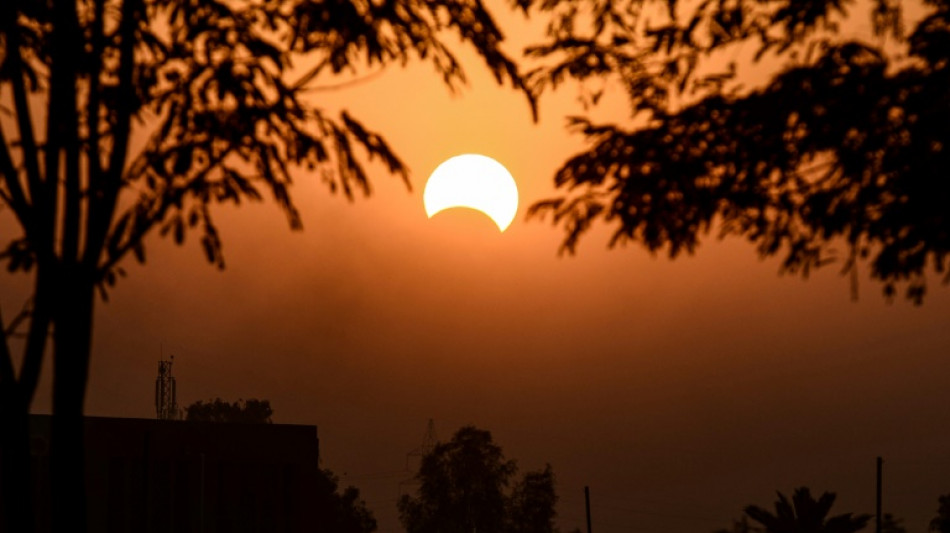
Partial solar eclipse begins in Iceland headed towards India
Partial solar eclipse begins in Iceland headed towards India / Photo: Haidar HAMDANI - AFP/File

Partial solar eclipse begins in Iceland headed towards India

A partial solar eclipse began over Iceland on Tuesday as the rare celestial spectacle started to make its way east across a swathe of the Northern Hemisphere.

Text size:

The partial eclipse began at 0858 GMT and will end off the coast of India at 1302 GMT, crossing parts of Europe, North Africa and the Middle East on its way, according to the IMCCE institute of France's Paris Observatory.

Amateur astronomers must not stare directly at the eclipse, which will not darken the sky, and should instead wear protective glasses to avoid eye damage, experts said.

Solar eclipses occur when the Moon passes between the Sun and Earth, casting its shadow down onto our planet.

A total solar eclipse happens when the Moon completely blocks the Sun's disk, momentarily plunging a portion of the Earth into complete darkness.

However Tuesday's eclipse is only partial, and the "Moon's shadow will not touch the surface of the Earth at any point," the Paris Observatory said in a statement.

The Moon will cover a maximum of 82 percent of the Sun over Kazakhstan, but it will not be enough darken the daylight, Paris Observatory astronomer Florent Deleflie said.

At least 95 percent of the Sun needs to be obscured to get a "sense of darkness," Deleflie told AFP.

"It won't be spectacular, but it's always an event for amateur astronomers -- and it can make for beautiful photos."

- Chasing eclipses -

Ryan Milligan, an astrophysicist at Northern Ireland's Queen's University Belfast, is a self-described "solar eclipse chaser" who has travelled the world to witness the rare celestial events.

Though Tuesday's eclipse "will be a slight event", Milligan told AFP that as an eclipse chaser, it will be "exciting to get that buzz back again".

But even with "the brightest clear skies, you will be none the wiser of what's going on above your head" unless you have the correct glasses, he added.

It can also be observed by poking a small hole in one piece of paper and letting the sunshine stream through onto another piece.

The holes in kitchen colanders or even Ritz crackers can also be used, Milligan added.

Milligan has travelled to countries including Chile to Turkey to see a total of 10 eclipses.

This week he booked a camper van for a trip to Western Australia in April next year to see a total eclipse that will last 76 seconds.

He is also heading to Mexico in April 2024 for what he calls "the big one" -- a total eclipse that will pass over North America.

Closer to his home in Northern Ireland, a total eclipse will be visible in Spain in 2026.

To find out when eclipses can be seen in different countries, Milligan recommended the website timeanddate.com/eclipse.

Despite Tuesday not being the most exciting event, Milligan urged those interested to plan for the next total eclipse.

"People always talk about the northern lights being on their bucket list," Milligan said. "But a total solar eclipse is the most spectacular sight in nature."

Z.Marek--TPP