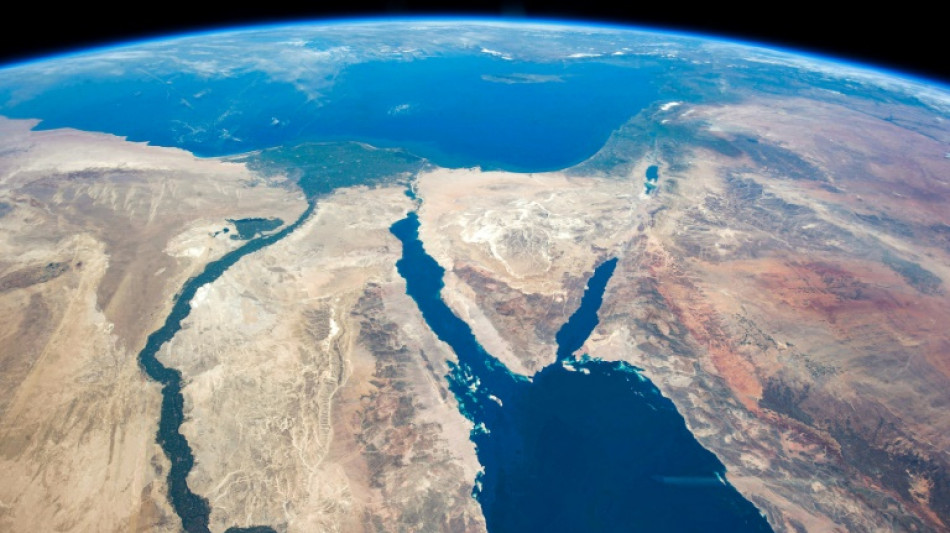
Nile is in mortal danger, from its source to the sea / Photo: Chris HADFIELD - NASA/AFP/File
The pharaohs worshipped it as a god, the eternal bringer of life. But the clock is ticking on the Nile.
Climate change, pollution and exploitation by man are putting existential pressure on the world's second longest river, on which half a billion people depend for survival.
All along its 6,500-kilometre (4,000-mile) length, alarm bells are ringing.
From Egypt to Uganda, AFP teams have gone out on the ground to gauge the decline of a river that drains a tenth of the African continent.
At its mouth on the Mediterranean, Sayed Mohammed is watching Egypt's fertile Nile Delta disappear. In Sudan, fellow farmer Mohammed Jomaa fears for his harvests, while at its threatened source in Uganda, there is less and less hydroelectric power for Christine Nalwadda Kalema to light her mud and wattle home.
"The Nile is the most important thing for us," said Jomaa, who at 17 is the latest generation of his family to work the river's rich banks at Alty in Gezira state.
"We certainly do not wish for anything to change," he said.
But the Nile is no longer the unperturbable river of myth. In half a century its flow has dropped from 3,000 cubic metres (10,600 cubic feet) per second to 2,830 cubic metres.
Yet it could get much, much worse. With multiple droughts in east Africa, its flow could fall by 70 percent, according to the United Nations' most dire predictions.
Every year for the past six decades, the Mediterranean has eaten away between 35 and 75 metres (38-82 yards) of the Nile Delta. If the sea level rises even by a metre, a third of this intensely fertile region could disappear, the UN fears, forcing nine million people from their homes.
What was once a bread basket has become the third most vulnerable place on the planet to climate change.
Lake Victoria, the Nile's biggest source of water after rainfall, could also dry up due to drought, evaporation and slow tilts in the Earth's axis.
With such grim scenarios in store, governments have scrambled to capture its flow. But experts say dams are only hastening the coming catastrophe.
- Land lost to sea -
At the mouth of the Nile, the promontories of Damietta and Rosetta that once stuck out into the Mediterranean in northern Egypt have disappeared.
The concrete barriers that were supposed to protect them are half covered by water and sand.
The sea ate three kilometres into the Nile Delta between 1968 and 2009, with the river's weaker flow unable to hold back the Mediterranean, which rose some 15 centimetres (six inches) over the last century due to climate change.
The silt that for millennia formed a barrier to protect the land no longer makes it to the sea.
This rich dark sediment that was once swept along the river's bed has struggled to get beyond southern Egypt since the Aswan dam was built in the 1960s to regulate the Nile's floods.
Before its construction "there was a natural balance", Ahmed Abdel Qader, the head of Egypt's coast protection authority, told AFP.
"Every Nile flood would deposit silt bulking up the promontories at Damietta and Rosetta. But this balance has been disturbed by the dam," he said.
If temperatures keep rising, the Mediterranean will advance a further 100 metres a year into the Delta, the UN's environment agency UNEP has warned.
- Poisoned by salt -
Fifteen kilometres inland, the bustling farming community of Kafr El-Dawar seems as yet far from danger.
But all is not well, said Sayed Mohammed, 73, who supports his 14 children and grandchildren growing rice and corn in fields sandwiched between the Nile and a road cacophonous with car horns.
Salt from the Mediterranean has already seeped into large swathes of land, killing and weakening plants. Farmers say their vegetables no longer taste the same.
To compensate for the salination of the soil, they have to pump more fresh water onto it from the Nile.
For 40 years Mohammed and his neighbours used pumps that guzzled diesel and electricity. The cost strangled villagers whose income was already being eaten up by inflation and devaluations of the Egyptian pound.
So much so that in some parts of the Delta fields were abandoned.
But the old man, who sports a djellaba and a traditional woollen cap, has been helped by a new irrigation system driven by solar energy which aims to increase farmers' incomes to stop more people fleeing the land.
Thanks to the 400 solar panels the UN's Food and Agriculture Organization financed for Kafr El-Dawar, he can water his half hectare (1.2 acres) of ground.
Solar power saves "farmers about 50 percent" of pumping costs, local irrigation chief Amr al-Daqaq told AFP. And they can also sell the surplus power the panels produce to the national grid.
Even so, none of Mohammed's descendants want to take on the farm.
For the Mediterranean may eventually swallow up 100,000 hectares of the region's prime agricultural land, according to UNEP, covering an area nearly 10 times the size of Paris.
Which would be a disaster for Egypt, with the Delta the source of between 30 and 40 percent of the nation's agricultural output.
- Power cuts -
All but three percent of Egypt's 104 million people live along the river on just eight percent of the country's territory. It is a similar story in neighbouring Sudan, with half its 45 million people living along its banks, and the Nile supplying two-thirds of its water.
By 2050 the population of both countries will have doubled, and it will be two or three degrees hotter.
The UN's group of climate experts, the IPCC, say the impact on the Nile will be catastrophic. They predict it will lose 70 percent of its flow by the end of the century, with the water supply available to every person along it plummeting to a third of what they have now.
Floods and other violent storms likely to lash East Africa as the climate warms will only make up 15 to 25 percent of that lost water, the IPCC has warned.
Which will leave the 10 countries who rely on the Nile for their crops and power in dire straits.
More than half of Sudan's power comes from hydroelectricity, with 80 percent of Uganda's generated from the river.
It is thanks to the Nile that Christine Nalwadda Kalema, a 42-year-old single mother, can light her humble shop and home in a poor part of the village of Namiyagi near Lake Victoria.
- Source threatened -
But the electricity that radically changed her life in 2016 may not last, said Revocatus Twinomuhangi, from Makerere University's Center for Climate Change in Kampala.
"If we have a reduction in rainfall... it will translate into reduced hydroelectric power potential," he said.
Already over "the last five to 10 years we have seen an increase in the frequency and intensity of drought, intense rainfall and flooding and also heat intensity, so it is becoming hotter and hotter".
Indeed, Lake Victoria could disappear entirely within the next 500 years, according to a study by British and American scientists based on geological data from the last 100,000 years.
But for Kalema, who grows bananas, manioc and coffee in her little garden to feed her family, such statistics remain abstract.
What concerns her are more and more frequent power cuts.
"Because of the cuts my son struggles to keep up with his homework. He has to read before nightfall," she said, dressed in colourful local "kitenge" cloth. "Candles are very expensive to me as a single mother with limited income."
- Mega dams -
More than half of Ethiopia's 110 million people have no choice but to live without electricity despite the country's having one of the fastest growth rates in Africa.
Addis Ababa is hoping that its GERD mega dam project on the Nile will remedy that, and is ready to burn bridges with its neighbours if it has to.
Begun in 2011, the Grand Ethiopian Renaissance Dam on the Blue Nile -- which joins the White Nile in Sudan to form the Nile -- already holds nearly a third of its 74-billion-cubic-metre capacity.
Addis Ababa claims it is the biggest hydroelectric project in Africa.
"The Nile is a gift of God given to us for Ethiopians to make use of it," Prime Minister Abiy Ahmed insisted in August.
But for Cairo it is a major headache, calling into question a deal signed with Sudan in 1959 which gave 66 percent of the Nile's annual flow to Egypt and 22 percent to Khartoum.
Although Ethiopia was not part of the accord, advisers to former Egyptian president Mohamed Morsi publicly floated bombing the dam back in 2013 to protect Cairo's vital interests.
The Egypt of President Abdel Fattah al-Sissi still fears a drastic fall in the Nile's flow because of the GERD dams.
And how much water Egypt is losing has sparked a heated debate within the scientific community, with some Egyptian researchers who minimise the effects accused of "betraying" their country.
- Disappearing silt -
But having already seen how the Aswan dam has reduced the flow of silt, farmers worry about being deprived of this precious natural fertiliser.
Over the years, Sudanese farmer Omar Abdelhay has found it harder and harder to grow the cucumbers, aubergines and potatoes in his luxuriantly green fields watered by the brown Nile water that passes close by his mud-brick home.
Eight years ago when this 35-year-old father began to cultivate his family's land, "there was good silt" to nurture his crops, he told AFP.
But little by little as dam-building has increased, "the water has got clearer. Even if the water level rises" during floods, it "comes without silt", he added.
Stuck in a political and economic slump, and with ongoing protests against its military leaders, Sudan is struggling to manage its water resources.
- Stalked by hunger -
Every year the country is lashed by rainstorms that killed 150 people this summer and washed away entire villages. But the deluges are no help to its agriculture because of the lack of a system to store and recycle rainwater.
Famine now threatens a third of its people despite Sudan long being a major player in world markets for peanuts, cotton and gum arabic.
Modest irrigation canals built during the colonial era mean even a small flow is enough to water its fertile land. But the development of this system through the Gezira Scheme has been long delayed.
Vast fields cultivated under the corrupt command economy of dictator Omar al-Bashir, who was overthrown in 2019, have fallen fallow, and in their place families grow peppers and cucumbers on small parcels of land.
Sudan, like other countries along the Nile -- and many other east African states -- is near the bottom of Notre Dame University's GAIN rankings, which measure resilience to climate change.
For Callist Tindimugaya, of Uganda's ministry of water and the environment, rising temperatures will impact not just the country's ability to feed itself but to generate electricity to power homes and industry.
"Short heavy rains can cause flooding. Long dry periods will bring loss of water... And you cannot survive without water," he said.
C.Zeman--TPP