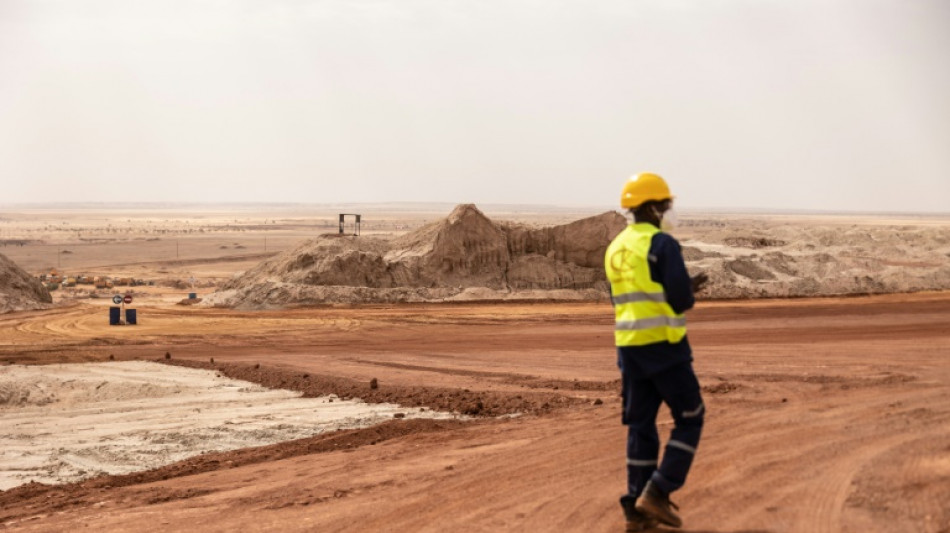
Sahel juntas pile pressure on foreign mining firms / Photo: OLYMPIA DE MAISMONT - AFP
Army strongmen who have seized power in coups across Africa's Sahel region since 2020 have ramped up pressure on foreign mining companies in the name of greater control over their countries' riches.
Niger's nationalisation of the local branch of French uranium giant Orano on Thursday is the latest such measure by the junta and its allies in Burkina Faso and Mali.
In particular the coup-hit trio, which have all turned their backs on their shared former colonial master France in favour of stronger ties with Russia, have placed Western firms firmly in their sights.
- Tug-of-war -
Niger's nationalisation of Orano's local branch Somair has brought a months-long struggle with the French firm to a peak.
Orano, which is 90-percent owned by the French state, had already admitted to having lost operational control of its subsidiary months ago.
Meanwhile in Mali, Canadian giant Barrick Mining is locked in a tug-of-war with the army over a mining code that came into force in 2023. The military is demanding hundreds of millions of dollars of back taxes from the firm.
Barrick has since lost control of Loulo-Gounkoto, the country's largest gold mine, in which the Canadian firm holds a majority stake.
In November 2024, Malian soldiers arrested the director of Australia's Resolute Mining, along with two employees. All were subsequently released after Resolute agreed to pay the junta $160 million in exchange.
Other mine companies such as Canada's allied Gold, B2Gold and Robex had previously agreed to review their activities and pay to settle their tax or customs dispute.
And in 2023 Burkina Faso seized 200 kilograms (440 pounds) of gold produced by a branch of Canada's Endeavour Mining on "public necessity" grounds.
- End of resource sell-out -
For the juntas, the point of the push against foreign mining companies is to reestablish sovereignty and control over their national resources.
Where they believed the Sahel's resource riches were previously sold out to foreigners, and to the West in particular, today the army leaders promise their people that ordinary citizen will receive a greater share of the profits from the wealth under their feet.
Niger produces nearly five percent of the world's uranium. Gold makes up a quarter of Mali's national budget.
And Burkina Faso's gold production contributes around 14 percent of the country's revenues, according to official statistics.
"The population sees this as a push to free states which were previously, according to the new authorities, subservient to Westerners and therefore foreign interests," said Jeremie Taieb, director of consulting firm Tikva Partners.
This rejection therefore "helps to satisfy public opinion and nurtures a narrative that allows those in power to keep it", Taieb added.
All three countries are plagued by jihadist violence, which has claimed thousands of lives across the region.
Besides economic sanctions imposed on the juntas in the wake of the coups, "the pressures exerted to fund the fight against terrorism" provide as good a reason as any "to extract more income from the sector", said Beverly Ochieng, an analyst at Control Risks.
- International arbitration attempts -
To fight back against the juntas, the mining industry has looked to international arbitration.
Barrick has turned to the International Centre for Settlement of Investment Disputes (ICSID), part of the Washington-based World Bank.
France's Orano has launched various lawsuits against the state of Niger, accusing the junta of a "systematic policy of stripping mining assets".
In a statement Friday evening, the day after Niger announced its intention to nationalise its subsidiary, the firm said it "intends to claim compensation for all of its damages and assert its rights over the stock corresponding to Somair's production to date".
- Russians, Chinese gain upper hand -
For Taieb, this "legal instability" in the Sahel could drive investors towards countries with a more reliable business backdrop.
But for Control Risks' Ochieng, "foreign firms will probably continue to engage with administrations in the Sahel... as mining assets represent a hefty and long-term investment".
In any case the countries that stand to gain most from the current climate are Mali, Niger and Burkina Faso's so-called "security partners" -- especially Turkey, China and Russia.
On Monday, Mali and Russia began construction work on a new gold refinery in the Malian capital Bamako. Moscow has also sent mercenaries from its paramilitary Africa Corps to the Sahel country to help fight jihadists.
For the Russians, the deal is "minerals for weapons, in the same way that for the Chinese, it's minerals for infrastructure", said Taieb.
F.Vit--TPP