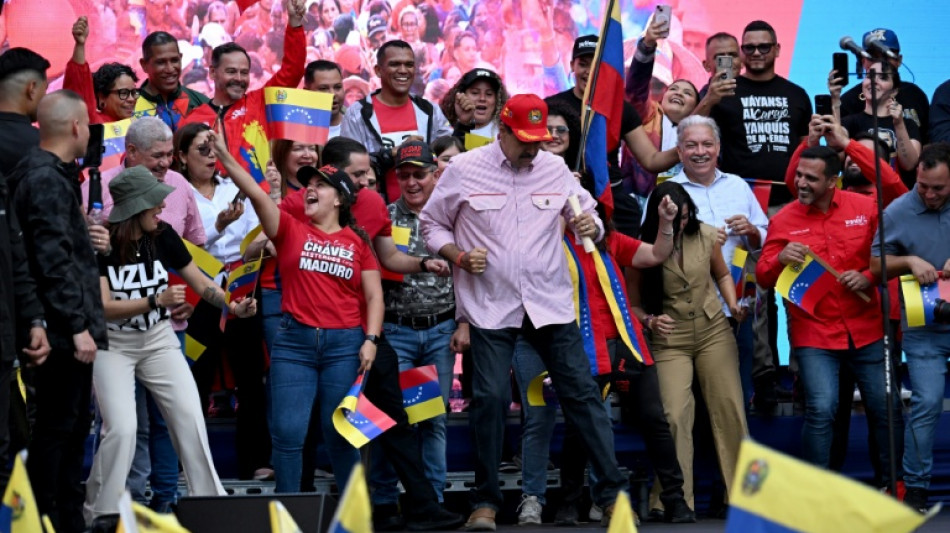
Trump holds Venezuela meeting as Maduro rejects 'slave's peace' / Photo: Juan BARRETO - AFP
US President Donald Trump summoned his top national security officials to the Oval Office on Monday to discuss Venezuela, as his counterpart Nicolas Maduro rejected a "slave's peace" amid mounting fears of American military action.
The meeting comes as Trump ramps up pressure with a major naval build-up in the Caribbean, bombings of suspected drug-ferrying boats, and ominous warnings to avoid Venezuelan airspace.
"I will confirm that the president will be meeting with his national security team on this subject and on many matters," White House Press Secretary Karoline Leavitt told a briefing when asked by AFP about reports of the meeting.
Leavitt would not say whether Trump would reach a final decision after months of tensions with Caracas, saying she was "definitely not going to detail the specifics of the meeting."
But she declined to rule out the possibility of US troops on the ground on Venezuela.
"There's options at the president's disposal that are on the table, and I'll let him speak on those," Leavitt said.
- 'Peace of colonies' -
Maduro, who accuses Washington of seeking to topple him, told thousands of supporters at a rally in Caracas that Venezuela does not want a "slave's peace."
"We want peace, but peace with sovereignty, equality, freedom!" said Maduro, who danced on stage with flag-waving supporters during the event. "We do not want a slave's peace, nor the peace of colonies."
The United States has moved the world's largest aircraft carrier and other warships into the region, and designated an alleged drug cartel run by Maduro as a terrorist group as tensions mount with Venezuela.
Washington says the aim of the military deployment launched in September is to curb drug trafficking in the region, but Caracas insists regime change is the ultimate goal.
Trump confirmed Sunday he had recently spoken with Maduro for the first time since returning to office in January, but would not give details.
"I wouldn't say it went well or badly. It was a phone call," Trump told reporters aboard Air Force One.
The New York Times reported that Trump and Maduro had discussed a possible meeting, while The Wall Street Journal said that the conversation also included conditions of amnesty if Maduro were to step down.
Republican Senator Markwayne Mullin said Sunday on CNN's "State of the Union" talk show that the United States has offered Maduro the chance to leave his country for Russia or elsewhere.
- Airstrike controversy -
The United States accuses Maduro, the political heir to Venezuela's late leftist leader Hugo Chavez, of heading the "Cartel of the Suns" and has issued a $50 million reward for his capture.
Venezuela and countries that support it insist no such organization even exists.
The United States also does not recognize Maduro as the legitimate winner of last year's presidential election.
But Trump's administration faces growing controversy over air strikes that have targeted alleged drug-trafficking boats in the Caribbean Sea and the eastern Pacific Ocean, killing at least 83 people.
Trump said Sunday he would "look into" claims the military conducted a "double-tap" strike that killed two survivors clinging to a burning boat in the Caribbean in early September.
The White House defended the move, saying that the admiral who leads US Special Operations Command had ordered the follow-up strike, and that he was acting lawfully.
Admiral Frank Bradley "worked well within his authority and the law directing the engagement to ensure the boat was destroyed and the threat to the United States of America was eliminated," Leavitt said.
Z.Pavlik--TPP