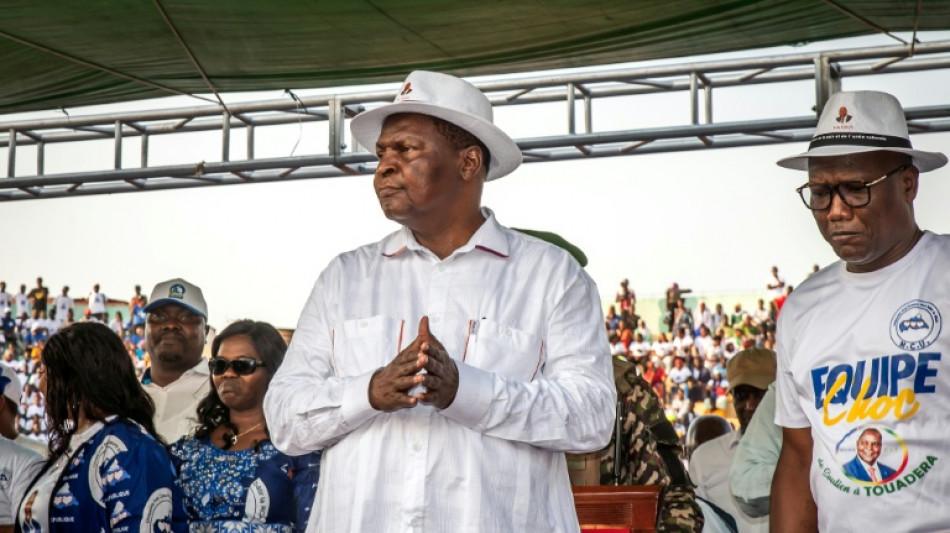
Touadera on path to third presidential term as Central African Republic votes / Photo: Annela NIAMOLO - AFP
The Central African Republic holds elections Sunday, with Faustin-Archange Touadera widely tipped to remain president after a campaign in which he boasted of steadying a nation long plagued by conflict.
Polling stations will open at 0500 GMT and close at 1700 GMT with 2.3 million voters asked to select their president and legislators, as well as municipal and regional representatives.
After changing the constitution to allow him to seek a third term, Touadera is in pole position out of a seven-strong field.
The 68-year-old president concluded his campaign with a rally in a 20,000-seat stadium in Bangui, before a large and enthusiastic crowd.
The campaign unfolded without major incidents, with the exception of the most credible opposition figures, Anicet-Georges Dologuele and former prime minister turned critic Henri-Marie Dondra, being prevented from flying to the provinces to hold rallies.
Security forces were omnipresent in the capital's streets, with a significant deployment of police, army, and Wagner Group mercenaries.
Since Touadera was first elected in 2016 in the middle of a bloody civil war, the CAR has seen unrest ease despite ongoing feuds between armed groups and the government in some regions. The incumbent has warned that those gains are fragile.
Part of the opposition called for a boycott of the poll they consider a sham. Critics accuse Touadera of wanting to cling on to power as president for life in one of the world's poorest countries.
Touadera was last re-elected in 2020, in a vote marred by allegations of fraud and an uprising by six rebel groups attempting to overthrow the government.
The rebels were pushed back thanks to the intervention of the Rwandan army and Russian mercenaries from the Wagner paramilitary group.
The CAR's ballot, along with Guinea's presidential vote on the same day, will cap a packed year of elections across Africa.
- 'Orchestrated' rallies -
According to political scientist and civil society figure Paul Crescent Beninga, "orchestrated" rallies have taken place across the country to plant the idea that Touadera enjoys widespread popular support.
Images of the incumbent have flooded the capital, with neon signs, giant portraits and T-shirts bearing his likeness seen everywhere on the streets.
While Touadera held rallies in Bangui's stadium, his top two critics had to make do with neighbourhood walkabouts and events in schools or their party offices.
Both Dologuele and Dondra also faced the prospect of being barred from standing over allegations they held another country's citizenship.
Touadera's 2023 constitutional change introduced the requirement that candidates be single-nationals.
Although the courts rejected the bans, Dologuele, who previously ran for the top job in 2020, was stripped of his Central African passport in mid-October even after giving up his French citizenship. That prompted him to file a complaint to the UN's human rights office.
"But despite their candidacies being approved, many ... remain sceptical about the point of voting and the transparency of the elections," said Beninga.
Touadera has pointed to his record on improving the security situation, paved roads, public lighting installed on major avenues and renovated rainwater drainage canals in the capital.
But life for many people in the CAR -- 71 percent of whom still live below the poverty line -- remains precarious, with a lack of basic services, an absence of passable roads, widespread unemployment, low levels of training and a steadily rising cost of living.
And despite being pushed back, anti-government fighters are still at large on the country's main highways, as well as in the east near the borders with war-battered Sudan and South Sudan.
H.Vesely--TPP