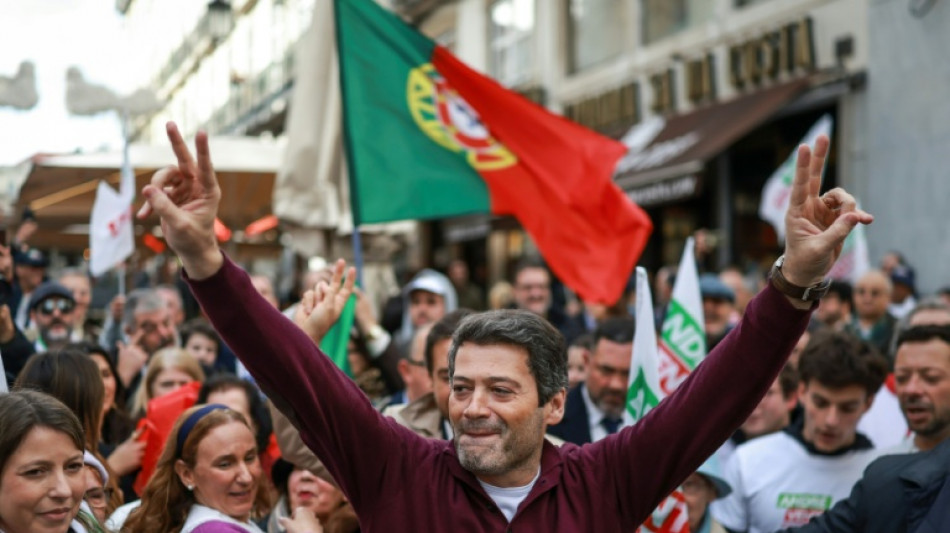
Portugal votes for president with far-right surge expected / Photo: PATRICIA DE MELO MOREIRA - AFP
Portugal was voting Sunday in the first round of a presidential election in which a far-right candidate is expected it get to the run-off for the first time.
Andre Ventura, leader of the far-right Chega (Enough) party, is favourite to win the first round but polls predict he would lose round two regardless of who he is up against.
The role of president is largely ceremonial but in times of crisis the incumbent can dissolve parliament, call elections or dismiss a prime minister.
This election could be the first time in four decades that no candidate wins outright in the first round by securing more than 50 percent of the vote.
Ventura said he felt "very confident" after casting his vote in the sunny capital.
"We cannot spend our time criticising things and then sit on the couch on the day we are called to make a decision," he said.
Only five of 11 candidates are thought to have a realistic chance of making it to the decisive vote on February 8 to succeed conservative incumbent Marcelo Rebelo de Sousa.
One of them, Socialist Antonio Jose Seguro, said he was the only one capable of defeating Ventura's "extremism" and urged "all democrats" to unite behind him.
"I believe in the good sense of the Portuguese," he said after voting in his home city of Caldas da Rainha.
By noon, turnout stood at 21.18 percent, up from the 2021 presidential election, which took place during the Covid-19 pandemic and saw record abstention.
Exit polls will be announced at 8:00 pm (2000 GMT).
- Young 'not happy' -
Voting in Lisbon, Alexandre Leitao, a 50-year-old biologist, said he had voted left wing to stave off the "very negative shift toward the far right".
"We young people are not happy with the country we have," said 33-year-old Irina Ferestreoaru.
She said public approval of Ventura was "a warning sign for the country, because people are desperate to see change".
Experts say Ventura has his sights set on eventually running the country as prime minister.
"Andre Ventura is running to keep his voter base," said Antonio Costa Pinto, a political scientist at Lisbon University.
Chega's party emerged as the biggest opposition party in parliament after a general election last May, overtaking the Socialists.
A stronger far right would add pressure on the minority government of right-winger Luis Montenegro, which relies on Chega for support to implement some of its policies.
"Another solid result for the far right would confirm its domination over the political landscape," consulting firm Teneo said in a note.
EU and eurozone member Portugal accounts for around 1.6 percent of the bloc's economic output.
X.Vanek--TPP