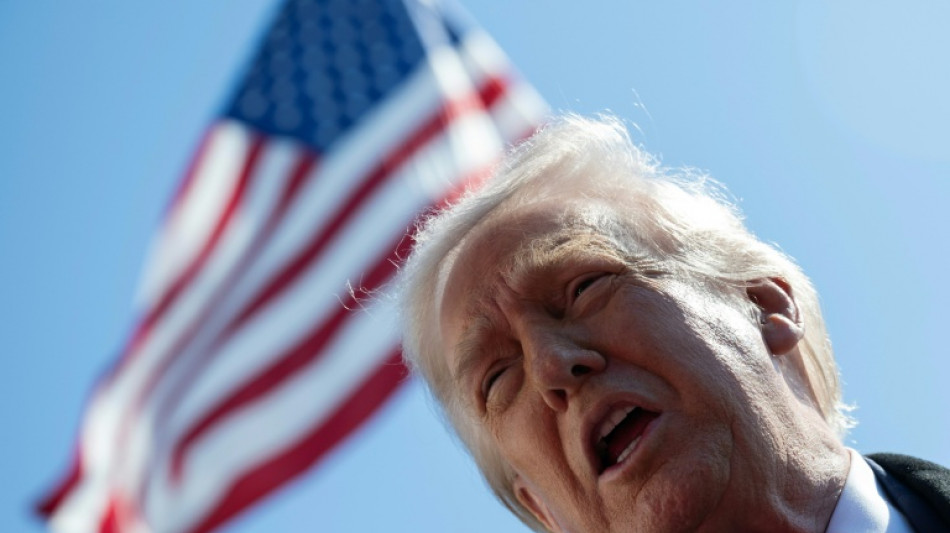
Trump sending second aircraft carrier to pile pressure on Iran / Photo: ANDREW CABALLERO-REYNOLDS - AFP
US President Donald Trump said Friday he was sending a second aircraft carrier group to the Middle East -- warning it would be a "bad day for Iran" if it fails to make a deal on its nuclear program.
Trump has upped the military threat against the Islamic republic in the wake of Tehran's deadly crackdown by security forces on protests last month that rights groups say killed thousands.
"In case we don't make a deal, we'll need it," Trump told journalists at the White House when asked about reports the USS Gerald R. Ford would be moved from the Caribbean to the Middle East.
"It'll be leaving very soon. We have one out there that just arrived. If we need it we'll have it ready, a very big force."
Trump said he believed the talks with Iran would be "successful" but added: "If they're not, it's going to be a bad day for Iran, very bad."
The US leader had already sent one aircraft carrier, the USS Abraham Lincoln, to the Middle East, as part of a fleet of 12 US Navy ships in the region.
The four vessels led by the Ford, the world's largest aircraft carrier, have been in the Caribbean, where US forces captured Venezuelan president Nicolas Maduro in January.
They are not expected to return to their home ports until late April or early May, The New York Times said.
- 'Terribly difficult' -
While the protests have subsided for now, US-based Reza Pahlavi, the son of the shah ousted by the 1979 Islamic revolution, urged Iranians to chant slogans against the clerical establishment in the coming days to coincide with demonstrations abroad.
Rather than pointing to the crackdown -- which has seen tens of thousands arrested and hundreds facing possible execution, according to rights groups -- Trump has recently focused his military threats on Iran's nuclear program.
The West fears the program is aimed at making a bomb, which Tehran denies.
The head of the UN nuclear watchdog, Rafael Grossi, said Friday that reaching an accord with Iran on inspections of its processing facilities was possible but "terribly difficult".
Iran and the United States, who have had no diplomatic relations since shortly after the revolution, held talks on the nuclear issue last week in Oman. No dates have been set for new talks yet.
The United States joined Israel's 12-day war against the Islamic republic in June, carrying out strikes on Iranian nuclear facilities.
Israeli Prime Minister Benjamin Netanyahu said after meeting Trump in Washington on Wednesday that the US leader believed he may clinch a "good deal".
But the Israeli prime minister himself expressed skepticism at the quality of any agreement if it didn't also cover Iran's ballistic missiles and support for regional proxies.
- Reformists released -
There is no consensus on what Washington would target in new strikes or whether it would seek to slacken Iranian supreme leader Ayatollah Ali Khamenei's grip on power.
Pahlavi in a post on X urged Iranians inside the country to add their voices to protests planned abroad on Saturday by chanting slogans from their homes and rooftops.
Videos verified by AFP showed people in Iran this week chanting anti-government slogans as the clerical leadership celebrated the anniversary of the Islamic revolution.
According to the US-based Human Rights Activists News Agency, 7,005 people, mostly protesters, were killed in the recent crackdown, although rights groups warn the toll is likely far higher.
More than 53,000 people have also been arrested, it added.
The Norway-based Iran Human Rights (IHR) NGO said "hundreds" of people were facing charges linked to the protests that could see them sentenced to death.
It said one protester Saleh Mohammadi, 18, had already been sentenced to death on charges of killing a policeman, although the Iranian judiciary said no final and "enforceable" verdict had been issued in the case.
Figures working within the Iranian system have also been arrested, with three politicians detained this week from the so-called reformist wing of Iranian politics supportive of President Masoud Pezeshkian.
The three -- Azar Mansouri, Javad Emam and Ebrahim Asgharzadeh -- were released on bail Thursday and Friday, their lawyer Hojjat Kermani told the ISNA news agency.
burs-dk/dw
N.Kratochvil--TPP