Dubai's low-paid workers on edge as Mideast war hits tourism / Photo: Fadel SENNA - AFP
For thousands of workers in Dubai's tourism sector, the Middle East war has brought business to a standstill -- leaving their income suddenly at risk.
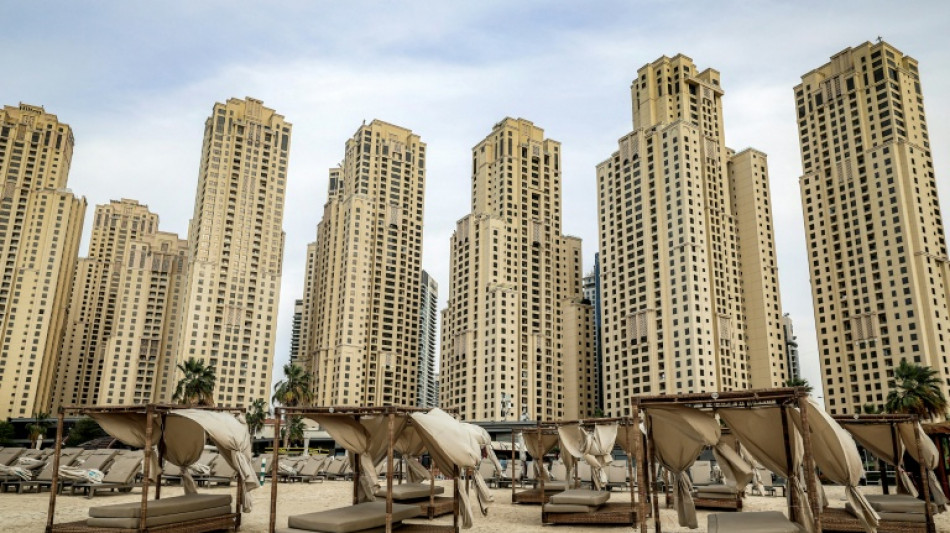
At the famous Jumeirah Beach Residence (JBR), normally heaving with visitors, rows of sun loungers now face an almost empty sea.
Restaurant terraces sit deserted, while souvenir, watersports and perfume vendors watch for the rare passerby.
Across the water, Ain Dubai -- the world's tallest Ferris wheel -- has stopped turning, and the Madame Tussauds wax museum below is drawing few visitors despite hefty discounts.
"Yesterday: zero. Today: zero. Not a single customer," said Dulash, 26, a Sri Lankan worker at a jet-ski rental company.
"I've never seen Dubai like this."
With its artificial islands and soaring skyscrapers, the UAE's second city has become a major Middle Eastern tourism hub, welcoming nearly 19.6 million visitors last year.
But in the middle of peak season, before the summer heat sets in, the barrage of Iranian missiles and drones since February 28 has sent tourists fleeing.
Starved of income, the industry is hoping for a quick end to the war, triggered by US-Israeli strikes on Iran.
But many workers, speaking to AFP on condition of anonymity, said they were already struggling.
Paid 4,500 dirhams ($1,225) a month, Dulash did not receive his salary on time.
"I borrowed 1,000 dirhams from a friend, paid my 800-dirham rent and now I have 200 dirhams left to live on," he said. He had no idea when his employer would catch up.
"Even going back home isn't an option," he added. Airfares had tripled because of reduced flight traffic. "We have no choice but to wait and hope."
- 'That scares me' -
The World Travel and Tourism Council (WTTC) estimated this week that the war is costing the Middle East $600 million a day.
In the UAE, the sector made up nearly 13 percent of GDP in 2025 and supported about 925,000 jobs, mostly expats.
Many workers come from Asian countries or elsewhere in the Middle East, drawn by hopes of safety and economic stability.
"I'm from Syria, I've lived through war so missiles and drones don't scare me," said a young perfume seller.
"But I'm paid only on commission, and the idea of no longer being able to afford to stay here -- that, yes, that scares me."
Kalhan, also from Sri Lanka, earns a small percentage on each sale, topping up a fixed salary of barely 3,000 dirhams -- an amount he will have to survive on this month.
"I came to Dubai for better living conditions, but now I don't know what comes next," he said.
As the Eid al-Fitr holiday approaches, hundreds of Dubai's luxury hotels are slashing rates in a bid to attract at least local residents and their families.
Offers are piling up on the man-made Palm Jumeirah island, where one hotel was hit by drone debris early in the conflict.
Another property was damaged on Thursday in Dubai's Creek Harbour.
Industry professionals also fear lasting damage to the country's image as a haven of peace and security in a volatile region.
Nabil Haryouli, owner of a Dubai-based travel agency, said there would "certainly be an impact for a few months", but he believed visitors would eventually return.
"What matters most is the return of stability," said the Frenchman, recalling the city's resilience after the 2008 financial crisis and the Covid pandemic.
"If there's one city that has shown us it can bounce back, it's Dubai."
D.Dvorak--TPP