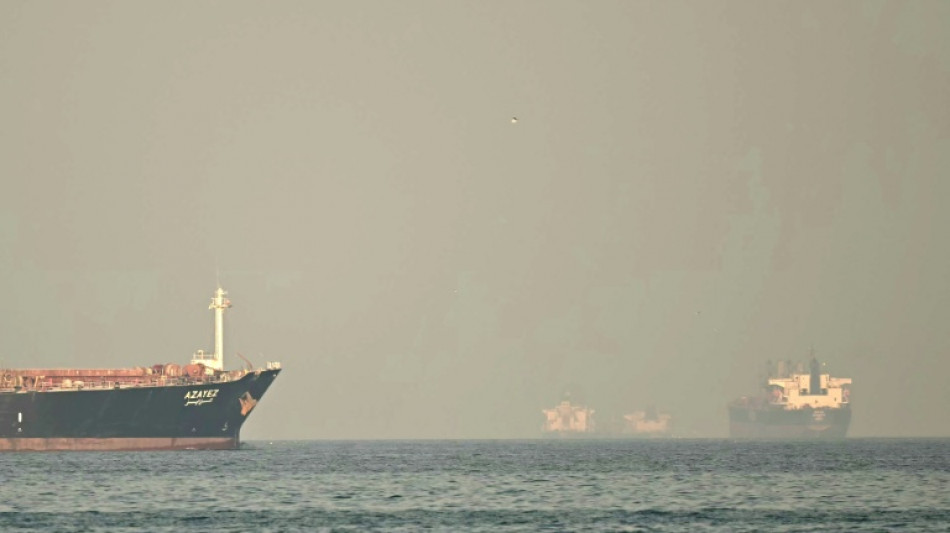
US blockade of Iran ports threatens already crippled oil supply / Photo: Giuseppe CACACE - AFP/File
Washington's decision to blockade Iranian ports in the Strait of Hormuz is sending tremors through global energy markets, raising fears of a fresh oil shock by threatening supplies to Asia.
Iran had continued to pump crude to Asia since the start of the Middle East war, partly shielded by its elusive "dark fleet".
Roughly one-fifth of the world's oil normally flows through the vital waterway. In recent weeks, Iran has already tightened the screws, sharply slowing maritime traffic and reportedly charging transit fees.
Now the additional blockade of Iranian ports ordered Sunday by US President Donald Trump threatens to land another blow to global oil and gas supplies after the fighting damaged energy facilities in the Gulf states and blocked their exports through the Strait, said Amir Handjani of the US‑based Quincy Institute for Responsible Statecraft.
Just days after launching the war against Iran with Israel on February 28, the US temporarily eased some sanctions on Tehran to prevent an abrupt energy shock -- particularly for Asian economies.
On Sunday, the Felicity -- a tanker operated by the National Iranian Tanker Company (NITC)-- delivered two million barrels of oil to India, the first such above-board shipment since 2019, according to tracking site Tanker Tracker.
- Oil still flowing -
Iranian crude had been helping ease the market in meeting demand so far, Handjani told AFP, warning the blockade now threatens that fragile balance.
"What is the US Navy going to do? They're not going to confront Chinese, Indian and Pakistani merchant ships" loading in Iranian ports, he said.
"That's an act of war."
China remains the world's largest importer of Iranian crude, and on Tuesday said the US blockade was "dangerous and irresponsible."
Oil prices, already climbing, will continue to surge, Handjani predicted.
Prices jumped eight percent to above $100 a barrel Monday in early Asian trading -- just hours after the blockade was announced.
For expert Elisabeth Braw of the Atlantic Council, "it's a bit of a Hail Mary move" by Washington after it had "exhausted all options".
Blockading merchant ships violates the UN Convention on the Law of the Sea and is illegal, she noted.
According to data from commodities tracking firm Kpler analysed by AFP, Iran has exported an average of about 1.8 million barrels of crude per day by sea since early March. That is slightly above its 2025 average of around 1.7 million per day.
Between March 1 and April 12, 58 oil tankers transited through the strait carrying cargo, AFP analysis of Kpler data showed.
Nearly 80 percent set off from Iranian ports -- mainly Kharg Island -- or flew the Iranian flag, hauling a total of 11 million tonnes of crude.
Many of those vessels belong to Iran's "dark fleet", made up of ageing ships operating for years in deep opacity -- with unclear ownership, false flags, lack of insurance or manipulated GPS data, all with the intent to dodge international sanctions, experts told AFP.
- Dark fleet advantage -
"It's actually surprising how effectively the dark fleet operated throughout the duration of the war," said David Tannenbaum, director at US‑based sanctions consultancy Blackstone Compliance Services.
"We thought that there would actually be a crackdown on the dark fleet but in reality, what happened was the (Trump) administration basically gave the dark fleet a shot in the arm and allowed them to export all this oil."
As sanctions eased, Iranian crude flipped "from trading at a 40-percent discount to a 10-percent premium," compared with previous pricing, Tannenbaum estimated.
"Because Saudi Arabia, the UAE, and other Gulf producers are seeing exports constrained or rerouted at great cost, Iran has managed to sustain flows at strikingly resilient levels," said Cyril Widdershoven, an analyst at Blue Water Strategy.
"Tehran has managed to set up a system that is sophisticated, decentralised, and remarkably difficult to disrupt without escalating into a full-scale maritime conflict," he added in a Saturday op-ed.
Handjani said Iran is ready to withstand the blockade.
Retaining control of Hormuz is "existential, it's life or death," both as a long-term security guarantee and a crucial source of funding for post‑war reconstruction, he added.
On the US side, Handjani said Trump will be watching how markets react.
If "the price of oil is going up, inflation is going up and the stock market's going down, he's going to start to panic," he said.
V.Nemec--TPP