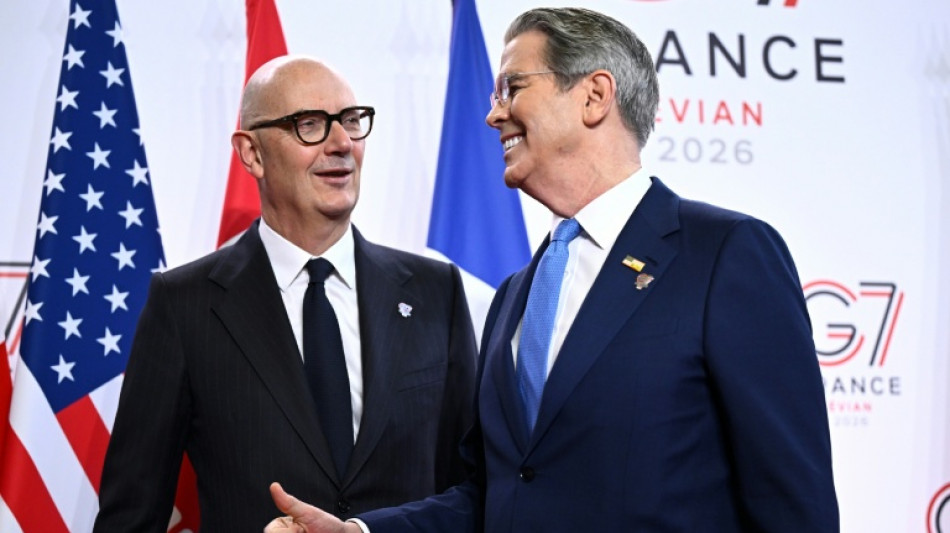
G7 finance chiefs meet to seek common stance on unstable ground / Photo: JULIEN DE ROSA - AFP
Finance chiefs from the G7 industrialised nations gathered in Paris on Monday for two days of talks aimed at forging a united front as the Middle East war roils economic prospects worldwide.
France, which currently chairs the rotating presidency of the Group of Seven, faces the tricky task of keeping dialogue open as trade feuds spurred by US President Donald Trump's tariff blitz compound geopolitical tensions.
Reducing reliance on China's vast holdings of rare earths -- crucial for the AI boom that has underpinned economic growth in recent years -- is also at the top of the agenda.
"We are facing significant challenges -- war in the Middle East, obviously, multilateral imbalances that are not sustainable, and the stakes regarding rare earths, critical materials and development aid," French Finance Minister Roland Lescure told journalists Monday.
He noted in particular the surging US budget deficit, a lack of technological innovation in Europe, and China's efforts to counter slumping consumer spending and industrial over-capacity that has pushed its companies to elbow into overseas markets.
"I believe that today, we are going to show that multilateralism is useful, and it works," Lescure said. "We have... to commit ourselves to figure out a return to a more sustainable growth model."
But the meeting, which also aims to lay the groundwork for the G7 summit meeting in Evian, France, next month, comes after US President Donald Trump met with China's President Xi Jinping, without appearing to secure any breakthrough on either the war against Iran or trade and geopolitical tensions.
Trump's combative, transactional approach to dealing with allies and rivals alike is also unnerving G7 leaders as they grapple with the threat of both stagnant growth and surging inflation.
"We can do a lot to... calm the markets and give positive, let me say, momentum in a way that we have these discussions here," said German central bank chief Joachim Nagel, who was attending alongside European Central Bank president Christine Lagarde.
"I'm always worried -- that's my job!" Lagarde told journalists as she arrived.
- 'Economic security' -
Even a shared recognition of the challenges would be considered a victory for the French government, which is hoping to issue two joint statements after the discussions.
Finance ministers from Kenya, Brazil, India and South Korea have also been invited for talks on Tuesday, when a closing press conference is set for midday.
The talks come days after Trump's trip to Beijing for talks with President Xi Jinping failed to provide a clear breakthrough on easing tariffs or ending the war in the Middle East.
China has been making inroads in much of the G7 nations' backyards, and is increasingly willing to play hardball on trade as a key supplier of both raw materials and inexpensive finished goods.
"Up to now, the problem of macroeconomic imbalances was addressed... with regards to global financial stability," said Pierre Jaillet, a researcher at France's Institute for International and Strategic Affairs (IRIS).
But now officials are looking "through the optic of economic security: trade surpluses or deficits can reflect vulnerabilities or dependencies, in particular with critical minerals or energy", and the risk of supply chain disruptions, Jaillet told AFP.
The G7 goal is to "ensure that we don't depend on any one country -- China, without naming names -- for our rare earth supplies", Lescure told journalists last week.
And oil and gas security has become even more crucial with the Middle East war.
"We must do for critical materials what we did with energy in the 1970s," Lescure said, and find common cause for dealing with any crisis.
- 'Common toolbox' -
France is hoping to create a "common toolbox" to combat market disruptions to key raw materials, Lescure said, via strategic trade deals or interventionist measures such as price floors, quotas or tariffs.
It also wants to promote "multilateral projects" among countries to develop their own extraction and refining capabilities, such as a French-Japanese factory to produce and recycle rare earths and magnets and other minerals under construction in southwest France.
The French state has invested 106 million euros ($124 million) in the project, which aims to provide all of France's needs by 2030.
Using financial aid to strike deals in developing countries that encourage private investments is also a way forward, Lescure said.
O.Ruzicka--TPP