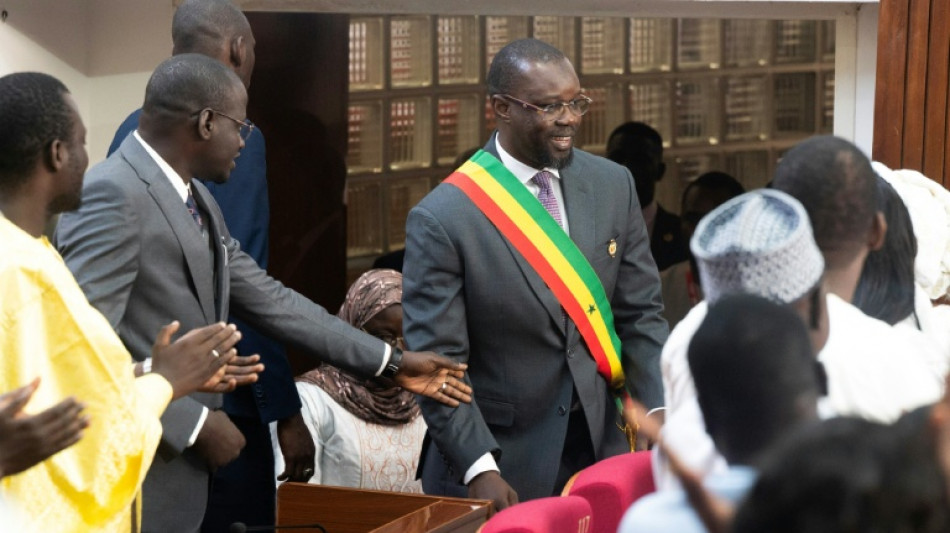
Senegal parliament elects ousted PM as speaker in challenge to president / Photo: SEYLLOU - AFP
Senegal's National Assembly elected ousted prime minister Ousmane Sonko as its speaker Tuesday, in a move which could challenge the president's ability to govern as he navigates a massive debt crisis.
President Bassirou Diomaye Faye dramatically fired Sonko, his former mentor, and dismissed the cabinet four days ago after months of tension and growing disagreement including over the troubled economy.
But on Tuesday, lawmakers rebuffed the president by overwhelmingly backing Sonko -- the sole candidate -- for the powerful position of speaker.
The high-profile political divorce between the former allies, who are both from the same party, risks pitting Faye against the charismatic Sonko and his supporters in parliament.
Sonko remains the undisputed leader of Pastef, the party he founded in 2014 and which controls 130 of the 165 seats in Senegal's only legislative body.
He received a long ovation after securing 132 votes, with no member voting against him and one abstaining, according to the session's presiding member Ismael Diallo.
After being installed in his new position, Sonko promised to "not use this responsibility to orchestrate institutional chaos, to create an institutional crisis, or to cause problems for the president of the republic".
"No member of parliament with me will use this institution for a personal vendetta", Sonko said, speaking in Wolof.
But, he added, the National Assembly will not be "a rubber stamp body".
Emphasising that parliament was a source of checks and balances, he said that "we will vote for laws that are in the public interest and reject those that are not".
Sonko has replaced El Malick Ndiaye, a loyal supporter who resigned Sunday, paving the way for the ex-prime minister's appointment.
- 'Institutional coup' -
The opposition, which says Sonko's reinstatement to parliament is illegal, boycotted the vote by walking out of the chamber.
"The parliamentary majority has installed someone, Ousmane Sonko, who has already lost his parliamentary seat and cannot regain it. We will not be associated with this charade," opposition MP Abdou Mbow told reporters.
Aissata Tall Sall, who heads the main opposition, denounced an "institutional coup" which she said Monday had been prepared under "pressure that the majority wants to impose".
Faye appointed Sonko as prime minister in April 2024 just days after being elected president.
Sonko would almost certainly have won the top job if he had not been barred from the presidential election due to a defamation conviction.
With his pan-Africanist rhetoric, Sonko had gained a following among young Senegalese after a major power struggle with former president Macky Sall, who ruled from 2012 to 2024.
Tensions began to surface in July when the outspoken Sonko accused Faye of a "failure of leadership" by not backing him up enough against his many critics.
Earlier this month, the president took a shot at Sonko, saying the party needed to be "depersonalised" from any leaders embodying it.
- Economist as new PM -
On Monday, Faye named senior economist Ahmadou Al Aminou Mohamed Lo as prime minister, saying the new appointee had the expertise to steer Senegal out of its crippling debt.
The appointment of Lo, who has worked at the Central Bank of West African States, will seek to reassure donors and investors nervous about the country's financial situation.
Sonko said he disagreed with Lo on topics such as the "CFA franc and management of debt", which stands at 132 percent of GDP.
How to deal with the tattered economy had also been one of Sonko's major sources of contention with Faye, alongside justice matters.
While Faye is open to discussions with the International Monetary Fund on a new loan programme, Sonko had advocated a more sovereigntist approach.
In his speech Tuesday, Sonko said that "in all democracies, the executive branch cannot appoint a government without consulting the majority".
"It is the majority in the National Assembly that must govern", he said.
V.Sedlak--TPP