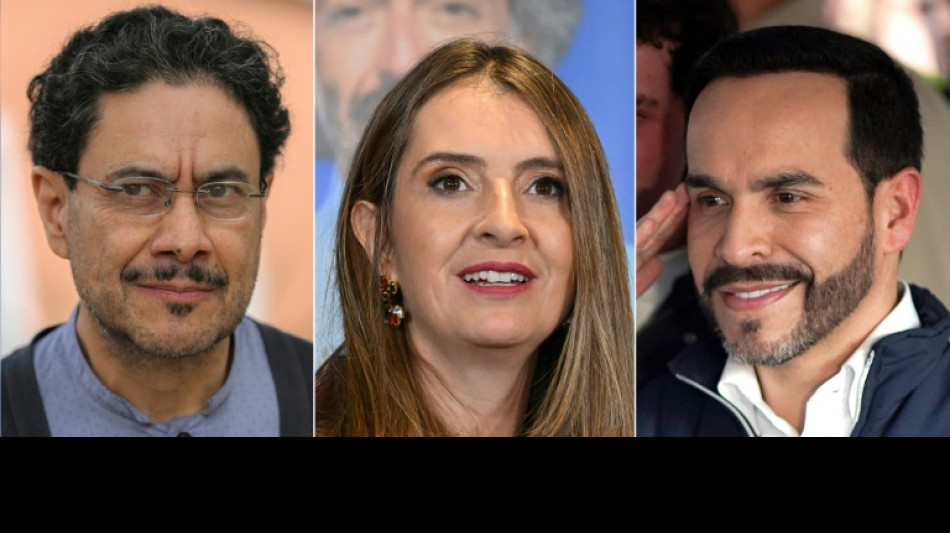
War or peace? Colombians choose destiny in high-stakes vote / Photo: Raul ARBOLEDA, Sergio Yate, Luis ACOSTA - AFP
Colombians vote Sunday in a presidential election that will determine the conflict-ridden nation's response to spiraling violence, either staying left and opting for dialogue or tacking right towards all-out war.
The constitution forbids a second term for the country's first-ever leftist President Gustavo Petro, whose "total peace" strategy has failed to negotiate an end to conflict with armed groups.
Despite his absence from the ballot, "the campaign revolves around Petro," said Yann Basset, political science professor at Bogota's University of Rosario. "He's at the center of all the discussions."
Car bombs, explosive drones and the assassination of a presidential candidate have pockmarked the polarizing leader's term, and experts say guerrillas have used talks to fortify their positions.
Whoever replaces Petro will have to reckon with a myriad of criminal groups engaging in drug trafficking and illegal mining.
But joblessness has fallen and wages have risen, and polls show Petro's protege, Senator Ivan Cepeda, as the front-runner.
The son of a slain communist leader, Cepeda was an architect of historic 2016 peace accords that saw the rebel army FARC lay down arms.
He has pledged to continue pursuing "total peace" and extend social programs in a deeply unequal society.
Eighteen-year-old Lizeth Saens said she was voting for Cepeda.
"The Petro administration has made quite a few changes because it has really helped the community," she said. "While the changes haven't been huge, they've definitely been noticeable."
- Right-wing rivals -
Dialogue with guerrillas, however, is not to the taste of Cepeda's right-wing rivals, who are betting on security fears to shunt the left out of office.
Polls suggest a June 21 run-off between Cepeda and millionaire lawyer Abelardo De la Espriella, as no candidate is projected to have enough support to win the first ballot outright.
De la Espriella, self-styled "Tiger" and admirer of US President Donald Trump, wants to bring the country back to all-out clashes with guerrillas.
"What De la Espriella wants is to put the house in order," said Wilmer Bolivar, a 47-year-old ex-soldier.
Conservative Senator Paloma Valencia, a close ally of kingmaker and former president Alvaro Uribe, favors the same militarized approach.
"We are going to put an end to 'total peace' in order to impose total security," she declared in a speech in March.
- Spooked voters -
Despite heightened fears of bloodshed, election day itself is expected to remain calm.
"Even criminal organizations unilaterally declare a ceasefire before the elections so that they can proceed peacefully," said Judge Alvaro Echeverry of the National Electoral Council.
Voting stations are open from 8 am to 4 pm (1300 GMT to 2100 GMT), and results are expected by around 6 pm.
Echeverry added that 1,207 electoral observers are working across the country.
The government has deployed 408,000 law enforcement officers to ensure security.
Colombia remains the world's largest cocaine producer, and the drug trade has much to answer for the highest levels of violence in a decade.
Last year's killing of right-wing candidate Miguel Uribe, blamed on a leftist guerrilla group, has left many Colombians nervous about a return to the bad old days.
In late April, a bomb on a highway in the southwestern Cauca region killed 21 people, making it the deadliest attack against civilians in recent decades. The group responsible later claimed a "tactical error."
The next president needs to provide "some peace of mind, some peace, because the way things are, we're very anxious. There's a lot, a lot of conflict," said Maria Eugenia Motato, a 57-year-old housewife in Suarez, Cauca.
V.Sedlak--TPP