US health deals cause trouble for Kenya govt / Photo: Luis TATO - AFP/File
Washington's transactional approach to aid has sparked anger in Kenya, with pushback over deals for an Ebola quarantine centre and access to personal health data.
The Kenyan government embraced the Trump administration's new approach to health assistance after it shuttered development agency USAID last year in favour of bilateral deals -- often with strings attached.
Kenya was the first country to sign up to one of the new health deals in December and has gone out of its way to cater to US demands.
When Washington wanted to build an Ebola facility for its citizens on Kenyan territory, President William Ruto said it would be "inhumane" to turn down the request.
But the Kenyan people and courts have been less obliging.
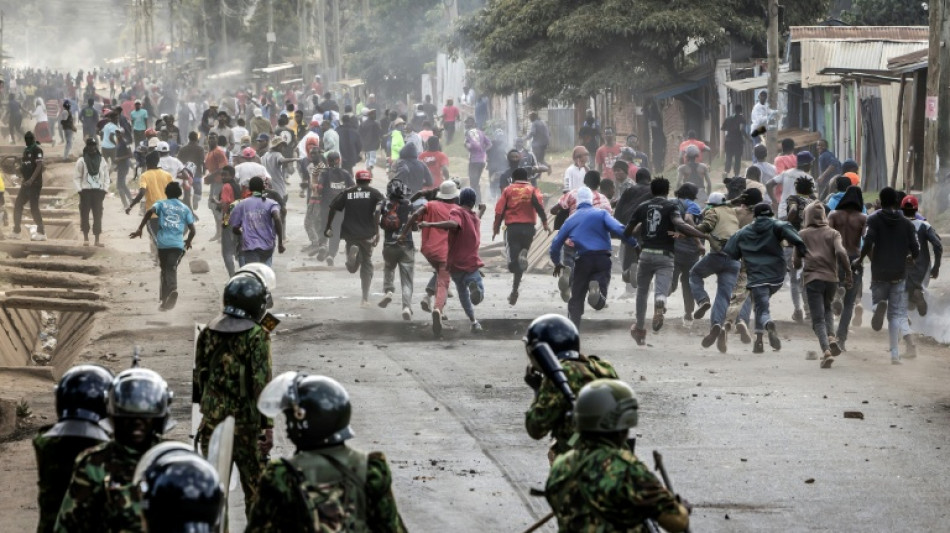
Three people were killed in mass protests against the Ebola facility on an air base in northern Kenya.
Health minister Aden Duale was held in contempt of court this week after failing to follow a ruling that halted its preparations and had to beg for a pardon.
"I sincerely regret any action, omission, misunderstanding or misinterpretation that may have resulted in a non-compliance with the order," a humbled Duale told the court.
"They are paying for arrogance," said political analyst Barrack Muluka told AFP.
- 'Violation' -
Similarly, the health deal signed last year which involves US funding for general healthcare in the east African country was halted by a Kenyan court, particularly over concerns about data-sharing.
It was ultimately cleared by an appeals court in May and will see the United States provide $1.6 billion over five years so long as Kenya progressively takes on more of the burden.
But it remains highly controversial, not least because Kenya must hand over personal health data of its citizens, which could be used by US pharmaceutical labs to prepare for future epidemics.
After the experience of the Covid-19 pandemic, when Africa was last in line for vaccines, that has not gone down well in some countries, notably Ghana and Zimbabwe, who have already rejected similar health deals from Washington this year.
The US administration also pledged $13.5 million to support Kenya's Ebola preparedness.
But the idea of then building an Ebola facility just for US citizens on Kenyan territory sparked fear, as well as anger at the colonial undertones.
Both agreements bypassed the necessary parliamentary approvals, said Charles Kanjama, president of the Law Society of Kenya, which was part of lawsuits against both deals.
"Kenyans were rightly concerned about whether this agreement was basically a blank cheque to American companies... to freely experiment or engage in Kenya without the normal public health guardrails," he told AFP.
Senator Okoiti Andrew Omtatah, another plaintiff interviewed by AFP, called the health deal a "violation" of Kenya's constitution, which has "very superior" data-protections to those of the US.
"I've got no problem with neo-colonialism, as long as the neo-colonialism obeys the laws of Kenya," he said, ironically.
"The government of Kenya cannot own my health data -- that's my private property. The government cannot purport to trade in my private property," he added.
A.Novak--TPP