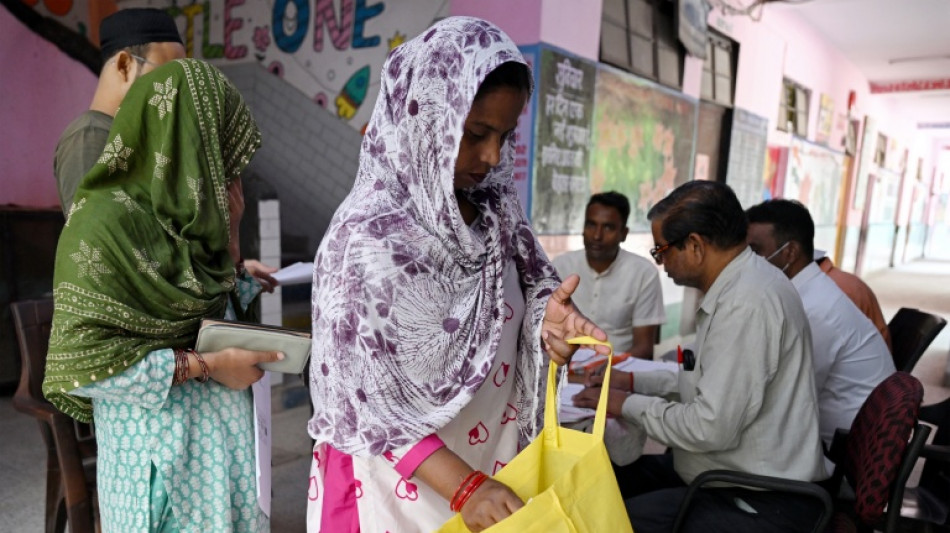
Fear as Indians struggle to prove voting rights / Photo: Arun SANKAR - AFP
Laddli Khatun pulled one document after another from a yellow bag, desperately hoping one would be enough to keep her name on India's electoral rolls.
As the world's largest democracy overhauls its voter lists, millions like Khatun are scrambling to re-establish their credentials, despite having voted before.
Critics and opposition parties say the exercise risks mass disenfranchisement, and those removed fear wider citizenship repercussions.
More than 133 million names -- including 28 million listed as dead -- have been cut from rolls, according to figures reported by Indian media and cited by opposition parties in court filings.
Protests have rocked New Delhi, with demonstrators demanding the chief election commissioner's resignation, alleging the overhaul is designed to benefit Prime Minister Narendra Modi's Bharatiya Janata Party (BJP).
The Election Commission of India (ECI), a constitutional body, denies wrongdoing and says the revision complies with the law.
- 'Burden of proof' -
The Special Intensive Revision (SIR) requires voters to link themselves -- directly or through their parents or grandparents -- to electoral rolls from 2002-03, the last time such a rigorous review took place.
Khatun, 39, was not of voting age at the time. So she must now prove that at least one of her parents or grandparents featured on those rolls.
"My parents died when I was a baby," Khatun, who lives in a Delhi slum, told AFP at a hearing reviewing voter credentials.
"They were poor unlettered people who left no documents behind."
Many face Khatun's predicament.
"Women, minorities, people living at the margins and the poorest are the worst hit by this exercise, because they find it very difficult to produce documents which can prove their citizenship," said transparency activist Anjali Bhardwaj.
The Election Commission previously sought to enrol eligible voters through door-to-door visits, guided by its motto: "No voter to be left behind".
Critics say the exercise shifts the "burden of proof" onto voters.
"The methodology followed has been of physical door-to-door verification," former election commissioner Ashok Lavasa told AFP.
"It was never that you asked people wholesale to establish their eligibility all over again... after they have been admitted to the rolls through the prescribed due process."
- 'Untraceable'-
Surajmukhi, made homeless when an eviction drive demolished the slum where she had lived for 30 years, was removed from Delhi's draft rolls and marked "untraceable".
"I have no document to link myself to the 2002 voter rolls, because at the time I was not enrolled as a voter, and my parents are long dead," she said, standing in the rubble of her home.
"But I have voted multiple times since -- the officials themselves came to our home and enrolled us as voters. What has suddenly changed?"
Officials on the ground acknowledge the difficulties the exercise poses for poorer voters.
"Mapping yourself to the 2002 voter lists is not easy for those who are not educated and technologically savvy," said Mukesh Khanna, a booth-level officer in a Delhi suburb with a large population of working-class migrants.
Special camps have been set up to help voters, but many still struggle to navigate the process.
- 'Suspicious' -
Millions have also been flagged for additional checks after the Election Commission used automated systems to identify what it calls "logical discrepancies", including mismatched names and inconsistent family details.
Independent analyses suggest Muslims have been disproportionately affected.
In Delhi, an analysis by The Hindu newspaper found Muslims accounted for around 20 percent of voters flagged, compared with 13.6 percent of the electorate.
The disparity was even starker in West Bengal, according to the Kolkata-based policy think tank Sabar Institute.
Street cleaner Shahida, 42, received a notice because her mother was only 15 years older than her -- an age gap the software flagged as "suspicious".
"What am I expected to do -- go back in time and ask my dead grandparents why they got my dead mother married so young?" she said.
"The reality is child marriages were common among the poor at the time."
National rugby player and actor Aslam, 24, who uses one name, said his voter registration was flagged as "suspicious" because six other people were linked to his deceased father, according to a notice seen by AFP.
"It is clearly targeted against voters who don't vote for the BJP," said Aslam, a Muslim with six siblings.
"It almost feels like the idea is to create a category of second-class citizens."
Modi's Hindu-nationalist BJP, which strongly backs the revision, has long alleged that undocumented migrants from neighbouring Bangladesh -- particularly Muslims -- have fraudulently entered electoral rolls.
The Supreme Court has said exclusion from electoral rolls does not establish that someone is a foreign national.
However, Indian media have reported cases in West Bengal in which people excluded from voter rolls were accused of being undocumented migrants from Bangladesh, detained and, in some instances, pushed across the border.
For Khatun, the prospect of such an outcome hangs over an already gruelling ordeal.
"I have provided document after document, everything that I have," she said. "But what if they still ask us to leave the country?"
I.Mala--TPP