The Prague Post - Costa Rica's 'urban mine' for planet-friendlier lithium

EUR -
AED 4.343054
AFN 77.464136
ALL 97.314396
AMD 448.283543
ANG 2.116924
AOA 1084.432259
ARS 1694.708788
AUD 1.714639
AWG 2.13043
AZN 2.015092
BAM 1.969853
BBD 2.380986
BDT 144.641832
BGN 1.986001
BHD 0.445363
BIF 3501.922827
BMD 1.182587
BND 1.512403
BOB 8.170984
BRL 6.256361
BSD 1.182133
BTN 108.538796
BWP 16.401265
BYN 3.347345
BYR 23178.695489
BZD 2.378068
CAD 1.622805
CDF 2578.039008
CHF 0.922409
CLF 0.026073
CLP 1029.489324
CNY 8.24689
CNH 8.21806
COP 4303.43229
CRC 585.073884
CUC 1.182587
CUP 31.338542
CVE 111.079508
CZK 24.267271
DJF 210.169739
DKK 7.466899
DOP 74.481346
DZD 153.154875
EGP 55.703589
ERN 17.738798
ETB 184.1847
FJD 2.661179
FKP 0.876646
GBP 0.866681
GEL 3.18162
GGP 0.876646
GHS 12.888617
GIP 0.876646
GMD 86.329235
GNF 10357.032173
GTQ 9.075625
GYD 247.383983
HKD 9.221278
HNL 31.183461
HRK 7.533317
HTG 155.079109
HUF 382.153287
IDR 19840.785951
ILS 3.707232
IMP 0.876646
INR 108.332615
IQD 1548.748685
IRR 49816.456691
ISK 145.777895
JEP 0.876646
JMD 186.126375
JOD 0.838501
JPY 184.134678
KES 152.412203
KGS 103.416722
KHR 4758.95617
KMF 496.686746
KPW 1064.338708
KRW 1710.387141
KWD 0.362349
KYD 0.985426
KZT 595.242259
LAK 25552.69332
LBP 105886.62599
LKR 366.242755
LRD 218.745839
LSL 19.080821
LTL 3.491871
LVL 0.715335
LYD 7.523229
MAD 10.830718
MDL 20.124567
MGA 5349.292392
MKD 62.085779
MMK 2483.184454
MNT 4217.418655
MOP 9.497241
MRU 47.26418
MUR 54.292994
MVR 18.271409
MWK 2050.351871
MXN 20.533018
MYR 4.736855
MZN 75.57955
NAD 19.080821
NGN 1680.526824
NIO 43.500329
NOK 11.555294
NPR 173.661872
NZD 1.987207
OMR 0.45421
PAB 1.182486
PEN 3.965993
PGK 5.057082
PHP 69.733624
PKR 330.77503
PLN 4.208885
PYG 7907.046545
QAR 4.310947
RON 5.101724
RSD 117.525888
RUB 89.207823
RWF 1724.582233
SAR 4.434624
SBD 9.606873
SCR 16.856244
SDG 711.330129
SEK 10.584272
SGD 1.505082
SHP 0.887246
SLE 28.859447
SLL 24798.24684
SOS 674.551964
SRD 45.081425
STD 24477.153012
STN 24.676037
SVC 10.345951
SYP 13078.904017
SZL 19.08015
THB 36.767051
TJS 11.055903
TMT 4.139053
TND 3.441552
TOP 2.847384
TRY 51.289018
TTD 8.030288
TWD 37.116428
TZS 3021.508915
UAH 50.984149
UGX 4178.811402
USD 1.182587
UYU 44.778344
UZS 14348.360383
VES 416.584326
VND 31036.982812
VUV 141.991093
WST 3.267707
XAF 660.805254
XAG 0.011483
XAU 0.000237
XCD 3.196
XCG 2.131053
XDR 0.821141
XOF 660.80244
XPF 119.331742
YER 281.814608
ZAR 19.059842
ZMK 10644.701884
ZMW 23.197393
ZWL 380.792372
  • SCS

    0.0200

    16.14

    +0.12%

  • RBGPF

    -0.8100

    83.23

    -0.97%

  • CMSD

    0.0900

    24.13

    +0.37%

  • BCC

    -1.1800

    84.33

    -1.4%

  • RELX

    0.0600

    39.9

    +0.15%

  • CMSC

    0.1000

    23.75

    +0.42%

  • GSK

    0.5000

    49.15

    +1.02%

  • RIO

    3.1300

    90.43

    +3.46%

  • BCE

    0.4900

    25.2

    +1.94%

  • BTI

    0.9400

    59.16

    +1.59%

  • AZN

    1.2600

    92.95

    +1.36%

  • JRI

    0.0100

    13.68

    +0.07%

  • VOD

    0.2300

    14.17

    +1.62%

  • RYCEF

    0.3000

    17.12

    +1.75%

  • NGG

    1.3200

    81.5

    +1.62%

  • BP

    1.1000

    36.53

    +3.01%

Costa Rica's 'urban mine' for planet-friendlier lithium
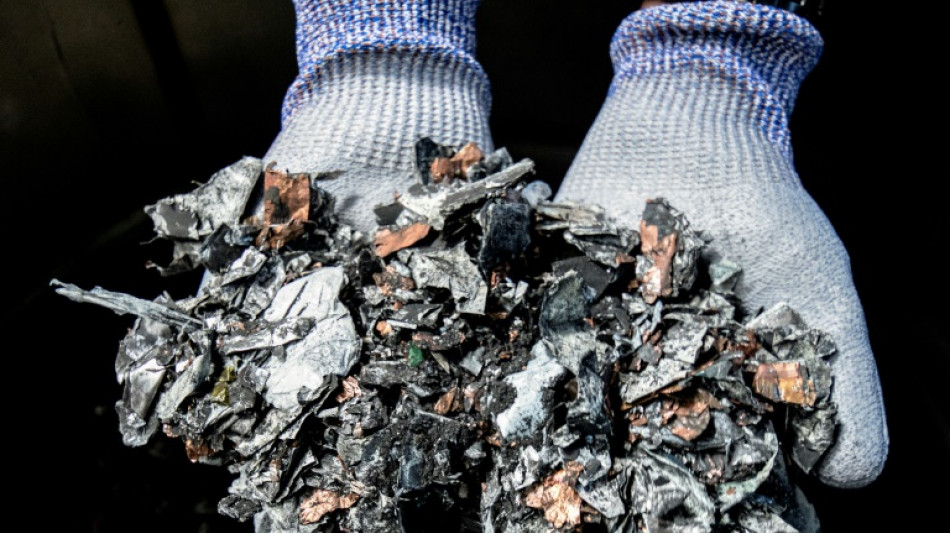
Costa Rica's 'urban mine' for planet-friendlier lithium / Photo: Ezequiel BECERRA - AFP

Costa Rica's 'urban mine' for planet-friendlier lithium

Costa Rica, a country where open pit mining is banned, has become a leader in the extraction of heavy metals such as lithium -- not from the Earth, but old batteries.

Text size:

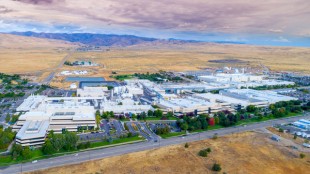
The Fortech recycling factory which opened nearly three decades ago in Cartago about 27 kilometers (17 miles) from the capital San Jose, is referred to by its staff as an "urban mine."

For the last six years, it has focused on extracting lithium contained in rechargeable batteries used in everything from mobile phones and laptops to electric cars and solar panels.

Millions of batteries are discarded every year.

While the battery casings take about 100 years to decompose, the often toxic heavy metals inside never do.

For Fortech, this presents a proverbial gold mine, and for our planet, perhaps a lifeboat.

"We now know that waste does not exist. We know it is a resource that can be used again," Fortech managing director Guillermo Pereira told AFP.

"It’s important to break paradigms," added the 54-year-old, who with his son Francisco, 25, created a new method for extracting metals from used batteries.

"The world needs a circular economy" that recycles precious primary materials rather than sourcing new ones, said Pereira.

- 'White gold' -

Unlike lithium mined elsewhere in conditions often harmful to the environment, workers and local populations, Fortech's metals are taken from 1,500 tons of used batteries discarded every year in Costa Rica alone, according to his son, the company's project manager.

They are collected in malls, electronics stores or electric vehicle sales points.

Lithium, dubbed "white gold" or the "oil of the 21st century," has seen its price explode on the global market from $5,700 per ton in November 2020 to 60,500 dollars in September 2022 due to electric cars replacing their polluting, gas-guzzling forerunners.

But lithium production plants consume millions of liters of water and can be harmful to the environment.

Obtaining lithium from recycling batteries expels only a quarter of the planet-warming CO2 that comes with mining it, according to Fortech chemist Henry Prado.

Recycling also saves the planet of the environment pollution caused by the "usual disposal method" of lithium batteries, which is often simply to dump them, he added.

According to the American Chemical Society, as little as five percent of the world’s lithium-ion batteries are thought to be recycled.

- 'Pioneer' -

At Fortech, collected spent batteries are placed on a conveyor belt that feeds them into a crusher.

The waste extracted in this way is then transformed into a mix of cobalt, nickel, manganese and lithium known as "black mass."

These metals comprise about 57 percent of each battery -- the rest is copper, aluminum, plastic and iron, all of which can also be recycled.

Fortech does not have the technology to further separate the individual metals in the "black mass," which it sells instead to factories in Europe to complete the process and manufacture new batteries.

According to the German development agency GIZ, Fortech has turned Costa Rica into "a pioneer in Latin America in the valorization of used lithium batteries."

C.Novotny--TPP