The Prague Post - US lab repeats nuclear fusion feat, with higher yield

EUR -
AED 4.30156
AFN 72.620152
ALL 95.459622
AMD 435.00857
ANG 2.096473
AOA 1075.243359
ARS 1659.152929
AUD 1.631686
AWG 2.111249
AZN 1.99376
BAM 1.954923
BBD 2.36478
BDT 144.445202
BGN 1.95383
BHD 0.441962
BIF 3489.494207
BMD 1.17129
BND 1.494855
BOB 8.11343
BRL 5.858551
BSD 1.174103
BTN 110.530832
BWP 15.808246
BYN 3.297377
BYR 22957.275435
BZD 2.36382
CAD 1.597241
CDF 2723.248494
CHF 0.921342
CLF 0.026634
CLP 1048.257636
CNY 7.991884
CNH 7.999984
COP 4244.284861
CRC 533.462967
CUC 1.17129
CUP 31.039173
CVE 110.216498
CZK 24.356673
DJF 209.081562
DKK 7.472246
DOP 69.798986
DZD 155.201711
EGP 61.554792
ERN 17.569343
ETB 183.32909
FJD 2.572679
FKP 0.867771
GBP 0.8658
GEL 3.144929
GGP 0.867771
GHS 13.026268
GIP 0.867771
GMD 85.50412
GNF 10304.465423
GTQ 8.976088
GYD 245.641903
HKD 9.176755
HNL 31.203535
HRK 7.536663
HTG 153.723665
HUF 364.426245
IDR 20192.212164
ILS 3.485113
IMP 0.867771
INR 110.437789
IQD 1538.116571
IRR 1540245.775128
ISK 143.400985
JEP 0.867771
JMD 185.350808
JOD 0.830412
JPY 186.489796
KES 151.635293
KGS 102.406664
KHR 4698.932191
KMF 491.941283
KPW 1054.160601
KRW 1725.912762
KWD 0.360511
KYD 0.978465
KZT 537.910991
LAK 25728.89742
LBP 104620.504751
LKR 373.668754
LRD 215.446111
LSL 19.34985
LTL 3.458514
LVL 0.708501
LYD 7.44785
MAD 10.849426
MDL 20.32423
MGA 4879.915042
MKD 61.653399
MMK 2459.61789
MNT 4189.106255
MOP 9.477889
MRU 46.882169
MUR 54.710957
MVR 18.107697
MWK 2035.930143
MXN 20.367144
MYR 4.625463
MZN 74.849048
NAD 19.349602
NGN 1593.177022
NIO 43.210985
NOK 10.903887
NPR 176.848931
NZD 1.985424
OMR 0.450361
PAB 1.174083
PEN 4.094063
PGK 5.098756
PHP 71.339717
PKR 327.258975
PLN 4.250194
PYG 7396.808116
QAR 4.291911
RON 5.089017
RSD 117.350363
RUB 87.701835
RWF 1720.664841
SAR 4.393186
SBD 9.427221
SCR 16.601702
SDG 703.356794
SEK 10.824123
SGD 1.493248
SHP 0.874486
SLE 28.815665
SLL 24561.352001
SOS 671.013308
SRD 43.765213
STD 24243.329131
STN 24.489223
SVC 10.273435
SYP 129.456757
SZL 19.333822
THB 37.971455
TJS 11.027894
TMT 4.10537
TND 3.415797
TOP 2.820184
TRY 52.748797
TTD 7.972492
TWD 36.964142
TZS 3046.961033
UAH 51.781576
UGX 4368.077786
USD 1.17129
UYU 46.699649
UZS 14175.701336
VES 566.827394
VND 30861.137407
VUV 138.434182
WST 3.195871
XAF 655.67686
XAG 0.0157
XAU 0.000251
XCD 3.165469
XCG 2.11606
XDR 0.815452
XOF 655.679658
XPF 119.331742
YER 279.4792
ZAR 19.394562
ZMK 10543.012219
ZMW 22.215577
ZWL 377.154761
  • RBGPF

    0.0000

    64

    0%

  • AZN

    -2.2400

    187.51

    -1.19%

  • BCE

    -0.3200

    23.56

    -1.36%

  • NGG

    -0.1900

    87.23

    -0.22%

  • RIO

    0.3400

    99.95

    +0.34%

  • RELX

    -0.1400

    36.39

    -0.38%

  • CMSC

    -0.0900

    22.86

    -0.39%

  • BTI

    -0.7700

    57.32

    -1.34%

  • BP

    -0.2800

    45.97

    -0.61%

  • GSK

    -0.2200

    54.22

    -0.41%

  • RYCEF

    0.1000

    15.4

    +0.65%

  • JRI

    -0.0600

    12.83

    -0.47%

  • CMSD

    -0.0600

    23.26

    -0.26%

  • BCC

    -0.2900

    83.86

    -0.35%

  • VOD

    -0.1200

    15.51

    -0.77%

US lab repeats nuclear fusion feat, with higher yield
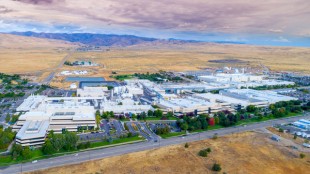
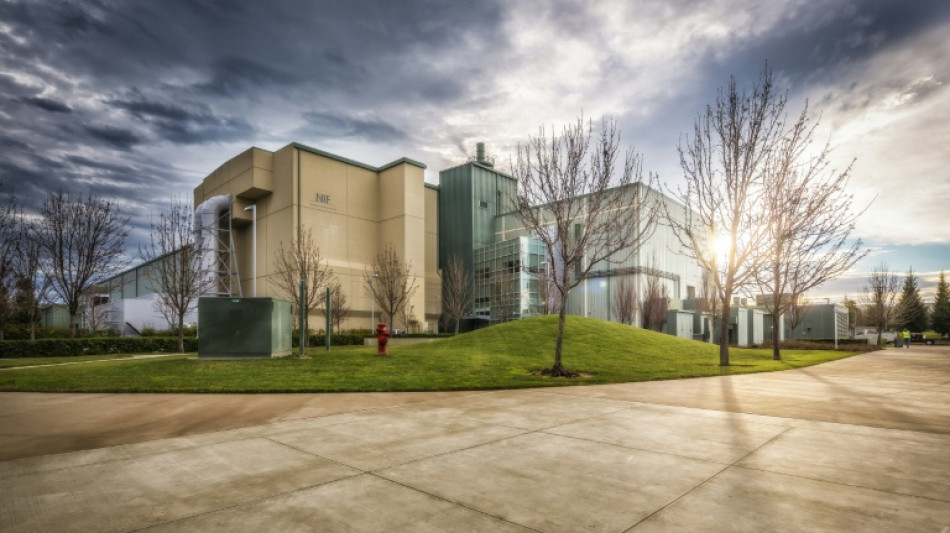
US lab repeats nuclear fusion feat, with higher yield / Photo: Handout - Lawrence Livermore National Laboratory/AFP/File

US lab repeats nuclear fusion feat, with higher yield

US scientists responsible for a historic nuclear fusion breakthrough say they have repeated the feat -- this time achieving a greater yield of energy.

Text size:

The Lawrence Livermore National Laboratory stunned the world in December when it announced it had carried out an experimental nuclear reaction that put out more energy than was put into it, a holy grail of science in the quest for unlimited, clean power to end the era of fossil fuels.

"We can confirm the experiment produced a higher yield than the December 2022 experiment," public information officer Paul Rhien said Monday in an emailed statement, without disclosing specific figures.

He added the California lab planned to report the results at upcoming scientific conferences and in peer-reviewed publications.

The new development was first reported by the Financial Times.

Nuclear fusion has been touted by its supporters as a clean, abundant and safe source of energy that could eventually allow humanity to break its dependence on coal, crude oil, natural gas and other hydrocarbons driving a global climate crisis.

However, there is still a long way to go before fusion is viable on an industrial scale, providing power to homes and businesses.

Nuclear power plants around the world currently use fission -- the splitting of a heavy atom's nucleus -- to produce energy.

Fusion on the other hand combines two light hydrogen atoms to form one heavier helium atom, releasing a large amount of energy in the process.

That is what occurs inside stars, including our Sun.

On Earth, fusion reactions can be provoked by heating hydrogen to extreme temperatures inside specialized devices.

Like fission, fusion is carbon-free during operation, and has additional critical advantages: it poses no risk of nuclear disaster and produces much less radioactive waste.

During December's experiment, the lab used 192 ultra-powerful lasers to deliver 2.05 megajoules of energy to a tiny capsule smaller than a pea containing isotopes of hydrogen. It produced 3.15 megajoules of fusion energy output.

While the result was a net energy gain, 300 megajoules of energy was needed from the electrical grid to power the lasers.

X.Kadlec--TPP