The Prague Post - Black hole observed 'awakening' for the first time

EUR -
AED 4.308126
AFN 74.482581
ALL 95.530224
AMD 434.876386
ANG 2.099301
AOA 1076.694304
ARS 1633.430504
AUD 1.628669
AWG 2.111165
AZN 1.965707
BAM 1.958337
BBD 2.362793
BDT 143.940617
BGN 1.956466
BHD 0.442905
BIF 3489.287302
BMD 1.17287
BND 1.49646
BOB 8.10609
BRL 5.83057
BSD 1.173135
BTN 111.283999
BWP 15.942812
BYN 3.310457
BYR 22988.245756
BZD 2.359378
CAD 1.592399
CDF 2721.057967
CHF 0.916621
CLF 0.026849
CLP 1056.720618
CNY 8.00853
CNH 8.013747
COP 4288.985037
CRC 533.345622
CUC 1.17287
CUP 31.081047
CVE 110.837016
CZK 24.383316
DJF 208.442259
DKK 7.472605
DOP 69.676157
DZD 155.310268
EGP 62.836842
ERN 17.593045
ETB 184.081928
FJD 2.571051
FKP 0.869443
GBP 0.862147
GEL 3.14914
GGP 0.869443
GHS 13.130323
GIP 0.869443
GMD 86.20339
GNF 10294.873151
GTQ 8.962491
GYD 245.425783
HKD 9.186982
HNL 31.221701
HRK 7.53311
HTG 153.674839
HUF 364.350205
IDR 20313.047299
ILS 3.462863
IMP 0.869443
INR 111.140369
IQD 1536.459283
IRR 1542323.631439
ISK 143.813067
JEP 0.869443
JMD 183.818172
JOD 0.831541
JPY 184.336996
KES 151.505454
KGS 102.532852
KHR 4706.13801
KMF 492.605147
KPW 1055.407589
KRW 1728.844869
KWD 0.360412
KYD 0.977638
KZT 543.376594
LAK 25761.90553
LBP 105109.106795
LKR 374.93256
LRD 215.264518
LSL 19.54009
LTL 3.463179
LVL 0.709457
LYD 7.453576
MAD 10.830302
MDL 20.212654
MGA 4879.137814
MKD 61.615302
MMK 2462.653947
MNT 4196.644722
MOP 9.466051
MRU 46.903081
MUR 55.171957
MVR 18.12671
MWK 2042.55632
MXN 20.479888
MYR 4.656723
MZN 74.952213
NAD 19.539534
NGN 1612.112655
NIO 43.068095
NOK 10.867939
NPR 178.045837
NZD 1.986249
OMR 0.450968
PAB 1.173105
PEN 4.114133
PGK 5.090212
PHP 71.923874
PKR 326.919943
PLN 4.256725
PYG 7215.055949
QAR 4.29048
RON 5.200857
RSD 117.377298
RUB 87.922577
RWF 1715.04647
SAR 4.398531
SBD 9.439939
SCR 17.153207
SDG 704.307623
SEK 10.838119
SGD 1.493315
SHP 0.875666
SLE 28.857779
SLL 24594.486288
SOS 670.414381
SRD 43.933321
STD 24276.034391
STN 24.534194
SVC 10.265307
SYP 129.771086
SZL 19.671417
THB 38.141749
TJS 11.003655
TMT 4.110908
TND 3.424137
TOP 2.823989
TRY 52.948383
TTD 7.963065
TWD 37.043902
TZS 3055.325613
UAH 51.546843
UGX 4411.148016
USD 1.17287
UYU 46.785207
UZS 14001.13781
VES 569.531156
VND 30912.153323
VUV 138.99247
WST 3.181044
XAF 656.855688
XAG 0.015748
XAU 0.000253
XCD 3.169739
XCG 2.114274
XDR 0.818332
XOF 656.224101
XPF 119.331742
YER 279.876052
ZAR 19.559772
ZMK 10557.235521
ZMW 21.907974
ZWL 377.663559
  • RBGPF

    0.2800

    63.75

    +0.44%

  • CMSC

    0.0000

    22.82

    0%

  • BCC

    0.2700

    79.27

    +0.34%

  • CMSD

    0.0700

    23.13

    +0.3%

  • BTI

    1.3500

    58.8

    +2.3%

  • BCE

    0.5200

    23.78

    +2.19%

  • NGG

    3.5600

    89.54

    +3.98%

  • RIO

    3.9900

    100.48

    +3.97%

  • GSK

    0.9100

    52.31

    +1.74%

  • RELX

    0.7900

    36.59

    +2.16%

  • BP

    0.5800

    47.38

    +1.22%

  • JRI

    0.2500

    12.99

    +1.92%

  • RYCEF

    0.5800

    15.8

    +3.67%

  • AZN

    2.1700

    187.37

    +1.16%

  • VOD

    0.4600

    15.8

    +2.91%

Black hole observed 'awakening' for the first time
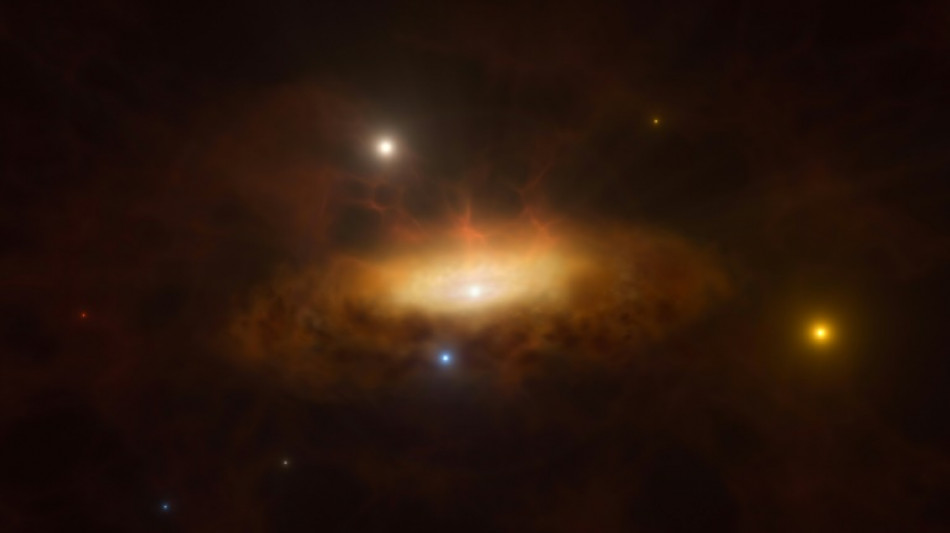
Black hole observed 'awakening' for the first time / Photo: ESO/M. Kornmesser - European Southern Observatory/AFP

Black hole observed 'awakening' for the first time

Astronomers have been able to observe a supermassive black hole waking up and setting the heart of its host galaxy alight for the first time, the European Southern Observatory said on Tuesday.

Text size:

The galaxy 300 million light years from Earth in the Virgo constellation had been quiet for decades until late 2019, when it suddenly began to shine brighter than ever before.

The centre of the galaxy -- where a supermassive black hole is believed to be squatting -- since then has been radiating a variety of rays.

"This behaviour is unprecedented," Paula Sanchez Saez, an European Southern Observatory astronomer and first author of a new study in the journal Astronomy & Astrophysics, said in a statement.

The "most tangible option" to explain this brightening is that the astronomers were watching "the activation of a massive black hole in real time", study co-author Lorena Hernandez Garcia said.

Most galaxies -- including our own Milky Way -- are believed to have a supermassive black hole at their centre.

These cosmic behemoths are by definition invisible -- not even light can escape the pull of their awesome power.

The only way to observe black holes is when they destroy something huge that lets off light in its death throes: such as a star that wandered too close being torn apart.

"These giant monsters usually are sleeping," study co-author Claudio Ricci explained.

But for the galaxy SDSS1335+0728, "we were able to observe the awakening of the massive black hole, (which) suddenly started to feast on gas available in its surroundings, becoming very bright," the astrophysicist added.

Initial observations indicate the black hole has 1.5 million times more mass than the Sun, enough for it to be classified as a supermassive black hole.

But it is still on the lighter side, as the true heavyweights easily exceed a billion times the Sun's mass.

The international team of astronomers is analysing data from a number of telescopes hoping to determine whether the black hole's activity is temporary -- perhaps caused by a star being ripped apart -- or whether it will continue to be active for a long time.

"This is something that could happen also to our own Sgr A*," the Milky Way's supermassive black hole, Hernandez Garcia said.

But fortunately for us, our own black hole remains fast asleep.

U.Ptacek--TPP