The Prague Post - Nobel-winning physicist 'unnerved' by AI technology he helped create

EUR -
AED 4.305195
AFN 72.681647
ALL 95.422252
AMD 435.827436
ANG 2.098242
AOA 1076.151323
ARS 1630.008661
AUD 1.642996
AWG 2.1101
AZN 1.997526
BAM 1.958653
BBD 2.357256
BDT 143.807031
BGN 1.955479
BHD 0.44221
BIF 3481.282142
BMD 1.172278
BND 1.495035
BOB 8.098659
BRL 5.838651
BSD 1.170328
BTN 110.242601
BWP 15.852374
BYN 3.315378
BYR 22976.642144
BZD 2.353856
CAD 1.603618
CDF 2713.823208
CHF 0.92276
CLF 0.026706
CLP 1051.074801
CNY 8.014047
CNH 8.011674
COP 4178.1617
CRC 532.612567
CUC 1.172278
CUP 31.065358
CVE 110.633752
CZK 24.357004
DJF 208.414918
DKK 7.473392
DOP 69.721645
DZD 155.165661
EGP 61.629454
ERN 17.584165
ETB 180.927869
FJD 2.584462
FKP 0.868692
GBP 0.868643
GEL 3.142162
GGP 0.868692
GHS 13.016802
GIP 0.868692
GMD 86.166922
GNF 10273.242401
GTQ 8.959899
GYD 245.201957
HKD 9.185323
HNL 31.099734
HRK 7.537164
HTG 153.223615
HUF 365.188391
IDR 20224.954791
ILS 3.50048
IMP 0.868692
INR 110.48776
IQD 1533.136175
IRR 1543889.679138
ISK 143.780307
JEP 0.868692
JMD 184.694358
JOD 0.831191
JPY 186.820076
KES 151.611121
KGS 102.460824
KHR 4689.111052
KMF 492.357028
KPW 1055.080305
KRW 1731.032534
KWD 0.360781
KYD 0.975323
KZT 543.652828
LAK 25645.605119
LBP 104805.07292
LKR 373.058802
LRD 214.755067
LSL 19.461359
LTL 3.461432
LVL 0.7091
LYD 7.426175
MAD 10.844014
MDL 20.35248
MGA 4863.114747
MKD 61.636454
MMK 2461.622702
MNT 4197.266044
MOP 9.444723
MRU 46.711102
MUR 54.945098
MVR 18.112133
MWK 2029.447886
MXN 20.373721
MYR 4.648126
MZN 74.920708
NAD 19.461359
NGN 1590.781188
NIO 43.071016
NOK 10.922156
NPR 176.388162
NZD 2.000304
OMR 0.450331
PAB 1.171982
PEN 4.087777
PGK 5.08012
PHP 71.151438
PKR 326.265098
PLN 4.243587
PYG 7421.175106
QAR 4.273543
RON 5.088276
RSD 117.422771
RUB 88.13868
RWF 1710.640363
SAR 4.39724
SBD 9.431334
SCR 17.347409
SDG 703.957044
SEK 10.808811
SGD 1.495948
SHP 0.875224
SLE 28.867382
SLL 24582.071905
SOS 668.815781
SRD 43.917629
STD 24263.780751
STN 24.500578
SVC 10.240242
SYP 129.609818
SZL 19.453459
THB 37.905643
TJS 11.00136
TMT 4.108833
TND 3.377376
TOP 2.822563
TRY 52.770123
TTD 7.948188
TWD 36.907408
TZS 3045.871869
UAH 51.571617
UGX 4360.258615
USD 1.172278
UYU 46.426838
UZS 14128.880742
VES 566.403138
VND 30901.239128
VUV 138.129285
WST 3.179532
XAF 655.972478
XAG 0.015467
XAU 0.000249
XCD 3.168139
XCG 2.10925
XDR 0.815819
XOF 655.972478
XPF 119.331742
YER 279.764489
ZAR 19.382861
ZMK 10551.909878
ZMW 22.148523
ZWL 377.472928
  • BCC

    0.3300

    84.15

    +0.39%

  • CMSD

    0.0900

    23.32

    +0.39%

  • NGG

    0.4600

    87.42

    +0.53%

  • RBGPF

    64.0000

    64

    +100%

  • GSK

    -1.1900

    54.44

    -2.19%

  • BCE

    -0.2200

    23.88

    -0.92%

  • CMSC

    0.0400

    22.95

    +0.17%

  • JRI

    0.0100

    12.89

    +0.08%

  • BTI

    0.8100

    58.09

    +1.39%

  • RELX

    0.4000

    36.53

    +1.09%

  • BP

    -0.1000

    46.25

    -0.22%

  • RIO

    0.7600

    99.61

    +0.76%

  • VOD

    0.0100

    15.63

    +0.06%

  • RYCEF

    -0.1200

    15.3

    -0.78%

  • AZN

    -2.5500

    189.75

    -1.34%

Nobel-winning physicist 'unnerved' by AI technology he helped create
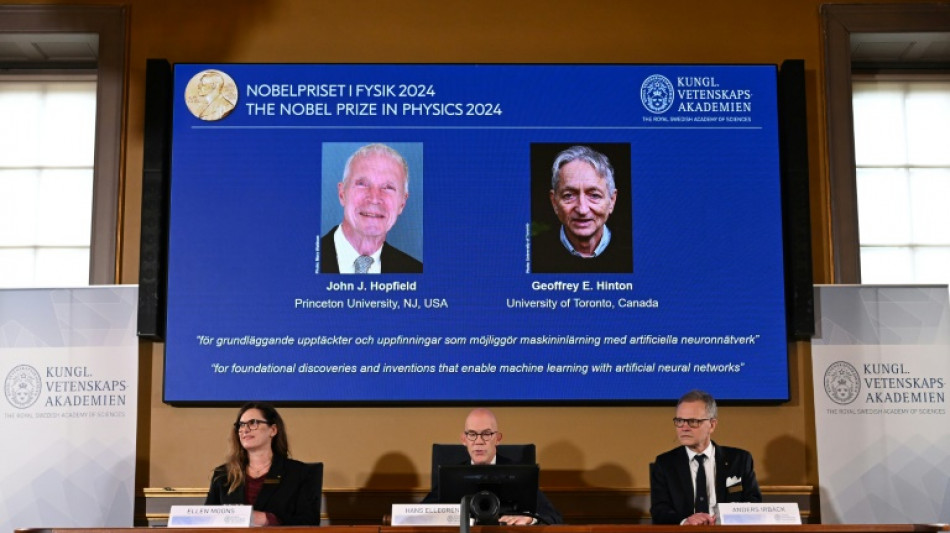
Nobel-winning physicist 'unnerved' by AI technology he helped create / Photo: Jonathan NACKSTRAND - AFP

Nobel-winning physicist 'unnerved' by AI technology he helped create

A US scientist who won the 2024 Nobel physics prize for his pioneering work on artificial intelligence said Tuesday he found recent advances in the technology "very unnerving" and warned of possible catastrophe if it isn't kept in check.

Text size:

John Hopfield, a professor emeritus at Princeton, joined co-winner Geoffrey Hinton in calling for a deeper understanding of the inner workings of deep-learning systems to prevent them from spiraling out of control.

Addressing a gathering at the New Jersey university via video link from Britain, the 91-year-old said that over the course of his life he had watched the rise of two powerful but potentially hazardous technologies -- biological engineering and nuclear physics.

"One is is accustomed to having technologies which are not singularly only good or only bad, but have capabilities in both directions," he said.

"And as a physicist, I'm very unnerved by something which has no control, something which I don't understand well enough so that I can understand what are the limits which one could drive that technology."

"That's the question AI is pushing," he continued, adding that despite modern AI systems appearing to be "absolute marvels," there is a lack of understanding about how they function, which he described as "very, very unnerving."

"That's why I myself, and I think Geoffrey Hinton also, would strongly advocate understanding as an essential need of the field, which is going to develop some abilities that beyond the abilities you can imagine at present."

Hopfield was honored for devising the "Hopfield network" — a theoretical model demonstrating how an artificial neural network can mimic the way biological brains store and retrieve memories.

His model was improved upon by British-Canadian Hinton, often dubbed the "Godfather of AI," whose "Boltzmann machine" introduced the element of randomness, paving the way for modern AI applications such as image generators.

With the meteoric rise of AI capabilities -- and the fierce race it has sparked among companies -- the technology has faced criticism for evolving faster than scientists can fully comprehend.

"You don't know that the collective properties you began with are actually the collective properties with all the interactions present, and you don't therefore know whether some spontaneous but unwanted thing is lying hidden in the works," stressed Hopefield.

He evoked the example of "ice-nine" -- a fictional, artificially engineered crystal in Kurt Vonnegut's 1963 novel "Cat's Cradle" developed to help soldiers deal with muddy conditions but which inadvertently freezes the world's oceans solid, causing the downfall of civilization.

"I'm worried about anything that says... 'I'm faster than you are, I'm bigger than you are...can you peacefully inhabit with me?' I don't know, I worry."

F.Prochazka--TPP