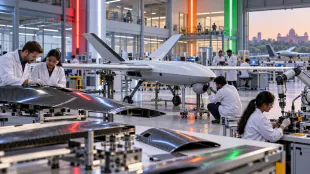
As AI gets real, slow and steady wins the race / Photo: Sameer Al-DOUMY - AFP
In the wake of ChatGPT's dramatic arrival two years ago, companies are excited about generative AI's possibilities but heading into 2025 with careful deliberation rather than rushing to transform their operations.
The Channel Tunnel, one of the world's most strained travel checkpoints, presents a compelling example of AI's current limitations and practical applications.
Each day, 400 of the world's largest locomotives cross the tunnel linking France and Britain, with nearly 11 million rail passengers and 2 million cars carried through annually.
For GetLink, the company managing the 800-meter-long trains, caution around AI implementation remains paramount.
"We're in a highly regulated business. We're not kidding around. These are very strict procedures," explained Denis Coutrot, GetLink's Chief Data and AI officer.
Rather than controlling train operations, their AI primarily handles more mundane tasks like searching through rules and regulations.
The legal sector, initially viewed as prime for AI disruption, tells a similar story.
"ChatGPT is obviously incredible. But it's really quite hard to apply it in your day-to-day workflows in a way that is impactful," noted James Sutton, founder and CEO of Avantia Law.
- 'Verify everything' -
While AI excels at basic tasks like searching legal databases and generating simple summaries, more complex work requires careful human oversight.
Sutton explained that AI's inconsistency remains a challenge: "One contract I can put in and the AI kicks it out perfectly. Another one will be 40 percent right. That lack of certainty means lawyers still have to verify everything."
The tech industry presents a more aggressive adoption curve.
Google reports that 25 percent of its coding is now handled by generative AI.
JetBrains CEO Kirill Skrygan predicts that by next year, AI will handle about 75-80 percent of all coding tasks.
"Developers are using AI as assistants to generate code, and these numbers are growing every day," said Skrygan at the Web Summit in Lisbon.
"The next level is coding agents that can resolve entire tasks usually assigned to developers."
He suggested that over time, these agents could replace virtually all of the world's millions of developers.
Visual design industries, particularly fashion, are seeing significant impact from AI image generators like DALL-E, Midjourney, and Stable Diffusion.
These tools are already transforming work habits and shortening time-to-market for new collections.
In healthcare, despite a study showing AI's potential —including one where ChatGPT outperformed human doctors in diagnosis from case histories — practitioners remain hesitant to fully embrace the technology.
"They didn’t listen to AI when AI told them things they didn’t agree with," Dr. Adam Rodman, who carried out the study, told the New York Times.
- 'Very concerned' -
Companies face a complex calculation between innovation, prudence and how much they are willing to spend.
"It will take some time for the market to sort out all of these costs and benefits, especially in an environment where companies are already feeling hesitation around technology investments," observed Seth Robinson, VP for industry research at CompTIA.
Anant Bhardwaj, CEO of Instabase, believed that AI's limitations were real but temporary.
"The real new innovation, like new physics or new ways of space exploration, those are still beyond the reach of AI... If people think that AI can solve every single human problem, the answer today is 'No.'"
While AI excels at processing existing patterns and data, Bhardwaj argued it lacks the human curiosity needed to explore truly new frontiers.
But he predicted that within the next decade, most industries will have some form of AI-driven operations, with humans in the backseat, but complete AI autonomy remains distant.
Still, the disruption caused by AI is coming hard and fast, and countries must be prepared.
"White collar process work is hugely impacted, that's already happening. Call centers is already happening," Professor Susan Athey of Stanford University told a statistics conference at the IMF.
Athey, an economist of the tech industry, expressed worry about regions where a core profession such as call centers risked being swept away by AI.
"Those are ones I would really watch very carefully. Any country that specializes in call centers, I'm very concerned about that country," she said.
S.Danek--TPP