The Prague Post - Scientists unearth 'cute' but fearsome ancient whale

EUR -
AED 4.238796
AFN 72.139036
ALL 95.241751
AMD 424.971852
ANG 2.066546
AOA 1059.554355
ARS 1662.930755
AUD 1.631514
AWG 2.080442
AZN 1.959832
BAM 1.957077
BBD 2.322666
BDT 141.550549
BGN 1.927419
BHD 0.434878
BIF 3439.985633
BMD 1.154198
BND 1.48617
BOB 7.99722
BRL 5.939152
BSD 1.153128
BTN 110.311566
BWP 15.651148
BYN 3.235612
BYR 22622.287321
BZD 2.319264
CAD 1.608445
CDF 2654.655907
CHF 0.918638
CLF 0.026804
CLP 1054.776017
CNY 7.808902
CNH 7.8282
COP 4160.019341
CRC 532.135793
CUC 1.154198
CUP 30.586256
CVE 110.337016
CZK 24.226738
DJF 205.353142
DKK 7.473942
DOP 67.173552
DZD 154.341736
EGP 60.220872
ERN 17.312975
ETB 185.920448
FJD 2.555914
FKP 0.86481
GBP 0.863635
GEL 3.070073
GGP 0.86481
GHS 13.624893
GIP 0.86481
GMD 84.256224
GNF 10108.378681
GTQ 8.791586
GYD 241.266427
HKD 9.044269
HNL 30.836592
HRK 7.537724
HTG 150.775797
HUF 355.515591
IDR 20953.316532
ILS 3.365943
IMP 0.86481
INR 110.170597
IQD 1510.659814
IRR 1587166.982561
ISK 143.593616
JEP 0.86481
JMD 182.048821
JOD 0.818297
JPY 184.612295
KES 149.239344
KGS 100.934299
KHR 4630.001895
KMF 493.997157
KPW 1038.611428
KRW 1763.54588
KWD 0.35689
KYD 0.961023
KZT 561.626836
LAK 25355.10965
LBP 103269.302752
LKR 388.767007
LRD 210.454626
LSL 19.053906
LTL 3.408048
LVL 0.698163
LYD 7.332786
MAD 10.66416
MDL 20.089025
MGA 4853.062423
MKD 61.733057
MMK 2423.008049
MNT 4130.6315
MOP 9.307754
MRU 46.081079
MUR 55.288091
MVR 17.832613
MWK 1999.696517
MXN 20.098113
MYR 4.701629
MZN 73.765095
NAD 19.053906
NGN 1571.533622
NIO 42.436963
NOK 10.916691
NPR 176.500435
NZD 1.9796
OMR 0.443792
PAB 1.153233
PEN 4.003043
PGK 5.126346
PHP 71.205973
PKR 320.963699
PLN 4.242273
PYG 7096.631895
QAR 4.215852
RON 5.243635
RSD 117.384278
RUB 84.459239
RWF 1693.497991
SAR 4.332628
SBD 9.289661
SCR 15.378645
SDG 693.09979
SEK 10.87458
SGD 1.485771
SHP 0.861726
SLE 28.392693
SLL 24202.964367
SOS 659.027285
SRD 43.064869
STD 23889.57517
STN 24.51547
SVC 10.090367
SYP 127.575963
SZL 19.039097
THB 37.814421
TJS 10.788195
TMT 4.039694
TND 3.392114
TOP 2.779032
TRY 53.209125
TTD 7.810929
TWD 36.357826
TZS 3029.768279
UAH 51.478299
UGX 4347.818939
USD 1.154198
UYU 46.450519
UZS 13814.717488
VES 649.334767
VND 30407.355075
VUV 136.5181
WST 3.147515
XAF 656.38257
XAG 0.016842
XAU 0.000266
XCD 3.119279
XCG 2.078311
XDR 0.817641
XOF 656.396797
XPF 119.331742
YER 275.420522
ZAR 18.999778
ZMK 10389.166128
ZMW 20.267228
ZWL 371.651392
  • CMSC

    -0.0200

    22.45

    -0.09%

  • JRI

    -0.0700

    12.53

    -0.56%

  • BCE

    -0.1650

    24.245

    -0.68%

  • BCC

    0.7300

    68.81

    +1.06%

  • RIO

    0.9200

    101.61

    +0.91%

  • CMSD

    -0.0200

    22.5

    -0.09%

  • AZN

    -0.9600

    184.99

    -0.52%

  • BTI

    0.1100

    59.83

    +0.18%

  • RELX

    -0.3850

    34.765

    -1.11%

  • RBGPF

    1.4900

    61.5

    +2.42%

  • NGG

    -1.5300

    80.33

    -1.9%

  • VOD

    0.2000

    14.9

    +1.34%

  • RYCEF

    -0.3300

    16.52

    -2%

  • GSK

    -0.4100

    51.11

    -0.8%

  • BP

    0.7400

    43.71

    +1.69%

Scientists unearth 'cute' but fearsome ancient whale
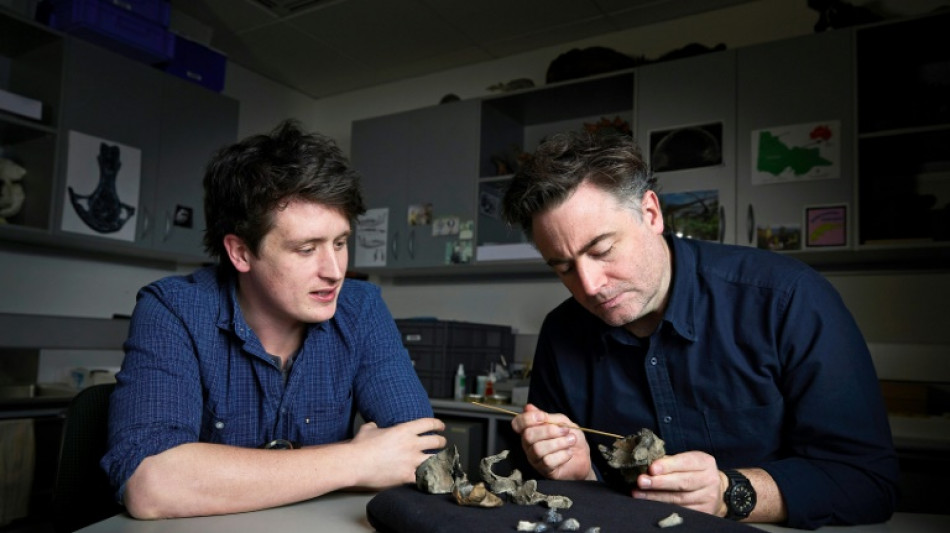
Scientists unearth 'cute' but fearsome ancient whale / Photo: Tom BREAKWELL - MUSEUMS VICTORIA/AFP

Scientists unearth 'cute' but fearsome ancient whale

Australian scientists have discovered a razor-toothed whale that prowled the seas 26 million years ago, saying Wednesday the species was "deceptively cute" but a fearsome predator.

Text size:

Museums Victoria pieced together the species from an unusually well-preserved skull fossil found on Victoria's Surf Coast in 2019.

Scientists discovered a "fast, sharp-toothed predator" that would have been about the size of a dolphin.

"It's essentially a little whale with big eyes and a mouth full of sharp, slicing teeth," said researcher Ruairidh Duncan.

"Imagine the shark-like version of a baleen whale -- small and deceptively cute, but definitely not harmless."

The skull belonged to a group of prehistoric whales known as the mammalodontids, distant smaller relatives of today's filter-feeding whales.

It is the fourth mammalodontid species ever discovered, Museums Victoria said.

"This fossil opens a window into how ancient whales grew and changed, and how evolution shaped their bodies as they adapted to life in the sea," said palaeontologist Erich Fitzgerald, who co-authored the study.

Victoria's Surf Coast lies on the Jan Juc Formation -- a geological feature dating to the Oligocene epoch between 23 and 30 million years ago.

A string of rare fossils have been unearthed along the scenic stretch of beach, a renowned site for the study of early whale evolution.

"This region was once a cradle for some of the most unusual whales in history, and we're only just beginning to uncover their stories," said Fitzgerald.

"We're entering a new phase of discovery.

"This region is rewriting the story of how whales came to rule the oceans, with some surprising plot twists."

The species was named Janjucetus dullardi, a nod to local Ross Dullard who stumbled across the skull while strolling the beach in 2019.

It was described in the peer-reviewed Zoological Journal of the Linnean Society.

K.Dudek--TPP