The Prague Post - AI delay may affect Europe's future, says ECB chief

EUR -
AED 4.183608
AFN 75.185325
ALL 93.475856
AMD 416.380642
AOA 1045.760713
ARS 1688.928865
AUD 1.62924
AWG 2.051935
AZN 1.942914
BAM 1.953841
BBD 2.294689
BDT 140.529083
BHD 0.429967
BIF 3396.17954
BMD 1.139173
BND 1.470525
BOB 12.56035
BRL 5.780619
BSD 1.139253
BTN 109.963733
BWP 15.492397
BYN 3.287703
BYR 22327.784586
BZD 2.291292
CAD 1.603431
CDF 2574.530657
CHF 0.929561
CLF 0.027128
CLP 1067.655673
CNY 7.715592
CNH 7.715622
COP 3666.199446
CRC 516.879425
CUC 1.139173
CUP 30.188076
CVE 110.154541
CZK 24.186238
DJF 202.878343
DKK 7.475678
DOP 66.214765
DZD 151.647825
EGP 58.439328
ERN 17.08759
ETB 183.887398
FJD 2.556534
FKP 0.85166
GBP 0.853236
GEL 2.996121
GGP 0.85166
GHS 13.232673
GIP 0.85166
GMD 83.734331
GNF 9995.976432
GTQ 8.691247
GYD 238.319976
HKD 8.93268
HNL 30.516935
HRK 7.533806
HTG 148.963241
HUF 364.503375
IDR 20470.19265
ILS 3.500245
IMP 0.85166
INR 110.110894
IQD 1492.529554
IRR 1566647.232079
ISK 143.410726
JEP 0.85166
JMD 180.479023
JOD 0.807646
JPY 186.237703
KES 147.534026
KGS 99.620428
KHR 4597.470555
KMF 492.122132
KRW 1677.738898
KWD 0.352905
KYD 0.949448
KZT 532.663528
LAK 25797.018549
LBP 102022.348256
LKR 382.916027
LRD 206.206888
LSL 18.701665
LTL 3.363681
LVL 0.689074
LYD 7.306673
MAD 10.678592
MDL 20.062794
MGA 4891.073958
MKD 61.508322
MMK 2391.388129
MNT 4090.960131
MOP 9.202032
MRU 45.526348
MUR 53.757852
MVR 17.611752
MWK 1975.536353
MXN 19.895263
MYR 4.657735
MZN 72.804425
NAD 18.702075
NGN 1560.028855
NIO 41.927956
NOK 10.949671
NPR 175.941573
NZD 1.969303
OMR 0.438011
PAB 1.139253
PEN 3.868021
PGK 5.100885
PHP 70.397477
PKR 316.524602
PLN 4.327563
PYG 6897.083879
QAR 4.153235
RON 5.234611
RSD 117.435047
RUB 89.310702
RWF 1676.518854
SAR 4.271472
SBD 9.202102
SCR 15.252961
SDG 684.078591
SEK 11.09426
SGD 1.471156
SLE 27.625007
SOS 651.147056
SRD 42.987252
STD 23578.574557
STN 24.47535
SVC 9.969003
SZL 18.700166
THB 38.533644
TJS 10.526721
TMT 3.998496
TND 3.372418
TRY 53.806313
TTD 7.732213
TWD 36.819883
TZS 3001.717747
UAH 51.063595
UGX 4277.691725
USD 1.139173
UYU 45.75412
UZS 13788.173768
VES 839.523846
VND 29979.037911
VUV 135.588974
WST 3.124487
XAF 655.299891
XAG 0.019494
XAU 0.000279
XCD 3.078671
XCG 2.053332
XDR 0.81309
XOF 655.299891
XPF 119.331742
YER 271.81464
ZAR 18.731872
ZMK 10253.922663
ZMW 21.105743
ZWL 366.813139
  • CMSD

    -0.0700

    22.08

    -0.32%

  • BCE

    -0.2160

    21.264

    -1.02%

  • RIO

    -0.1900

    92.09

    -0.21%

  • JRI

    -0.0050

    12.915

    -0.04%

  • BCC

    -1.8600

    75.84

    -2.45%

  • CMSC

    -0.0450

    21.865

    -0.21%

  • NGG

    -1.8300

    82.04

    -2.23%

  • AZN

    -1.7200

    168.01

    -1.02%

  • RELX

    -0.2400

    32.5

    -0.74%

  • GSK

    -0.3600

    50.4

    -0.71%

  • RYCEF

    -0.5000

    18.25

    -2.74%

  • BP

    1.0000

    44.32

    +2.26%

  • VOD

    -0.0300

    15.48

    -0.19%

  • BTI

    -2.0300

    60.03

    -3.38%

  • RBGPF

    -1.0400

    66.73

    -1.56%

AI delay may affect Europe's future, says ECB chief
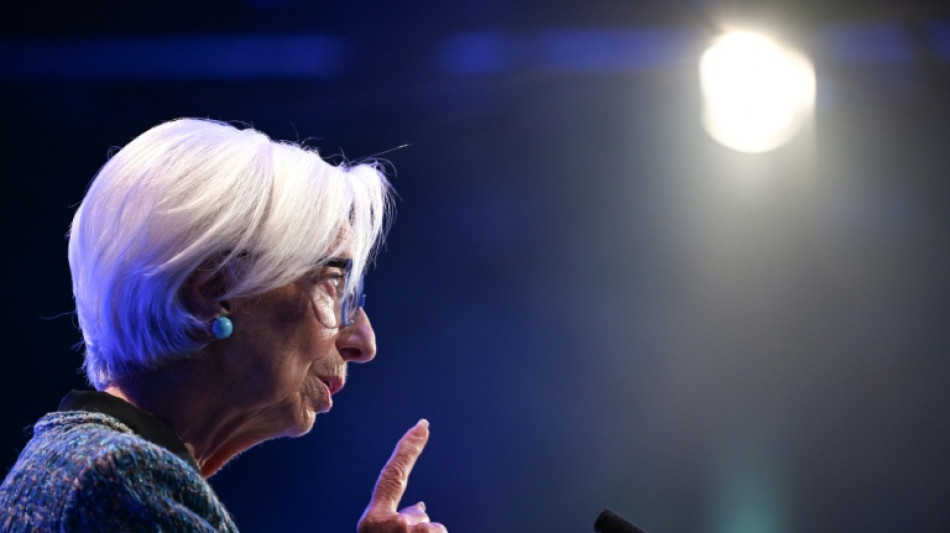
AI delay may affect Europe's future, says ECB chief / Photo: Kirill KUDRYAVTSEV - AFP

AI delay may affect Europe's future, says ECB chief

European Central Bank chief Christine Lagarde warned Monday that a delay in embracing artificial intelligence could "jeopardise" the continent's future, urging barriers to its adoption to be swiftly lifted.

Text size:

Her comments add to growing fears that Europe is lagging behind the United States and China when it comes to AI, with proponents of the technology blaming issues from overregulation to underinvestment.

"We need to remove all the obstacles that stop us from embracing this transformation," she told a Bratislava conference.

"Otherwise we risk letting the wave of AI adoption pass us by and jeopardise Europe's future."

Lagarde, who heads the central bank for the 20-nation euro area, conceded that Europe had "already missed the opportunity to be a first mover in AI".

But if the continent deploys the technology decisively across its key industries, "Europe can turn a late start into a competitive edge", she emphasised.

She listed several barriers to rapid adoption in Europe, ranging from fragmented regulations to the high cost of energy -- which makes it expensive to run the enormous data centres that power AI.

Bureaucratic obstacles, such as delays in obtaining permits, made it harder to quickly build up data centres, and the region's computing power, she said.

As of last year, Europe's data centres had computing capacity of just 16 gigawatts, compared with 48 in the Untied States and 38 in China, according to a recent study by German digital business association Bitkom.

- 'Losing competitiveness' -

Facing mounting concerns from businesses and governments that regulations are hobbling the digital sector and hampering growth, the EU last week proposed rolling back key AI and data privacy rules.

Privacy defenders, however, were unhappy with the proposed changes, arguing they weaken safeguards protecting Europeans' data.

European governments have also been stepping up calls to reduce over-reliance on US tech giants and strengthen the local industry, particularly at a time of uneasy ties with Washington under the Trump administration.

Echoing these sentiments, Lagarde urged Europe to "diversify critical parts of the AI supply chain and avoid single points of failure.

"If our data spaces use technology stacks that are owned and governed outside Europe, we deepen -- rather than reduce -- our strategic dependencies."

While some European leaders fret that losing out in the AI race could weaken the continent's already fragile economy, others are warning against a head-long rush to adopt the technology.

UN rights chief Volker Turk warned Monday that generative AI could become "a modern-day Frankenstein's monster" that could threaten human rights, including to privacy, political participation and free expression.

Lagarde nevertheless warned that the consequences of further foot-dragging go beyond "losing the race in AI models".

"We would eventually face a further loss of competitiveness for many of our sectors and industries."

J.Simacek--TPP