The Prague Post - Astronomers detect cosmic flash from early universe star blast

EUR -
AED 4.301512
AFN 73.790669
ALL 95.475949
AMD 435.455176
ANG 2.096449
AOA 1075.231129
ARS 1631.267406
AUD 1.639479
AWG 2.109762
AZN 1.993763
BAM 1.95698
BBD 2.358572
BDT 143.684199
BGN 1.953808
BHD 0.44278
BIF 3483.241172
BMD 1.171276
BND 1.495877
BOB 8.091742
BRL 5.858121
BSD 1.170981
BTN 110.304167
BWP 15.861295
BYN 3.317244
BYR 22957.016762
BZD 2.35517
CAD 1.602335
CDF 2709.161787
CHF 0.919733
CLF 0.026655
CLP 1048.983684
CNY 7.99572
CNH 8.002564
COP 4177.849093
CRC 532.910009
CUC 1.171276
CUP 31.038824
CVE 110.331538
CZK 24.371626
DJF 208.531309
DKK 7.472907
DOP 69.76088
DZD 155.189145
EGP 61.636019
ERN 17.569145
ETB 181.029683
FJD 2.582255
FKP 0.86795
GBP 0.86805
GEL 3.144875
GGP 0.86795
GHS 13.000618
GIP 0.86795
GMD 86.086277
GNF 10279.023486
GTQ 8.952246
GYD 244.992519
HKD 9.176892
HNL 31.117102
HRK 7.530488
HTG 153.309839
HUF 365.371516
IDR 20198.953741
ILS 3.490392
IMP 0.86795
INR 110.306533
IQD 1533.992368
IRR 1543800.813561
ISK 143.797682
JEP 0.86795
JMD 184.805396
JOD 0.830482
JPY 186.749479
KES 151.434177
KGS 102.373297
KHR 4691.749355
KMF 494.278817
KPW 1054.179114
KRW 1730.461294
KWD 0.360495
KYD 0.975872
KZT 543.956435
LAK 25659.927124
LBP 104864.050107
LKR 373.26714
LRD 214.875917
LSL 19.472311
LTL 3.458474
LVL 0.708493
LYD 7.43064
MAD 10.83458
MDL 20.363933
MGA 4865.830595
MKD 61.628235
MMK 2459.520119
MNT 4193.680971
MOP 9.450038
MRU 46.737388
MUR 54.850527
MVR 18.107528
MWK 2030.589921
MXN 20.364633
MYR 4.644121
MZN 74.847383
NAD 19.472311
NGN 1586.317933
NIO 43.09507
NOK 10.953015
NPR 176.486667
NZD 1.993776
OMR 0.450348
PAB 1.170981
PEN 4.060062
PGK 5.083087
PHP 71.043763
PKR 326.447304
PLN 4.240132
PYG 7425.35124
QAR 4.268874
RON 5.090948
RSD 117.412229
RUB 88.320226
RWF 1711.602996
SAR 4.392961
SBD 9.427115
SCR 17.433904
SDG 703.347971
SEK 10.815408
SGD 1.494912
SHP 0.874476
SLE 28.811972
SLL 24561.075254
SOS 669.192145
SRD 43.804604
STD 24243.055967
STN 24.514261
SVC 10.246004
SYP 129.499113
SZL 19.464406
THB 37.911856
TJS 11.007503
TMT 4.105324
TND 3.419489
TOP 2.820153
TRY 52.735436
TTD 7.95266
TWD 36.860651
TZS 3048.247428
UAH 51.602622
UGX 4356.534322
USD 1.171276
UYU 46.387183
UZS 14069.244547
VES 565.414603
VND 30873.673716
VUV 138.011302
WST 3.176816
XAF 656.341615
XAG 0.015411
XAU 0.000249
XCD 3.165433
XCG 2.110428
XDR 0.815912
XOF 656.366847
XPF 119.331742
YER 279.495832
ZAR 19.399263
ZMK 10542.873009
ZMW 22.160986
ZWL 377.150512
  • CMSC

    0.0800

    22.91

    +0.35%

  • CMSD

    0.1000

    23.23

    +0.43%

  • BCE

    0.3700

    24.1

    +1.54%

  • JRI

    -0.1200

    12.88

    -0.93%

  • NGG

    1.3600

    86.96

    +1.56%

  • GSK

    -0.0700

    55.63

    -0.13%

  • RIO

    -1.4300

    98.85

    -1.45%

  • BTI

    1.1100

    57.28

    +1.94%

  • BCC

    1.5800

    83.82

    +1.88%

  • BP

    -0.0200

    46.35

    -0.04%

  • RBGPF

    63.0000

    63

    +100%

  • RYCEF

    0.2200

    15.42

    +1.43%

  • AZN

    -2.5100

    192.3

    -1.31%

  • RELX

    -0.1400

    36.13

    -0.39%

  • VOD

    0.3100

    15.62

    +1.98%

Astronomers detect cosmic flash from early universe star blast
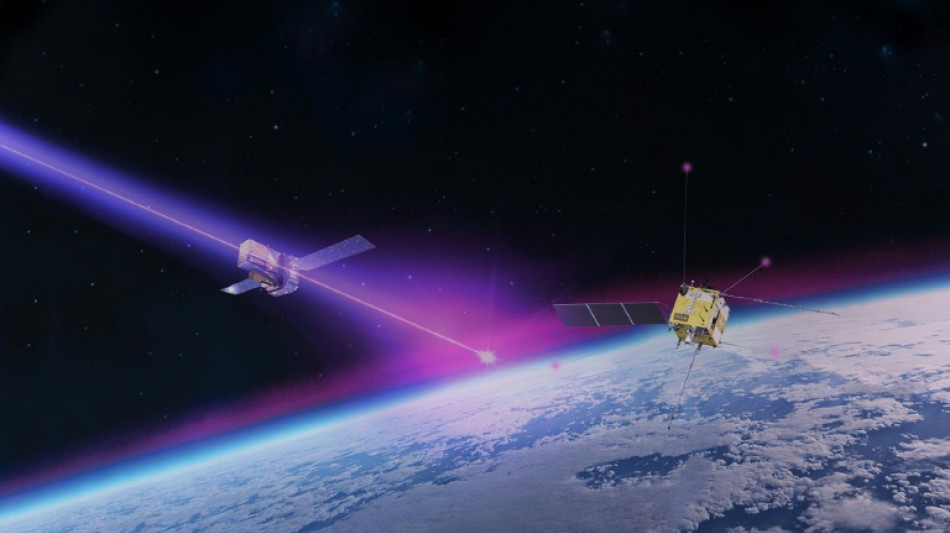
Astronomers detect cosmic flash from early universe star blast / Photo: Handout - ESA/ATG Europe/AFP/File

Astronomers detect cosmic flash from early universe star blast

An immensely powerful flash detected earlier this year was created by a massive star exploding when the universe was just five percent of its current age, astronomers said Tuesday.

Text size:

The flash was spotted on March 14 by a French-Chinese space telescope called SVOM, which launched last year on a mission to track gamma-ray bursts, the brightest and most powerful explosions in the cosmos.

When the young scientists working on the mission for France's Atomic Energy Commission (CEA) received a mobile phone alert that a major burst had arrived at Earth, they urged other telescopes to turn towards the source.

It came from a star around a hundred times bigger than our Sun that exploded 700 million years after the Big Bang, according to two studies published in the Astronomy & Astrophysics journal.

"This is extremely rare -- it's the fifth most distant gamma-ray burst ever detected," said Bertrand Cordier, the CEA's scientific lead for SVOM and a co-author of both studies.

"The photons that reached our instruments travelled for 13 billion years" to reach Earth, he told AFP.

The detection of the burst, which lasted tens of seconds, is also "the most precise in terms of the light we collected and the measurements we made," he added.

- Glimpse of ancient cosmos -

Gamma-ray bursts are the most energetic events in the universe, Cordier explained. They are thought to be caused by cataclysmic cosmic events such as massive stars going supernova or when binary neutron stars merge.

These flashes can release as much energy in a few seconds as our Sun will emit during its 10-billion-year life.

They shoot out matter at "speeds close to the speed of light", creating conditions impossible to reproduce on Earth, Cordier said.

These bright flashes also act as "probes" of the cosmos, illuminating all the matter they pass through before finally reaching us, he added.

This allows scientists a rare glimpse into the distant past of the universe, which is 13.8 billion years old.

The gamma-ray burst in March, called GRB250314A, was created by an explosion during the first generation of stars formed after the Big Bang.

These stars produced the first heavy elements -- such as iron, carbon and oxygen -- which played a fundamental role in the evolution of the universe.

Cordier hopes SVOM will be able to detect one or two similar events every year.

"The challenge is to get everything together in the chain" of observations which involves other telescopes, he said.

For example, after the burst was first detected in March, it took 17 hours before the Very Large Telescope in Chile turned its powerful lens towards the flash.

"During that time, the intensity had decreased," Cordier said.

"If we get there earlier, then we'll have better data."

G.Kucera--TPP