The Prague Post - Strange 'inside-out' planetary system baffles astronomers

EUR -
AED 4.299696
AFN 74.346056
ALL 95.453247
AMD 439.173161
ANG 2.095564
AOA 1074.777278
ARS 1613.916004
AUD 1.636896
AWG 2.107407
AZN 1.986527
BAM 1.955227
BBD 2.366237
BDT 144.147752
BGN 1.952984
BHD 0.441787
BIF 3493.446285
BMD 1.170782
BND 1.495349
BOB 8.117725
BRL 5.81609
BSD 1.174771
BTN 110.132722
BWP 15.795573
BYN 3.305474
BYR 22947.324487
BZD 2.362838
CAD 1.600553
CDF 2705.676811
CHF 0.918636
CLF 0.026482
CLP 1042.264874
CNY 7.990349
CNH 7.998167
COP 4181.412295
CRC 535.247699
CUC 1.170782
CUP 31.025719
CVE 110.233163
CZK 24.36157
DJF 209.201367
DKK 7.473077
DOP 70.699883
DZD 155.134135
EGP 60.891549
ERN 17.561728
ETB 184.925881
FJD 2.596682
FKP 0.867002
GBP 0.867625
GEL 3.149707
GGP 0.867002
GHS 13.005244
GIP 0.867002
GMD 85.466851
GNF 10311.066053
GTQ 8.979407
GYD 245.809007
HKD 9.169675
HNL 31.212119
HRK 7.537259
HTG 153.783615
HUF 365.026051
IDR 20249.843078
ILS 3.522924
IMP 0.867002
INR 110.150082
IQD 1538.955528
IRR 1544846.666305
ISK 143.795229
JEP 0.867002
JMD 186.107044
JOD 0.830035
JPY 186.891964
KES 151.278166
KGS 102.358414
KHR 4702.581578
KMF 492.899374
KPW 1053.645159
KRW 1733.19037
KWD 0.360624
KYD 0.979017
KZT 544.372777
LAK 25919.514076
LBP 105205.213829
LKR 373.312182
LRD 216.166645
LSL 19.311822
LTL 3.457014
LVL 0.708194
LYD 7.428918
MAD 10.84776
MDL 20.12436
MGA 4872.613529
MKD 61.652739
MMK 2458.362125
MNT 4190.341797
MOP 9.477063
MRU 46.898655
MUR 54.722532
MVR 18.088881
MWK 2036.720464
MXN 20.316343
MYR 4.643319
MZN 74.824752
NAD 19.311822
NGN 1581.761356
NIO 43.237328
NOK 10.87486
NPR 176.213859
NZD 1.988263
OMR 0.450163
PAB 1.174866
PEN 4.037282
PGK 5.167816
PHP 70.749763
PKR 327.510608
PLN 4.244447
PYG 7389.928803
QAR 4.283263
RON 5.09278
RSD 117.35099
RUB 87.920487
RWF 1716.711521
SAR 4.391138
SBD 9.422915
SCR 16.053877
SDG 703.014901
SEK 10.793514
SGD 1.494041
SHP 0.874107
SLE 28.859864
SLL 24550.705757
SOS 671.408955
SRD 43.855121
STD 24232.820735
STN 24.49439
SVC 10.280031
SYP 129.526455
SZL 19.304589
THB 37.906393
TJS 11.060758
TMT 4.10359
TND 3.416013
TOP 2.818962
TRY 52.597767
TTD 7.9647
TWD 36.941098
TZS 3044.033436
UAH 51.545433
UGX 4352.742866
USD 1.170782
UYU 46.706311
UZS 14248.823885
VES 564.498504
VND 30823.75946
VUV 138.190282
WST 3.190848
XAF 655.770405
XAG 0.015377
XAU 0.000248
XCD 3.164097
XCG 2.117288
XDR 0.815568
XOF 655.773205
XPF 119.331742
YER 279.406719
ZAR 19.33236
ZMK 10538.438884
ZMW 22.350736
ZWL 376.991282
  • CMSC

    0.0620

    22.892

    +0.27%

  • AZN

    0.9990

    195.809

    +0.51%

  • BTI

    0.8500

    57.02

    +1.49%

  • RBGPF

    -4.0600

    64.94

    -6.25%

  • GSK

    0.3300

    56.03

    +0.59%

  • BP

    -0.2500

    46.12

    -0.54%

  • RIO

    -0.4000

    99.88

    -0.4%

  • BCE

    0.0200

    23.75

    +0.08%

  • RYCEF

    0.3900

    15.49

    +2.52%

  • RELX

    -0.2300

    36.04

    -0.64%

  • CMSD

    0.1350

    23.265

    +0.58%

  • VOD

    0.3100

    15.62

    +1.98%

  • BCC

    1.5600

    83.8

    +1.86%

  • JRI

    -0.0500

    12.95

    -0.39%

  • NGG

    1.3100

    86.91

    +1.51%

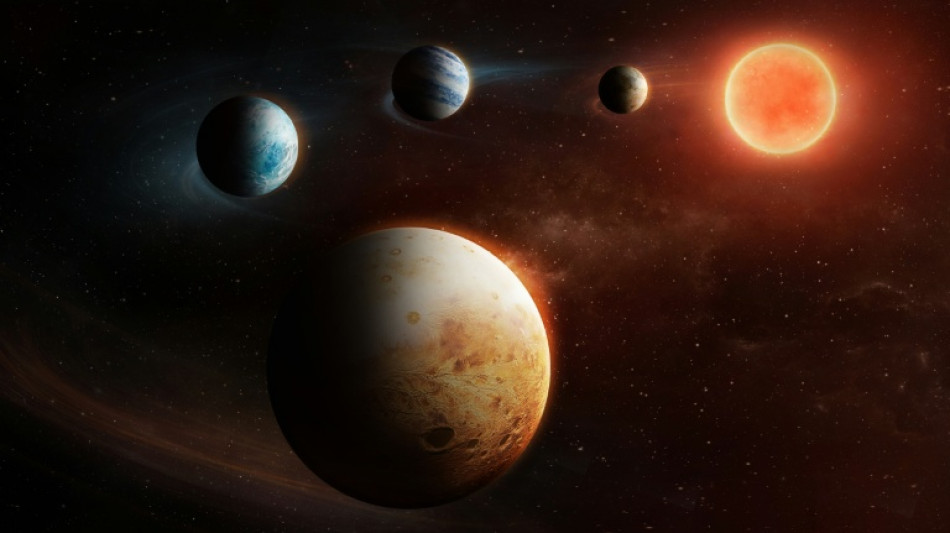
Strange 'inside-out' planetary system baffles astronomers
Strange 'inside-out' planetary system baffles astronomers / Photo: Handout - ESA/AFP

Strange 'inside-out' planetary system baffles astronomers

Surprised astronomers said Thursday they have discovered a star with planets in a bizarre order that defies scientific expectations -- and suggests these faraway worlds formed in a manner never seen before.

Text size:

In our Solar System, the four planets closest to the Sun are small and rocky, while the four farther out are gas giants.

Scientists had thought this planetary order -- rocky first, then gaseous -- was consistent across the universe.

However, a star called LHS 1903 discovered in the Milky Way's thick disc suggests otherwise.

An international team of astronomers analysing data from several different telescopes had already spotted three planets orbiting the red dwarf star, which is cooler and less bright than our Sun.

The closest planet to the star was rocky, followed by two gas giants. That is the order scientists expect.

But digging into observations made by Europe's exoplanet-probing Cheops space telescope revealed a fourth planet farther out in the system -- and it is rocky.

"That makes this an inside-out system, with a planet order of rocky-gaseous-gaseous-and then rocky again," explained Thomas Wilson, the lead author of a new study describing the discovery in the journal Science.

"Rocky planets don't usually form so far away from their home star," the planetary astrophysicist from University of Warwick in the UK said in a statement.

- One planet after another -

Inner planets are expected to be small and rocky because intense radiation from the nearby star blasts most of the gas away from their rocky core.

But farther out in the cold reaches of the system, a thick atmosphere can form around cores, creating gas giants.

Puzzled by the weird LHS 1903 planetary system, the team of astronomers tried to figure out what could have happened.

After ruling out several possibilities, they came up with a scenario: what if the planets formed one at a time?

According to the most widely accepted theory, planets form simultaneously in a massive ring of gas and dust called a protoplanetary disc. This involves tiny dust grains clumping together then snowballing into cores that eventually evolve into mighty planets.

However, by the time the fourth planet orbiting LHS 1903 formed, "the system may have already run out of gas," Wilson said.

"Yet here is a small, rocky world, defying expectations," he added.

"It seems that we have found first evidence for a planet which formed in what we call a gas-depleted environment."

Since the 1990s, astronomers have discovered more than 6,000 planets outside our Solar System -- called exoplanets -- mostly by spotting slight changes in brightness as they cross in front of their star.

"Historically, our planet formation theories are based on what we see and know about our Solar System," said Isabel Rebollido, a planetary disc researcher at the European Space Agency.

"As we are seeing more and more different exoplanet systems, we are starting to revisit these theories."

Q.Pilar--TPP