Laser-etched glass can store data for millennia, Microsoft says / Photo: ANDREW CABALLERO-REYNOLDS - AFP/File
Thousands of years from now, what will remain of our digital era?
The ever-growing vastness of human knowledge is no longer stored in libraries, but on hard drives that struggle to last decades, let alone millennia.
However, information written into glass by lasers could allow data to be preserved for more than 10,000 years, Microsoft announced in a study on Wednesday.
Since 2019, Microsoft's Silica project has been trying to encode data on glass plates, in a throwback to the early days of photography, when negatives were also stored on glass.
The system uses silica glass, a common material that is resistant to changes in temperature, moisture and electromagnetic interference.
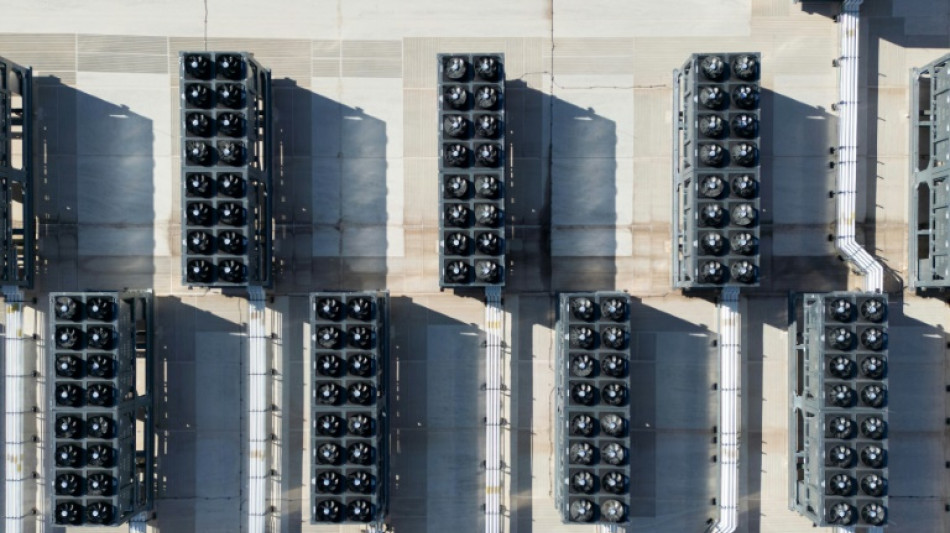
These are all problems for energy-hungry data centres, which use fast-degrading hard drives and magnetic tapes that require backing up every few years.
In the journal Nature, Microsoft's research arm said Silica was the first glass storage technology that had been demonstrated to be reliable for writing, reading and decoding data.
However, experts not involved in the project warned that this new tech still faces numerous challenges.
- How to write inside glass -
First, bits of data are turned into symbols, which correspond to three-dimensional pixels called voxels.
A high-powered laser pulse then inscribes these minuscule voxels into square glass plates that are roughly the size of a CD.
"The symbols are written layer by layer, from the bottom up, to fill the full thickness of the glass," the study explained.
To read the data requires a special microscope that can see each layer, then decode the information using an algorithm powered by artificial intelligence.
The Microsoft researchers estimated that the glass could survive for more than 10,000 years at a blistering 290 degrees Celsius, which suggests the data could last even longer at room temperature.
However, the researchers did not look into what happened when the glass was deliberately smashed -- or corroded by chemicals.
Unlike data centres, the glass does not require a climate-controlled environment, which would save energy.
Another advantage is that the glass plates cannot be hacked or otherwise altered.
The Microsoft researchers emphasised that future storage is important because the amount of data being produced by humanity is now doubling roughly every three years.
- 'Carry the torch ' -
One of the glass plates holds the equivalent of "about two million printed books or 5,000 ultra-high-definition 4K films", according to Feng Chen and Bo Wu, researchers at Shandong University in China not involved in the study.
In a separate Nature article, the pair warned there were more challenges ahead, including finding a way to write the data faster, to mass produce the plates and to ensure people can easily access and read the information.
However, they praised Silica for creating a "viable solution for preserving the records of human civilisation".
"If implemented at scale, it could represent a milestone in the history of knowledge storage, akin to oracle bones, medieval parchment or the modern hard drive," they said.
"One day, a single piece of glass might carry the torch of human culture and knowledge across millennia."
I.Horak--TPP