Artemis mission shares office space -- and physics -- with Apollo / Photo: RONALDO SCHEMIDT - AFP
As four astronauts whiz toward a flyby of the Moon, looking out for them are mission control experts using cutting-edge technology and lessons learned from the Apollo program 50 years ago.
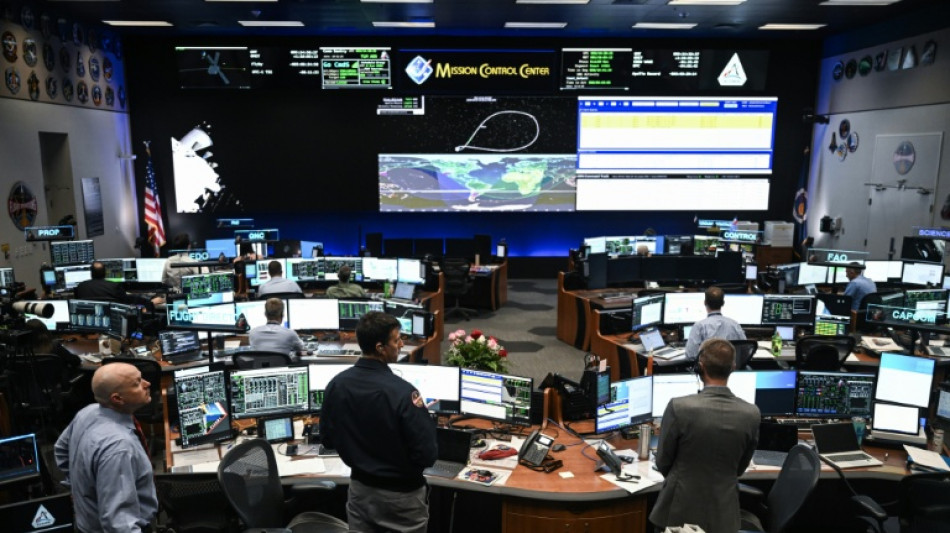
At the Johnson Space Center in Houston, a team of engineers and technicians watched over 100-odd computer screens Friday as the Artemis astronauts in the Orion capsule headed for their rendezvous with Earth's natural satellite on day three of their high-stakes mission.
The nerve center of the operation is the White Flight Control Room, where flight directors Judd Frieling and Rick Henfling oversee everything as the space travelers prepare to slingshot around the Moon on Monday using its gravitational pull, before heading home.
Nearby is the computer screen of the CAPCOM, or capsule communicator, the person responsible for all direct communication with the astronauts.
This time, the CAPCOM is Stan Love, a seasoned former astronaut who sends instructions, flight updates and decisions from the flight directors to the four astronauts: Reid Wiseman, Victor Glover and Christina Koch, all from the United States, and the Canadian Jeremy Hansen.
"The team in mission control is very well trained, and experts in their systems that they're watching over on the spacecraft," NASA spokesperson Kylie Clem said, with the busy control room visible behind her.
"They work for a period of years to earn and graduate essentially into this role and working in the front room," Clem added.
- History -
Of course, Houston is no stranger to space history.
On July 20, 1969, mission control received a message that reassured millions of Americans: "Houston, Tranquility Base here. The Eagle has landed."
It was of course the voice of Neil Armstrong, the first person to set foot on the Moon, with the Apollo 11 mission.
He would later utter what has become one of history's most famous quotes: 'That's one small step for man, one giant leap for mankind."
It was here, too, that NASA heard the anxious and oft-misquoted words "Ah, Houston, we've had a problem," spoken by astronaut Jim Lovell on April 13, 1970, during the Apollo 13 mission.
An oxygen tank had exploded in their spacecraft, forcing them to abort their lunar landing plans.
"All of our mission control rooms are all in this building," said Clem.
"There are different wings that have been modified over the years, but it's in the same building essentially as the historic Apollo mission control room, the International Space Station flight control room, and this room that we're in now."
-'Physics doesn't change'-
The Artemis 2 mission is the first crewed one to the Moon -- the astronauts will not land, only fly by it -- since the last Apollo flight in 1972.
Since then, of course, the technology has changed dramatically.
NASA Orion Program Manager Howard Hu said that among other things this involves much greater computing capability, which lets the crew interact more with the spacecraft's systems.
He said another is sensor capability -- "the ability for us to know exactly where we are in space."
Hu also said the precision with which NASA can now do rendezvous and docking, for instance, "is a huge step in technology."
And while the Apollo capsules had room for three astronauts, the Orion craft carries four, as equipment was made to be more compact without a loss of functionality.
The Apollo vessels were cone-shaped to maximize stability as the craft sped back to Earth through the atmosphere. Orion kept this feature.
"But physics doesn't change. The teardrop shape is very efficient from the aerodynamics perspective," said Hu.
"The Apollo giants were just very good technical engineering experts," he said.
"So we learned a lot from them in terms of the things they learned and we leveraged off of that."
C.Novotny--TPP