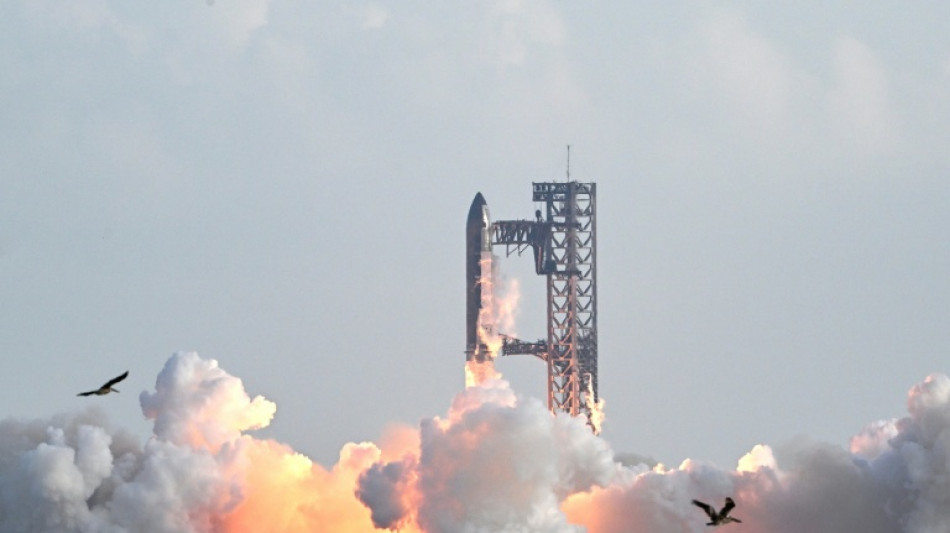
SpaceX's IPO moonshot draws some doubters on Wall Street / Photo: RONALDO SCHEMIDT - AFP
Elon Musk wants to take SpaceX public -- and he's asking investors to believe the rocket and AI company is worth almost $1.75 trillion.
On Wall Street, not everyone is convinced.
What does that number actually mean? SpaceX made $18.5 billion in sales last year. Musk is asking investors to value the company at nearly 100 times that.
To put it another way: even Apple, one of the most valuable companies on Earth, is worth about 11 times its annual revenue, as measured by market capitalization. Nvidia, the darling of the AI revolution, is worth 25 times.
The upcoming IPO -- short for initial public offering, when a private company sells shares to the public for the first time -- could be one of the biggest in history.
Ahead of the Wall Street liftoff, expected in mid-June, SpaceX backers say the company isn't just a rocket business but rather the gatekeeper to space itself.
"SpaceX controls the rails and controls access to orbit," said Chad Anderson, CEO of Space Capital, an investment firm that already owns a stake in SpaceX.
He argues we are only at the beginning of a decades-long space infrastructure boom worth hundreds of billions of dollars, from replacing aging satellites to building data centers in orbit.
The company's satellite internet service, Starlink, is already generating most of SpaceX's revenue and profit.
"If they can be the low-cost provider of Internet access to lots of people around the world, that can be an enormous source of revenue and profits," said Jay Ritter, an IPO expert at the University of Florida.
And Musk has made clear he is thinking way bigger than quarterly profits -- out-of-this-world big.
"I need to make sure SpaceX stays focused on making life multiplanetary and extending consciousness to the stars," he wrote on X in March.
"If SpaceX succeeds in this absurdly difficult goal, it will be worth many orders of magnitude more than the economy of Earth."
- Amazing or overvalued? -
Not so fast, say the skeptics.
When SpaceX absorbed xAI -- Musk's artificial intelligence company and the owner of social network X -- in February, eyebrows went up on Wall Street.
Eric Jhonsa of Dutch Asset Corporation pointed to a broader problem: "AI startups with little or no revenue getting sky-high valuations."
"Is this an amazing company or is it ridiculously overvalued? The answer is yes," quipped Scott Galloway, a marketing professor at NYU Stern.
Geoff Robinson, a financial analyst, was more blunt: "If I read one more 'expert' take on the SpaceX IPO that ignores the laws of financial physics, I'm going to need an actual rocket to escape the nonsense. The communication around this deal needs a serious BS filter."
Critics also raise more basic concerns: profit margins in the rocket launch business are thin, Starlink's prices may be too high to win over the mass market, and it's still unclear whether data centers in space are even a viable idea.
Kim Forrest, chief investment officer at Bokeh Capital Partners, argues that traditional financial math may simply not apply here.
"What people are really buying is the hope and dream of commercial space," she said, "which is more than a dream. It's a reality."
But Ritter offers a note of caution.
"Lots of things have to go right in order for revenue and profits to grow to justify that valuation," he said.
"And occasionally it happens -- but most of the time, something doesn't work out according to plan. And that's where I've gotten concerned about SpaceX."
G.Kucera--TPP