The Prague Post - Huawei touts new chipmaking technology to sidestep US restrictions

EUR -
AED 4.120833
AFN 72.374653
ALL 90.68597
AMD 405.213892
ANG 2.008278
AOA 1028.945251
ARS 1713.128375
AUD 1.597286
AWG 2.021143
AZN 1.906221
BAM 1.95442
BBD 2.261004
BDT 138.851961
BGN 1.961202
BHD 0.423701
BIF 3367.352434
BMD 1.122078
BND 1.434081
BOB 13.162823
BRL 5.641241
BSD 1.122607
BTN 106.103084
BWP 15.379141
BYN 3.334231
BYR 21992.723667
BZD 2.257726
CAD 1.577877
CDF 2598.73214
CHF 0.926595
CLF 0.027838
CLP 1095.630483
CNY 7.493291
CNH 7.490541
COP 3580.190997
CRC 511.139102
CUC 1.122078
CUP 26.941977
CVE 110.187691
CZK 24.274862
DJF 199.898858
DKK 7.474749
DOP 68.941323
DZD 151.101229
EGP 61.024421
ERN 16.831166
ETB 183.87581
FJD 2.52894
FKP 0.838851
GBP 0.83859
GEL 2.90609
GGP 0.838851
GHS 13.083762
GIP 0.838851
GMD 82.471988
GNF 9935.984531
GTQ 8.578943
GYD 234.86417
HKD 8.805101
HNL 30.135722
HRK 7.533407
HTG 147.087457
HUF 365.420883
IDR 20238.130708
ILS 3.465427
IMP 0.838851
INR 105.958979
IQD 1701.798417
IRR 2056067.194777
ISK 136.051813
JEP 0.838851
JMD 178.164204
JOD 0.795528
JPY 177.460525
KES 145.679109
KGS 98.126099
KHR 4564.776962
KMF 493.15641
KPW 1009.869921
KRW 1490.130267
KWD 0.348091
KYD 0.935535
KZT 501.445946
LAK 25267.384721
LBP 100528.116341
LKR 372.695192
LRD 191.404855
LSL 18.415597
LTL 3.313204
LVL 0.678734
LYD 7.202946
MAD 11.018371
MDL 20.195651
MGA 5073.463011
MKD 61.606502
MMK 2355.482879
MNT 4036.712338
MOP 9.073044
MRU 45.027208
MUR 53.063078
MVR 17.347799
MWK 1946.525623
MXN 20.926682
MYR 4.579423
MZN 71.703844
NAD 18.415597
NGN 1494.775718
NIO 41.310832
NOK 10.522281
NPR 169.765134
NZD 1.972383
OMR 0.431441
PAB 1.122617
PEN 3.858176
PGK 5.026518
PHP 71.260352
PKR 310.70134
PLN 4.357926
PYG 6459.439204
QAR 4.09251
RON 5.340639
RSD 117.418663
RUB 91.815241
RWF 1659.121156
SAR 4.206631
SBD 9.060306
SCR 15.520557
SDG 674.931784
SEK 11.108811
SGD 1.434072
SHP 0.838529
SLE 26.840145
SLL 23529.414064
SOS 641.547025
SRD 42.259131
STD 23224.743713
STN 24.482714
SVC 9.823108
SYP 14589.254397
SZL 18.423156
THB 37.711945
TJS 10.339
TMT 3.938493
TND 3.351134
TOP 2.701694
TRY 55.657864
TTD 7.621619
TWD 36.380565
TZS 2967.89529
UAH 50.546611
UGX 4720.666894
USD 1.122078
UYU 45.068179
UZS 13437.512218
VES 987.191539
VND 29013.003036
VUV 133.67989
WST 3.113405
XAF 655.957
XAG 0.019521
XAU 0.000271826755
XCD 3.032471
XCG 2.023172
XDR 0.793367
XOF 655.957
XPF 119.331742
YER 264.929387
ZAR 18.399657
ZMK 10100.046811
ZMW 22.519301
ZWL 361.308574
SSP 6494.085876
MXV 2.362129
  • RBGPF

    -1.1000

    70.15

    -1.57%

  • CMSC

    -0.1000

    19.53

    -0.51%

  • NGG

    -0.2800

    80.78

    -0.35%

  • RIO

    -1.2400

    86.92

    -1.43%

  • BCE

    -0.0900

    19.98

    -0.45%

  • AZN

    -0.3700

    168.45

    -0.22%

  • GSK

    -0.6100

    50.02

    -1.22%

  • BTI

    -0.2100

    58.9

    -0.36%

  • CMSD

    -0.0800

    19.61

    -0.41%

  • RELX

    -0.2600

    39.13

    -0.66%

  • RYCEF

    0.1300

    17.8

    +0.73%

  • BCC

    -0.6900

    75.59

    -0.91%

  • JRI

    -0.0100

    10.62

    -0.09%

  • BP

    0.4600

    49.85

    +0.92%

  • VOD

    -0.0300

    15.85

    -0.19%

Huawei touts new chipmaking technology to sidestep US restrictions
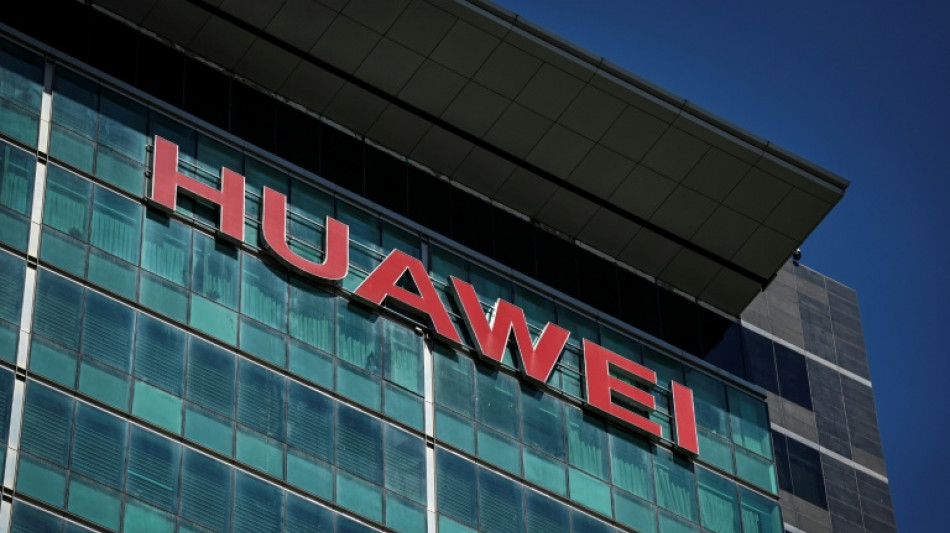
Huawei touts new chipmaking technology to sidestep US restrictions / Photo: Jade GAO - AFP

Huawei touts new chipmaking technology to sidestep US restrictions

Chinese tech giant Huawei said on Monday it had developed a new way of making semiconductors that could get around its US-enforced lack of access to the most advanced chipmaking equipment.

Text size:

Huawei has in recent years been at the centre of a geopolitical standoff after Washington warned its equipment could be used for espionage by the Chinese government, an allegation the firm denies.

Sanctions since 2019 have cut Huawei's access to components and technologies made by the United States and some of its allies -- including the lithography machines used to make the world's most advanced chips.

But on Monday the head of Huawei's semiconductor division He Tingbo said that the company will be able to produce next-generation 1.4-nanometre (1.4nm) chips by 2031.

Taiwan's TSMC, the industry leader, has projected it will be able to do the same by 2028.

Cutting-edge chips that can train and power artificial intelligence systems are a crucial and highly sensitive element of the technology rivalry between the United States and China.

The computing power of chips has increased dramatically over the decades as makers cram them with more microscopic electronic components.

Huawei's announcement suggests it might have sidestepped the need for extreme ultraviolet lithography (EUV) machines, which have been considered crucial for mass manufacturing chips of 5nm or under.

"Over the past six years, I have often been asked... how did you survive and come back on top?" He said in a presentation to the International Symposium on Circuits and Systems (ISCAS) in Shanghai.

She said the new technique came about through a shift in how chipmaking has historically been conceptualised.

"Moore's Law" is a principle developed by Intel co-founder Gordon Moore which states the number of transistors -- devices regulating the flow of electricity -- on a chip doubles every two years.

A higher density of transistors results in a smaller chip or one the same size with faster processing power.

He on Monday proposed "the Tau Scaling Law", or "Her's Law", by which instead of optimising for space, designers optimise for the time taken for the various elements making up a chip to communicate.

This overcomes a key challenge facing Moore's Law that Intel sums up as: "You can make something smaller and smaller and smaller... until you can't".

US sanctions have meant that "these challenges arrived earlier and are tougher" for Huawei, He said.

"Our solution is feasible and affordable. The performance of the new chip can fully compete with that of the other path," she said.

Huawei's next iteration of its Kirin chip, set to launch in the autumn, will be the first ever to fully adopt an architecture called "LogicFolding" based on the new principle, the company said.

The Tau Scaling Law "underscores the company's ambition to lead rather than follow in the global chip race", said George Chen, Partner and Chair of Digital Practice at The Asia Group.

"Even without a new product launch today, Huawei's intent is clear — and its trajectory will likely heighten US concerns."

W.Urban--TPP