The Prague Post - New space object 'black hole star' discovered by astronomers

EUR -
AED 4.120833
AFN 72.374653
ALL 90.68597
AMD 405.213892
ANG 2.008278
AOA 1028.945251
ARS 1713.128375
AUD 1.597286
AWG 2.021143
AZN 1.906221
BAM 1.95442
BBD 2.261004
BDT 138.851961
BGN 1.961202
BHD 0.423701
BIF 3367.352434
BMD 1.122078
BND 1.434081
BOB 13.162823
BRL 5.641241
BSD 1.122607
BTN 106.103084
BWP 15.379141
BYN 3.334231
BYR 21992.723667
BZD 2.257726
CAD 1.577877
CDF 2598.73214
CHF 0.926595
CLF 0.027838
CLP 1095.630483
CNY 7.493291
CNH 7.490541
COP 3580.190997
CRC 511.139102
CUC 1.122078
CUP 26.941977
CVE 110.187691
CZK 24.274862
DJF 199.898858
DKK 7.474749
DOP 68.941323
DZD 151.101229
EGP 61.024421
ERN 16.831166
ETB 183.87581
FJD 2.52894
FKP 0.838851
GBP 0.83859
GEL 2.90609
GGP 0.838851
GHS 13.083762
GIP 0.838851
GMD 82.471988
GNF 9935.984531
GTQ 8.578943
GYD 234.86417
HKD 8.805101
HNL 30.135722
HRK 7.533407
HTG 147.087457
HUF 365.420883
IDR 20238.130708
ILS 3.465427
IMP 0.838851
INR 105.958979
IQD 1701.798417
IRR 2056067.194777
ISK 136.051813
JEP 0.838851
JMD 178.164204
JOD 0.795528
JPY 177.460525
KES 145.679109
KGS 98.126099
KHR 4564.776962
KMF 493.15641
KPW 1009.869921
KRW 1490.130267
KWD 0.348091
KYD 0.935535
KZT 501.445946
LAK 25267.384721
LBP 100528.116341
LKR 372.695192
LRD 191.404855
LSL 18.415597
LTL 3.313204
LVL 0.678734
LYD 7.202946
MAD 11.018371
MDL 20.195651
MGA 5073.463011
MKD 61.606502
MMK 2355.482879
MNT 4036.712338
MOP 9.073044
MRU 45.027208
MUR 53.063078
MVR 17.347799
MWK 1946.525623
MXN 20.926682
MYR 4.579423
MZN 71.703844
NAD 18.415597
NGN 1494.775718
NIO 41.310832
NOK 10.522281
NPR 169.765134
NZD 1.972383
OMR 0.431441
PAB 1.122617
PEN 3.858176
PGK 5.026518
PHP 71.260352
PKR 310.70134
PLN 4.357926
PYG 6459.439204
QAR 4.09251
RON 5.340639
RSD 117.418663
RUB 91.815241
RWF 1659.121156
SAR 4.206631
SBD 9.060306
SCR 15.520557
SDG 674.931784
SEK 11.108811
SGD 1.434072
SHP 0.838529
SLE 26.840145
SLL 23529.414064
SOS 641.547025
SRD 42.259131
STD 23224.743713
STN 24.482714
SVC 9.823108
SYP 14589.254397
SZL 18.423156
THB 37.711945
TJS 10.339
TMT 3.938493
TND 3.351134
TOP 2.701694
TRY 55.657864
TTD 7.621619
TWD 36.380565
TZS 2967.89529
UAH 50.546611
UGX 4720.666894
USD 1.122078
UYU 45.068179
UZS 13437.512218
VES 987.191539
VND 29013.003036
VUV 133.67989
WST 3.113405
XAF 655.957
XAG 0.019521
XAU 0.000271826755
XCD 3.032471
XCG 2.023172
XDR 0.793367
XOF 655.957
XPF 119.331742
YER 264.929387
ZAR 18.399657
ZMK 10100.046811
ZMW 22.519301
ZWL 361.308574
SSP 6494.085876
MXV 2.362129
  • RYCEF

    0.1700

    17.67

    +0.96%

  • CMSC

    -0.1000

    19.53

    -0.51%

  • RBGPF

    0.5300

    70.53

    +0.75%

  • NGG

    -0.2800

    80.78

    -0.35%

  • GSK

    -0.6100

    50.02

    -1.22%

  • RELX

    -0.2600

    39.13

    -0.66%

  • AZN

    -0.3700

    168.45

    -0.22%

  • VOD

    -0.0300

    15.85

    -0.19%

  • RIO

    -1.2400

    86.92

    -1.43%

  • BCE

    -0.0900

    19.98

    -0.45%

  • BTI

    -0.2100

    58.9

    -0.36%

  • BCC

    -0.6900

    75.59

    -0.91%

  • BP

    0.4600

    49.85

    +0.92%

  • CMSD

    -0.0800

    19.61

    -0.41%

  • JRI

    -0.0100

    10.62

    -0.09%

New space object 'black hole star' discovered by astronomers
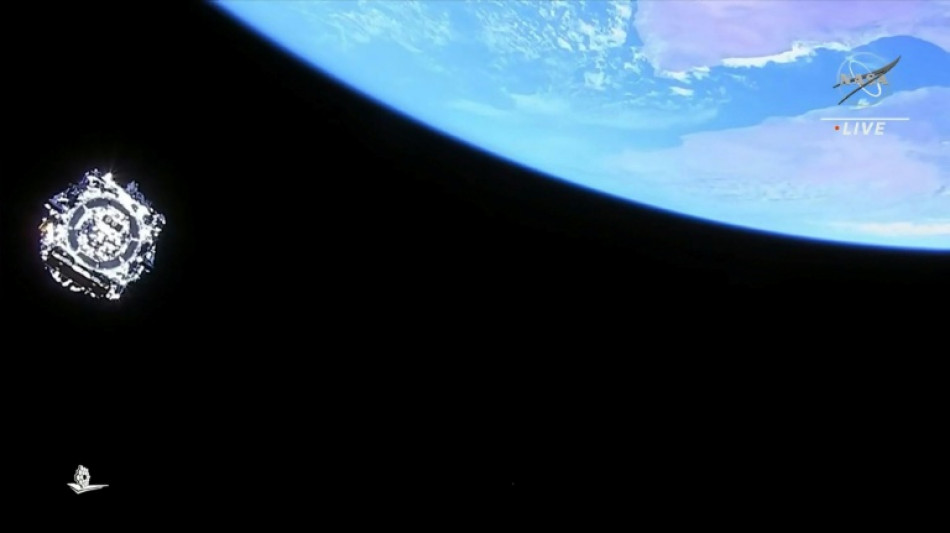
New space object 'black hole star' discovered by astronomers / Photo: - - NASA TV/AFP/File

New space object 'black hole star' discovered by astronomers

Astronomers announced Wednesday they had discovered a new type of astronomical object called a "black hole star", potentially solving a mystery involving strange red dots spotted in the early universe.

Text size:

The object looks like a star the size of our solar system, but produces 100 billion times more energy than any star -- a mighty blast of power closer to what is produced by a black hole.

The black hole star, which dates from 660 million years after the Big Bang, was spotted by a US-led team of astronomers using the James Webb Space Telescope, according to a study published in the journal Nature.

Since history's most powerful telescope went online in 2022, it has been spotting many extremely bright cosmic objects dubbed "little red dots" in the early universe that have baffled scientists.

"What exactly these objects are has been one of the most debated topics of the JWST era," lead study author Rohan Naidu of Hawaii University said in a statement.

The team had been trying to find clues for a different mystery: why JWST keeps finding bright galaxies in the universe's infancy, when it was thought to have been too early for them to have become so huge.

But while looking through the images, they spotted a little red dot.

- 'Pure black hole star light' -

"When we see something very red in the universe, we often assume that it is surrounded by dust, like soot or ash," said Robert Simcoe, a study co-author from the Massachusetts Institute of Technology.

"The same way that the wildfire smoke from Canada recently made the sky in Boston look bright red, astronomical objects can also appear redder than their intrinsic colour when you see them through a veil of dust," he added.

However when the team sifted through their data, they found that at certain wavelengths, the object's light simply disappeared.

To their surprise, this suggested that it is not dust making this object appear red -- it is hydrogen gas.

This explained the object's colour, but not how it could be pumping out so much energy.

"You can't be powering this by nuclear fusion, which is the energy source that sits at the heart of all the stars," Naidu explained.

Using modelling simulations, they determined the most likely scenario was that the object is powered by a central black hole surrounded by a cocoon of gas that makes it resemble a star.

The team named the object MoM-BH*-1. The BH and asterix is for black hole star -- and the number one suggests they believe there are more out there.

"Every little red dot is consistent with being a black hole star," Naidu said.

"What is special about MoM-BH*-1 is, the black hole star is essentially completely outshining its surrounding host galaxy, such that we're seeing pure black hole star light."

N.Kratochvil--TPP