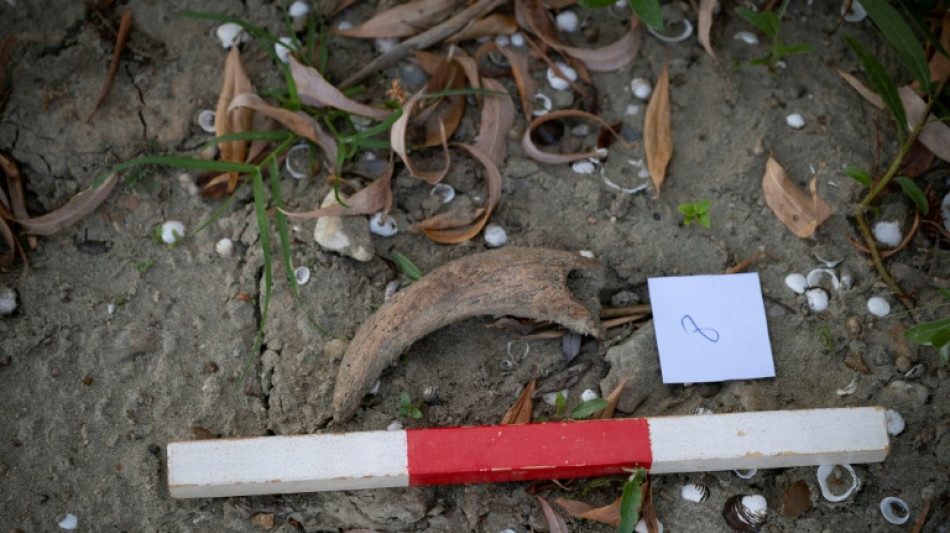
Drought-hit Danube gives way to fossil hunt in Bulgaria / Photo: Nikolay DOYCHINOV - AFP
Volunteers scanned the dried-up bank of the Danube in northern Bulgaria, close to where receding waters laid bare mammoth bones last month, hoping to find more fossilised fragments exposed by Europe's parching drought.
"I've found a tooth!" exclaimed Aleksandar Denkov, a 30-year-old amateur photographer, holding up a yellowish fragment protruding from the sand.
Denkov last week joined some 20 other volunteers, many hoping to find more mammoth fossils during the search organised by the regional history museum of the nearby city of Ruse, around 250 km (155 miles) northeast of Sofia.
Though their hopes were not fulfilled, the group found remains of a mammal -- "probably an aurochs or a European bison," according to the museum -- a horse jawbone in a subfossil state and a cluster of fossilised oysters dating back around 60 to 65 million years.
Europe's drought, exacerbated by human-induced climate change according to experts, has seen major rivers slow to a trickle, causing serious problems for cargo shippers and nuclear plants normally cooled by river water.
But the low waters have also revealed remains and historical artefacts not seen for decades -- or even millennia.
Finds in recent weeks along the Danube, Europe's second-longest river, have included World War II shipwrecks in Austria and Serbia and the remains of two German soldiers and a motorbike in the middle of Budapest.
- 'Close to history' -
Ruse Regional History Museum curator Krasimir Kirov said the museum decided to organise the field day "to teach people how to recognise different finds, show them what they might uncover, and give them safety tips."
"After the mammoth was discovered, I started getting dozens of calls from people telling me about what they'd found," he told AFP.
Last month, a resident of the village of Ryahovo -- some 30 kilometres from Ruse -- spotted by chance what museum specialists then identified as a mammoth jaw bone, fragments of tusks, part of a shoulder blade and a femur.
Announced on social media, the initiative to gather near Ryahovo for a guided search quickly sparked keen interest, with requests already pouring in for the next outing, according to Kirov.
The search began with a few instructions: the volunteers must advance in a line and, if someone spots something, raise a hand so that the whole group stops.
Above all, they must not touch any metal objects, which could be ammunition or explosives.
But the walk had barely begun when the line broke apart: enthusiasm won out over discipline.
"It's a very rare opportunity to feel this close to history," Ekaterina Yordanova, a 34-year-old psychologist, told AFP.
"Seeing the Danube in this state is worrying, but it also gives us the chance to discover new things."
Vladimir Tsvyatkov, a 44-year-old business owner, said he, his wife and their two children mainly came "for the adventure".
Having grown up on the banks of the river, he said he had "never seen the Danube so dried up."
- WWII remnants -
Further upstream in Bulgaria, the low Danube levels have also allowed archaeologists to document the foundations of a bridge, more than two km long, inaugurated under Emperor Constantine I in 328.
And elsewhere along the Danube, World War II weaponry and other remnants have been found.
In central Austria, two wrecks of German warships are protruding from the water.
Damaged in fighting with American tanks in 1945, they were later sunk by their own crews, according to local media.
In Serbia, near Prahovo, the receding river has likewise exposed wrecks of German warships, which were among dozens sunk by their own side in 1944 in an attempt to slow the Soviet Red Army's advance along Europe's second-longest river.
And in Budapest, a motorbike and the remains of two German soldiers were found, according to the German War Graves Commission.
The findings come as vast tracts of many of Europe's largest rivers have fallen to levels never recorded before in the month of July, according to data from European climate observatory Copernicus.
M.Jelinek--TPP