The Prague Post - Webb telescope captures 'breathtaking' images of Orion Nebula

EUR -
AED 4.315759
AFN 76.965077
ALL 96.421519
AMD 445.478764
ANG 2.103625
AOA 1077.61949
ARS 1679.594294
AUD 1.715559
AWG 2.117046
AZN 2.000594
BAM 1.963615
BBD 2.357426
BDT 143.722031
BGN 1.973524
BHD 0.443108
BIF 3466.288337
BMD 1.175157
BND 1.502348
BOB 8.135967
BRL 6.21072
BSD 1.170461
BTN 107.571281
BWP 15.558472
BYN 3.310639
BYR 23033.082408
BZD 2.354125
CAD 1.620483
CDF 2561.843319
CHF 0.92848
CLF 0.025945
CLP 1024.443328
CNY 8.195081
CNH 8.178684
COP 4230.566156
CRC 577.628912
CUC 1.175157
CUP 31.141668
CVE 110.64143
CZK 24.267325
DJF 208.436518
DKK 7.468592
DOP 73.736456
DZD 152.376764
EGP 55.298077
ERN 17.627359
ETB 182.646662
FJD 2.644455
FKP 0.87519
GBP 0.870606
GEL 3.160849
GGP 0.87519
GHS 12.779841
GIP 0.87519
GMD 85.786204
GNF 10253.331912
GTQ 9.011329
GYD 245.792597
HKD 9.16407
HNL 30.874891
HRK 7.535228
HTG 153.335525
HUF 381.925961
IDR 19774.37131
ILS 3.683748
IMP 0.87519
INR 107.636887
IQD 1533.342204
IRR 49503.500002
ISK 146.001417
JEP 0.87519
JMD 184.301131
JOD 0.833175
JPY 186.381121
KES 151.595713
KGS 102.767747
KHR 4711.091487
KMF 493.565918
KPW 1057.54907
KRW 1722.234156
KWD 0.361137
KYD 0.975518
KZT 592.282183
LAK 25291.644462
LBP 104817.092552
LKR 362.590921
LRD 217.933554
LSL 18.982736
LTL 3.469934
LVL 0.710841
LYD 7.449663
MAD 10.782105
MDL 19.980459
MGA 5401.205414
MKD 61.599434
MMK 2467.80175
MNT 4191.723753
MOP 9.401198
MRU 46.390748
MUR 53.951308
MVR 18.15605
MWK 2029.652968
MXN 20.495512
MYR 4.703563
MZN 75.104133
NAD 18.982736
NGN 1666.560574
NIO 43.069795
NOK 11.570892
NPR 171.47827
NZD 1.987766
OMR 0.451849
PAB 1.174816
PEN 3.943243
PGK 5.004138
PHP 69.31254
PKR 327.50209
PLN 4.199953
PYG 7887.760351
QAR 4.279041
RON 5.091597
RSD 117.397054
RUB 89.307453
RWF 1707.181
SAR 4.406683
SBD 9.54652
SCR 17.709322
SDG 706.85906
SEK 10.582826
SGD 1.502574
SHP 0.881672
SLE 28.67503
SLL 24642.459422
SOS 667.749025
SRD 44.909791
STD 24323.382767
STN 24.505573
SVC 10.241286
SYP 12996.739793
SZL 18.978235
THB 36.594986
TJS 10.961221
TMT 4.11305
TND 3.375933
TOP 2.829496
TRY 50.971665
TTD 7.945773
TWD 37.055999
TZS 2990.775318
UAH 50.577888
UGX 4106.098173
USD 1.175157
UYU 44.91859
UZS 14260.533324
VES 413.967262
VND 30845.52791
VUV 141.614195
WST 3.251485
XAF 656.103426
XAG 0.011858
XAU 0.000237
XCD 3.175921
XCG 2.109471
XDR 0.815982
XOF 656.103426
XPF 119.331742
YER 280.041533
ZAR 18.917443
ZMK 10577.825977
ZMW 23.380218
ZWL 378.40016
  • RBGPF

    0.0000

    84.04

    0%

  • RYCEF

    -0.1500

    16.82

    -0.89%

  • SCS

    0.0200

    16.14

    +0.12%

  • BTI

    0.5100

    58.22

    +0.88%

  • CMSC

    0.0400

    23.65

    +0.17%

  • GSK

    0.5800

    48.65

    +1.19%

  • AZN

    1.1500

    91.69

    +1.25%

  • NGG

    -0.6700

    80.18

    -0.84%

  • VOD

    0.3400

    13.94

    +2.44%

  • RIO

    -1.5400

    87.3

    -1.76%

  • BP

    -0.4900

    35.43

    -1.38%

  • RELX

    -0.4800

    39.84

    -1.2%

  • BCE

    0.2000

    24.71

    +0.81%

  • CMSD

    0.0400

    24.04

    +0.17%

  • BCC

    0.5000

    85.51

    +0.58%

  • JRI

    -0.0500

    13.67

    -0.37%

Webb telescope captures 'breathtaking' images of Orion Nebula
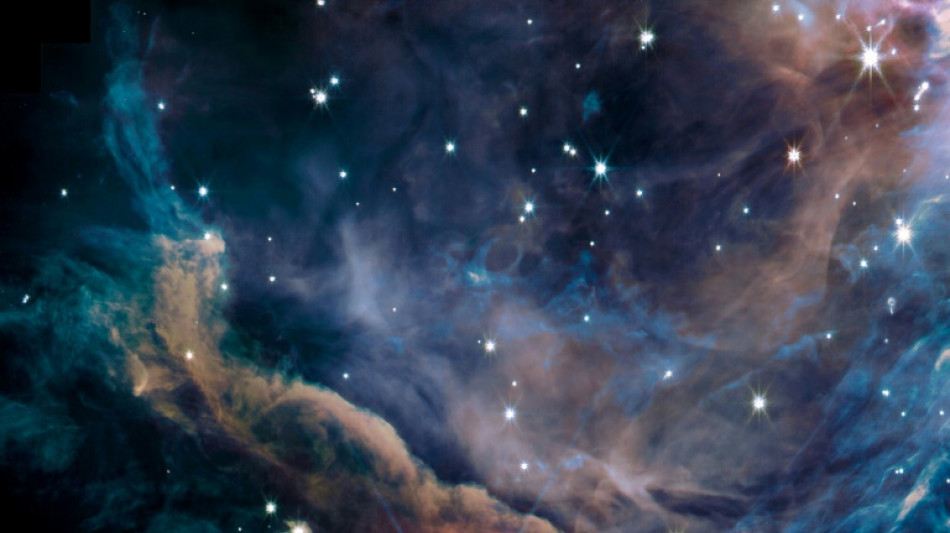
Webb telescope captures 'breathtaking' images of Orion Nebula / Photo: Handout - NASA/ESA/CSA/AFP

Webb telescope captures 'breathtaking' images of Orion Nebula

The wall of dense gas and dust resembles a massive winged creature, its glowing maw lit by a bright star as it soars through cosmic filaments.

Text size:

An international research team on Monday revealed the first images of the Orion Nebula captured with the James Webb Space Telescope, leaving astronomers "blown away."

The stellar nursery is situated in the constellation Orion, 1,350 light-years away from Earth, in a similar setting in which our own solar system was birthed more than 4.5 billion years ago.

Astronomers are interested in the region to better understand what happened during the first million years of our planetary evolution.

The images were obtained as part of the Early Release Science program and involved more than 100 scientists in 18 countries, with institutions including the French National Centre for Scientific Research (CNRS), Western University in Canada, and the University of Michigan.

"We are blown away by the breathtaking images of the Orion Nebula," Western University astrophysicist Els Peeters said in a statement.

"These new observations allow us to better understand how massive stars transform the gas and dust cloud in which they are born," she added.

Nebulas are obscured by large amounts of dust that made it impossible to observe with visible light telescopes, such as the Hubble Space Telescope, Webb's predecessor.

Webb however operates primarily in the infrared spectrum, penetrating the dust.

This revealed numerous spectacular structures, down to the scale of 40 astronomical units, or the size of our solar system.

These include dense filaments of matter, which could birth new generations of stars, as well as forming stellar systems that consist of a central proto-star surrounded by a disc of dust and gas, in which planets form.

"We hope to gain understanding about the entire cycle of star birth," said Edwin Bergin, University of Michigan chair of astronomy and a member of the international research team.

"In this image we are looking at this cycle where the first generation of stars is essentially irradiating the material for the next generation. The incredible structures we observe will detail how the feedback cycle of stellar birth occurs in our galaxy and beyond."

Webb is the most powerful space telescope ever built, boasting a primary mirror measuring 6.5 meters (more than 21 feet) that is made up of 18 hexagonal, gold-coated segments, as well as a five-layer sunshield the size of a tennis court.

V.Sedlak--TPP