The Prague Post - Neanderthals, humans co-existed in Europe for over 2,000 years: study

EUR -
AED 4.311101
AFN 76.888269
ALL 96.317334
AMD 444.997082
ANG 2.101352
AOA 1076.454519
ARS 1677.85032
AUD 1.712792
AWG 2.114758
AZN 1.995212
BAM 1.961494
BBD 2.354879
BDT 143.566737
BGN 1.971392
BHD 0.442618
BIF 3462.542969
BMD 1.173887
BND 1.500725
BOB 8.127176
BRL 6.211153
BSD 1.169197
BTN 107.455049
BWP 15.541661
BYN 3.307062
BYR 23008.19487
BZD 2.351582
CAD 1.617294
CDF 2559.07505
CHF 0.928317
CLF 0.02593
CLP 1023.870231
CNY 8.186225
CNH 8.171249
COP 4230.103582
CRC 577.004777
CUC 1.173887
CUP 31.108019
CVE 110.521047
CZK 24.257505
DJF 208.2113
DKK 7.468706
DOP 73.656783
DZD 152.260241
EGP 55.348768
ERN 17.608312
ETB 182.44931
FJD 2.641595
FKP 0.870197
GBP 0.868125
GEL 3.157266
GGP 0.870197
GHS 12.766018
GIP 0.870197
GMD 85.693681
GNF 10242.253057
GTQ 9.001593
GYD 245.527015
HKD 9.153511
HNL 30.84153
HRK 7.534709
HTG 153.169844
HUF 382.26766
IDR 19774.017437
ILS 3.688789
IMP 0.870197
INR 107.818072
IQD 1531.685408
IRR 49450.010844
ISK 146.00833
JEP 0.870197
JMD 184.101992
JOD 0.832274
JPY 185.608053
KES 151.431513
KGS 102.655993
KHR 4706.001093
KMF 493.03287
KPW 1056.509518
KRW 1722.916439
KWD 0.360547
KYD 0.974464
KZT 591.642214
LAK 25264.31652
LBP 104703.836356
LKR 362.199137
LRD 217.697813
LSL 18.962225
LTL 3.466184
LVL 0.710072
LYD 7.441613
MAD 10.770419
MDL 19.95887
MGA 5395.369343
MKD 61.532875
MMK 2464.918349
MNT 4186.395663
MOP 9.39104
MRU 46.340622
MUR 53.89336
MVR 18.137071
MWK 2027.459902
MXN 20.491391
MYR 4.702009
MZN 75.02354
NAD 18.962225
NGN 1664.810796
NIO 43.023258
NOK 11.552015
NPR 171.292985
NZD 1.987303
OMR 0.451358
PAB 1.173547
PEN 3.938983
PGK 4.998731
PHP 69.37769
PKR 327.14822
PLN 4.205498
PYG 7879.237526
QAR 4.274417
RON 5.094907
RSD 117.407751
RUB 89.003161
RWF 1705.336369
SAR 4.401978
SBD 9.536205
SCR 16.448665
SDG 706.083796
SEK 10.587068
SGD 1.501496
SHP 0.88072
SLE 28.626176
SLL 24615.832932
SOS 667.027514
SRD 44.861271
STD 24297.101044
STN 24.479095
SVC 10.23022
SYP 12982.696651
SZL 18.957729
THB 36.583617
TJS 10.949377
TMT 4.108606
TND 3.372285
TOP 2.826439
TRY 50.893896
TTD 7.937188
TWD 37.074891
TZS 3005.152017
UAH 50.523238
UGX 4101.661482
USD 1.173887
UYU 44.870055
UZS 14245.12448
VES 413.519965
VND 30808.677264
VUV 140.946618
WST 3.24367
XAF 655.394498
XAG 0.011874
XAU 0.000238
XCD 3.172489
XCG 2.107191
XDR 0.8151
XOF 655.394498
XPF 119.331742
YER 279.741058
ZAR 18.929759
ZMK 10566.398179
ZMW 23.354955
ZWL 377.991294
  • SCS

    0.0200

    16.14

    +0.12%

  • BCC

    -0.7500

    84.76

    -0.88%

  • NGG

    0.5600

    80.74

    +0.69%

  • RIO

    1.7800

    89.08

    +2%

  • CMSC

    0.0122

    23.6424

    +0.05%

  • BCE

    0.2500

    24.96

    +1%

  • AZN

    0.2850

    91.975

    +0.31%

  • BTI

    0.5150

    58.735

    +0.88%

  • GSK

    0.2050

    48.855

    +0.42%

  • RYCEF

    -0.1700

    16.8

    -1.01%

  • JRI

    -0.0400

    13.63

    -0.29%

  • CMSD

    0.0900

    24.13

    +0.37%

  • RBGPF

    0.0000

    84.04

    0%

  • VOD

    0.0950

    14.035

    +0.68%

  • RELX

    -0.1100

    39.73

    -0.28%

  • BP

    0.7850

    36.215

    +2.17%

Neanderthals, humans co-existed in Europe for over 2,000 years: study
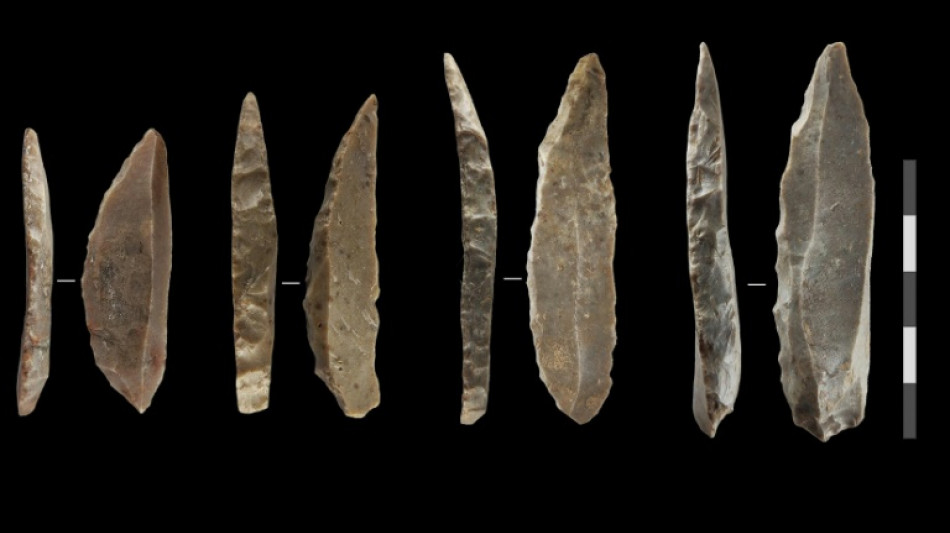
Neanderthals, humans co-existed in Europe for over 2,000 years: study / Photo: - - AFP

Neanderthals, humans co-existed in Europe for over 2,000 years: study

Neanderthals and humans lived alongside each other in France and northern Spain for up to 2,900 years, modelling research suggested Thursday, giving them plenty of time to potentially learn from or even breed with each other.

Text size:

While the study, published in the journal Scientific Reports, did not provide evidence that humans directly interacted with Neanderthals around 42,000 years ago, previous genetic research has shown that they must have at some point.

Research by Swedish paleogeneticist Svante Paabo, who won the medicine Nobel prize last week, helped reveal that people of European descent -- and almost everyone worldwide -- have a small percentage of Neanderthal DNA.

Igor Djakovic, a PhD student at Leiden University in the Netherlands and lead author of the new study, said we know that humans and Neanderthals "met and integrated in Europe, but we have no idea in which specific regions this actually happened".

Exactly when this happened has also proved elusive, though previous fossil evidence has suggested that modern humans and Neanderthals walked the Earth at the same time for thousands of years.

To find out more, the Leiden-led team looked at radiocarbon dating for 56 artefacts -- 28 each for Neanderthals and humans -- from 17 sites across France and northern Spain.

The artefacts included bones as well as distinctive stone knives thought to have been made by some of the last Neanderthals in the region.

The researchers then used Bayesian modelling to narrow down the potential date ranges.

- 'Never really went extinct' -

Then they used optimal linear estimation, a new modelling technique they adapted from biological conservation sciences, to get the best estimate for when the region's last Neanderthals lived.

Djakovic said the "underlying assumption" of this technique is that we are unlikely to ever discover the first or last members of an extinct species.

"For example, we'll never find the last woolly Rhino," he told AFP, adding that "our understanding is always broken up into fragments".

The modelling found that Neanderthals in the region went extinct between 40,870 and 40,457 years ago, while modern humans first appeared around 42,500 years ago.

This means the two species lived alongside each other in the region for between 1,400 and 2,900 years, the study said.

During this time there are indications of a great "diffusion of ideas" by both humans and Neanderthals, Djakovic said.

The period is "associated with substantial transformations in the way that people are producing material culture," such as tools and ornaments, he said.

There was also a "quite severe" change in the artefacts produced by Neanderthals, which started to look much more like those made by humans, he added.

Given the changes in culture and the evidence in our own genes, the new timeline could further bolster a leading theory for the end of the Neanderthals: mating with humans.

Breeding with the larger human population could have meant that, over time, Neanderthals were "effectively swallowed into our gene pool," Djakovic said.

"When you combine that with what we know now -- that most people living on Earth have Neanderthal DNA -- you could make the argument that they never really went extinct, in a certain sense."

Z.Pavlik--TPP