The Prague Post - Battle to save Panama turtle at center of aphrodisiac superstition

EUR -
AED 4.328076
AFN 77.196987
ALL 96.978789
AMD 446.737554
ANG 2.109624
AOA 1080.692392
ARS 1690.455255
AUD 1.714016
AWG 2.123082
AZN 2.008143
BAM 1.963059
BBD 2.372775
BDT 144.143008
BGN 1.979151
BHD 0.444326
BIF 3489.845793
BMD 1.178508
BND 1.507187
BOB 8.142805
BRL 6.23907
BSD 1.178056
BTN 108.16448
BWP 16.344702
BYN 3.335801
BYR 23098.759435
BZD 2.369867
CAD 1.617456
CDF 2569.148159
CHF 0.926961
CLF 0.025957
CLP 1024.925421
CNY 8.218449
CNH 8.197543
COP 4295.70929
CRC 583.056147
CUC 1.178508
CUP 31.230466
CVE 110.69643
CZK 24.253403
DJF 209.444929
DKK 7.467983
DOP 74.224483
DZD 152.769943
EGP 55.574206
ERN 17.677622
ETB 183.549505
FJD 2.652002
FKP 0.873623
GBP 0.866622
GEL 3.170647
GGP 0.873623
GHS 12.844168
GIP 0.873623
GMD 86.031513
GNF 10321.314016
GTQ 9.044326
GYD 246.530833
HKD 9.189871
HNL 31.075919
HRK 7.532675
HTG 154.54429
HUF 382.155427
IDR 19789.508593
ILS 3.694447
IMP 0.873623
INR 108.176209
IQD 1543.407536
IRR 49644.655348
ISK 145.793696
JEP 0.873623
JMD 185.484484
JOD 0.835609
JPY 184.37937
KES 151.886582
KGS 103.06007
KHR 4742.544022
KMF 494.973829
KPW 1060.668137
KRW 1710.086465
KWD 0.361308
KYD 0.982027
KZT 593.189455
LAK 25464.570091
LBP 105521.456212
LKR 364.979698
LRD 217.991453
LSL 19.015018
LTL 3.479829
LVL 0.712868
LYD 7.497284
MAD 10.793366
MDL 20.055163
MGA 5330.84436
MKD 61.871665
MMK 2474.620729
MNT 4202.8741
MOP 9.464488
MRU 47.101181
MUR 54.105754
MVR 18.208396
MWK 2043.28085
MXN 20.527927
MYR 4.720519
MZN 75.318899
NAD 19.015018
NGN 1674.731214
NIO 43.35031
NOK 11.558036
NPR 173.062967
NZD 1.987778
OMR 0.453137
PAB 1.178408
PEN 3.952316
PGK 5.039642
PHP 69.522597
PKR 329.634291
PLN 4.205771
PYG 7879.77762
QAR 4.29608
RON 5.092692
RSD 117.390062
RUB 88.976957
RWF 1718.634689
SAR 4.419135
SBD 9.573741
SCR 17.480412
SDG 708.876975
SEK 10.590994
SGD 1.501956
SHP 0.884186
SLE 28.75992
SLL 24712.725461
SOS 672.225646
SRD 44.925953
STD 24392.738984
STN 24.590938
SVC 10.310271
SYP 13033.798977
SZL 19.014349
THB 36.589736
TJS 11.017775
TMT 4.124778
TND 3.429683
TOP 2.837565
TRY 51.106058
TTD 8.002594
TWD 37.06385
TZS 3011.088678
UAH 50.808321
UGX 4164.399991
USD 1.178508
UYU 44.623918
UZS 14298.877386
VES 415.147657
VND 30929.945988
VUV 141.50141
WST 3.256437
XAF 658.526344
XAG 0.011639
XAU 0.000237
XCD 3.184978
XCG 2.123704
XDR 0.818309
XOF 658.523539
XPF 119.331742
YER 280.842718
ZAR 19.032086
ZMK 10607.991644
ZMW 23.117392
ZWL 379.479138
  • SCS

    0.0200

    16.14

    +0.12%

  • CMSC

    0.0777

    23.7079

    +0.33%

  • BCC

    -1.4700

    84.04

    -1.75%

  • JRI

    0.0000

    13.67

    0%

  • RBGPF

    0.0000

    84.04

    0%

  • BCE

    0.4450

    25.155

    +1.77%

  • NGG

    1.0520

    81.232

    +1.3%

  • GSK

    0.2330

    48.883

    +0.48%

  • BTI

    0.8550

    59.075

    +1.45%

  • RYCEF

    0.0300

    17

    +0.18%

  • RIO

    2.7400

    90.04

    +3.04%

  • CMSD

    0.0900

    24.13

    +0.37%

  • AZN

    1.0300

    92.72

    +1.11%

  • RELX

    0.0050

    39.845

    +0.01%

  • VOD

    0.1900

    14.13

    +1.34%

  • BP

    1.1400

    36.57

    +3.12%

Battle to save Panama turtle at center of aphrodisiac superstition
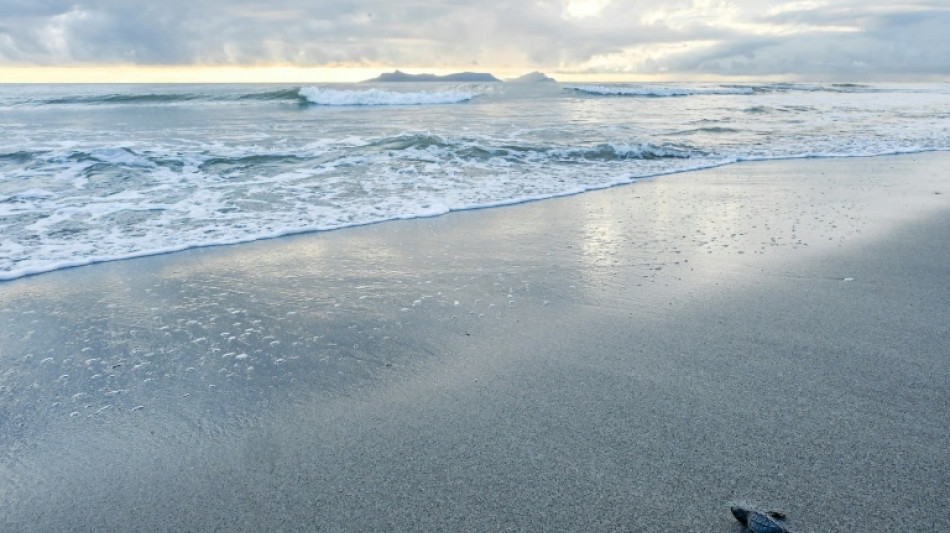
Battle to save Panama turtle at center of aphrodisiac superstition / Photo: Luis ACOSTA - AFP

Battle to save Panama turtle at center of aphrodisiac superstition

The sea turtles of Punta Chame, a peninsula of Panama that juts into the Pacific Ocean, face an existential threat similar to the rhino and pangolin: human superstition.

Text size:

The eggs of the protected olive ridley turtle, illegally harvested from the beach, are sold door to door in town for 75 cents to $1 each for their purported aphrodisiac qualities.

"Especially men think that by eating turtle eggs they will have more sexual pleasure," said Jorge Padilla, a conservationist with the NGO Fundacion Tortuguias which collects and hatches the precious eggs.

"The eggs won't help you. They are not an aphrodisiac," he insisted.

The olive ridley (Lepidochelys olivacea) is listed as "vulnerable" on the Red List of the International Union for Conservation of Nature, with its numbers declining.

Its survival relies heavily on people like Padilla, who with village volunteers collect freshly laid eggs and bury them in sand at the nursery.

Hundreds hatch here each year between July and February. Within hours they are brought to the beach and released near the water's edge by volunteers who look on with parent-like pride as the tiny critters make a frantic dash for the ocean.

"We cannot just put them (in the water) because they have to go through a process called 'imprinting' (along the beach) that will bring them back in 18-20 years to the same beach where they were born" to lay their own eggs.

- Used for combs, clothes -

Day and night, Padilla patrols the beach to scare off poachers.

Other threats include stray dogs roaming the beaches for food, and eagles.

Padilla repels the dogs but leaves the eagles as they are natural turtle predators and part of the circle of life.

The turtles also end up as by-catch from fishing, and face threats to their nesting beaches from human encroachment and climate change.

"There are many threats to sea turtles, both in the Pacific and in the Caribbean: illegal egg harvesting, overconsumption of their meat, their shells... They are used for combs... clothing," said Padilla.

Marine turtles and their uncertain fate are on the agenda of a global wildlife summit taking place in Panama City, not far from Punta Chame with its 500 human inhabitants.

The gathering of countries under the Convention on International Trade in Endangered Species of Wild Fauna and Flora (CITES) will consider ways to combat egg theft and trafficking.

A working document on the CITES website states "the illegal harvest and trade continues to threaten marine turtles."

D.Dvorak--TPP