The Prague Post - Homo sapiens in Europe used bow-and-arrow 54,000 years ago: study

EUR -
AED 4.264302
AFN 77.085196
ALL 96.591537
AMD 443.089257
ANG 2.078511
AOA 1064.768775
ARS 1685.124603
AUD 1.772874
AWG 2.090059
AZN 1.970453
BAM 1.956186
BBD 2.342482
BDT 142.007383
BGN 1.955825
BHD 0.437696
BIF 3428.177244
BMD 1.161144
BND 1.506197
BOB 8.06559
BRL 6.206544
BSD 1.163064
BTN 104.125975
BWP 15.522461
BYN 3.375665
BYR 22758.420523
BZD 2.339061
CAD 1.626983
CDF 2571.933458
CHF 0.934175
CLF 0.027475
CLP 1077.820153
CNY 8.21132
CNH 8.206785
COP 4424.132447
CRC 572.712903
CUC 1.161144
CUP 30.770313
CVE 110.286742
CZK 24.164392
DJF 207.107071
DKK 7.468396
DOP 72.664325
DZD 151.298812
EGP 55.178599
ERN 17.417159
ETB 181.625551
FJD 2.637886
FKP 0.877851
GBP 0.8798
GEL 3.12929
GGP 0.877851
GHS 13.176598
GIP 0.877851
GMD 84.763479
GNF 10104.992066
GTQ 8.913796
GYD 243.317967
HKD 9.041369
HNL 30.625433
HRK 7.535126
HTG 152.089983
HUF 381.059575
IDR 19307.50084
ILS 3.782014
IMP 0.877851
INR 104.452848
IQD 1523.600358
IRR 48913.186716
ISK 148.394256
JEP 0.877851
JMD 186.562402
JOD 0.823297
JPY 181.043235
KES 150.134597
KGS 101.542344
KHR 4646.916078
KMF 492.325004
KPW 1045.006201
KRW 1705.465262
KWD 0.356495
KYD 0.969191
KZT 594.417182
LAK 25232.865672
LBP 104153.832559
LKR 358.860745
LRD 210.502404
LSL 19.866531
LTL 3.428556
LVL 0.702364
LYD 6.338441
MAD 10.75462
MDL 19.730805
MGA 5196.158605
MKD 61.647153
MMK 2438.703728
MNT 4129.350504
MOP 9.330239
MRU 46.253118
MUR 53.574595
MVR 17.893605
MWK 2016.749682
MXN 21.266577
MYR 4.798423
MZN 74.195655
NAD 19.866616
NGN 1680.837251
NIO 42.798437
NOK 11.792816
NPR 166.600843
NZD 2.03085
OMR 0.446465
PAB 1.163029
PEN 3.910054
PGK 4.997985
PHP 68.09764
PKR 328.589867
PLN 4.238732
PYG 8129.672672
QAR 4.251056
RON 5.088828
RSD 117.418878
RUB 89.701447
RWF 1692.277333
SAR 4.358623
SBD 9.549042
SCR 16.300844
SDG 698.434972
SEK 10.983143
SGD 1.506936
SHP 0.871159
SLE 26.648123
SLL 24348.60494
SOS 663.550812
SRD 44.744098
STD 24033.334478
STN 24.504831
SVC 10.176006
SYP 12838.753644
SZL 19.874431
THB 37.174024
TJS 10.740464
TMT 4.064004
TND 3.42769
TOP 2.795756
TRY 49.25909
TTD 7.883554
TWD 36.466191
TZS 2861.657741
UAH 49.272486
UGX 4186.825378
USD 1.161144
UYU 46.259319
UZS 13887.677971
VES 286.792291
VND 30625.170475
VUV 142.065005
WST 3.251587
XAF 656.103294
XAG 0.020211
XAU 0.000276
XCD 3.138049
XCG 2.096013
XDR 0.815982
XOF 656.106119
XPF 119.331742
YER 276.758783
ZAR 19.870771
ZMK 10451.683745
ZMW 26.662486
ZWL 373.887863
  • RIO

    0.0200

    71.99

    +0.03%

  • CMSC

    0.0800

    23.4

    +0.34%

  • NGG

    0.3900

    76.04

    +0.51%

  • RYCEF

    0.0300

    13.83

    +0.22%

  • RBGPF

    1.2200

    79

    +1.54%

  • RELX

    0.0500

    39.77

    +0.13%

  • BCC

    -0.5700

    74.56

    -0.76%

  • AZN

    0.4700

    90.99

    +0.52%

  • BP

    -0.0500

    36.46

    -0.14%

  • BCE

    -0.2500

    23.24

    -1.08%

  • BTI

    -0.2150

    57.915

    -0.37%

  • CMSD

    0.0550

    23.345

    +0.24%

  • VOD

    0.2450

    12.375

    +1.98%

  • GSK

    1.0800

    48.27

    +2.24%

  • JRI

    0.0100

    13.79

    +0.07%

  • SCS

    0.0350

    16.415

    +0.21%

Homo sapiens in Europe used bow-and-arrow 54,000 years ago: study
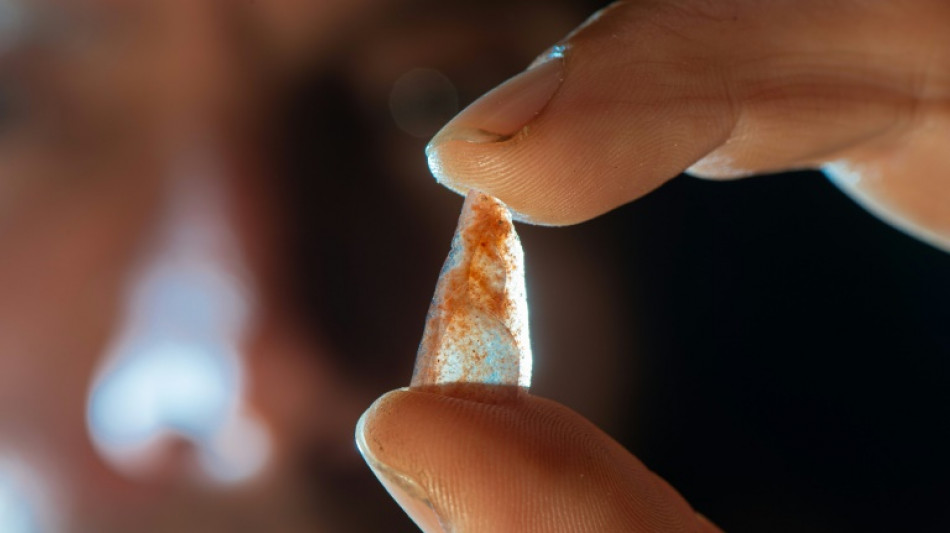
Homo sapiens in Europe used bow-and-arrow 54,000 years ago: study / Photo: Philippe Psaila - EUREKALERT!/AFP

Homo sapiens in Europe used bow-and-arrow 54,000 years ago: study

A cave in southern France has revealed evidence of the first use of bows and arrows in Europe by modern humans some 54,000 years ago, far earlier than previously known.

Text size:

The research, published on Wednesday in the journal Science Advances, pushes back the age of archery in Europe by more than 40,000 years.

The use of the bow-and-arrow in Africa has been documented to date back some 70,000 years.

But the oldest previous evidence of archery in Europe was the discovery of bows and arrows in peat bogs of Northern Europe, notably Stellmoor in Germany, dating back 10,000 to 12,000 years.

The new research comes from the Mandrin rock shelter overlooking the middle valley of the Rhone River in southern France.

The Grotte Mandrin site, which was first excavated in 1990, includes layer upon layer of archaeological remains dating back over 80,000 years.

The researchers who conducted the latest study have documented previously that Neanderthals and their modern "cousins" -- Homo sapiens -- alternated in inhabiting the Mandrin cave.

A level known as the "Layer E" has been attributed to the presence of Homo sapiens some 54,000 years ago and is interposed between layers of numerous Neanderthal occupations.

The researchers conducted a functional analysis of flint artifacts found in Layer E that were more finely executed than the points and blades in the layers above and below.

Tiny flint points were the key because other elements of archery technology such as wood, fibers, leather, resins and sinew are perishable and rarely preserved in European Paleolithic sites.

- 'Too light to be efficient' -

For the study, the researchers reproduced the tiny flint points found in the cave, some of which are smaller than a US penny, and fired them as arrowheads with a replica bow at dead animals.

"We couldn't throw them at the animals any other way than with a bow because they were too tiny and too light to be efficient," said Laure Metz of Aix Marseille University, a co-author of the study along with Ludovic Slimak of the University of Toulouse.

"We had to use this kind of propulsion," Metz told AFP. "The only way that it was working was with a bow."

Fractures on the flint points were compared with scars found on the artifacts found in the cave, proving undoubtedly that they were used as arrowheads, the researchers said.

"Fractures for a lot of them, not all, were fractures of impact," Metz said. "And they are coming at the end of the point."

Metz said the evidence suggests that the Neanderthals and the Homo sapiens who used in the cave likely met at some point although "we don't know the nature of the meeting, whether it was nicely or not."

The Neanderthals who inhabited the Mandrin site continued to use traditional weapons, however, such as thrusted or hand-thrown spears and did not develop mechanically propelled weapons, she said.

"The traditions and technologies mastered by these two populations were thus profoundly distinct, illustrating a remarkable objective technological advantage to modern populations during their expansion into the European continent," the researchers said.

Metz said the occupants of the cave would have typically hunted horses, bison and deer and animal bones have been found inside.

Q.Fiala--TPP